





Speak with a licensed insurance agent

1-888-891-0229

Hospital Indemnity Insurance Low vs High Plans: Real Examples and How to Choose

Reviewed by Russell Noga, Licensed Insurance Agent — Last updated October 27, 2026

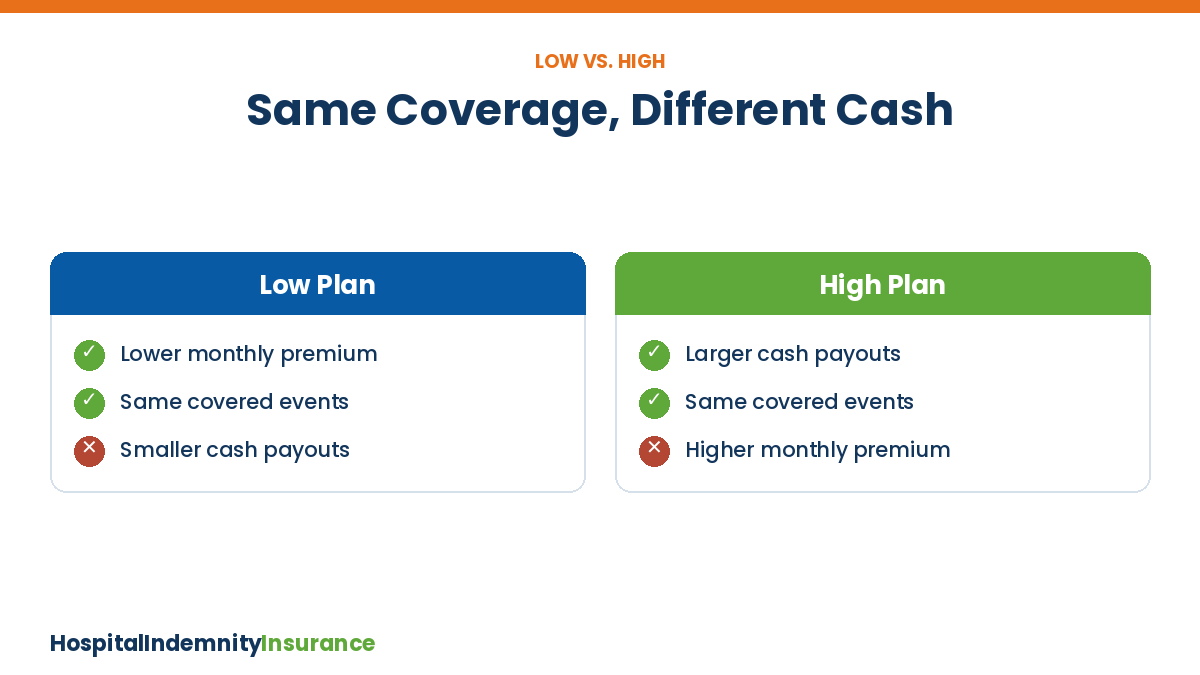
Low and high hospital indemnity plans usually cover the same hospital events; the high plan simply pays more cash for each one and costs more each month. In one MetLife employer plan, the High Plan paid twice as much as the Low Plan for about $9 more per month for the employee alone.

When you enroll in hospital indemnity at work or shop for your own policy, you often see two choices: a Low Plan and a High Plan. The names sound like different coverage, but in most cases the events covered are the same. What changes is the dollar amount and the premium.

Below are two real employer examples, the math on whether the extra premium pays off and a simple way to choose for your situation. For pricing basics, see our guide to hospital indemnity insurance cost.
Compare Hospital Indemnity Plans in Your Area

What Low vs. High Really Means

Hospital indemnity insurance low vs high plans comparison of benefits and premiums

Hospital indemnity pays fixed cash amounts when you are admitted to the hospital, for each day you stay and sometimes for ICU, newborn or observation care. A low plan and a high plan from the same insurer usually share one benefit list with two price tags.

Same covered events. Admission, daily stay, ICU and other benefits are usually listed on both plans.

Different dollar amounts. The high plan pays more for each event, sometimes double, sometimes less than double.

Different premiums. The high plan costs more every month, whether or not you file a claim.

Same fine print. Waiting periods, pre-existing condition limits and exclusions usually apply to both levels.

Important: Hospital indemnity is a limited-benefit plan that pays fixed cash amounts. It is NOT health insurance at either level and does not meet ACA minimum essential coverage.

Hospital Indemnity Quotes

Call a Licensed Agent Now

Compare hospital indemnity plans from several insurance companies in one call. Any age.

☎ 1-888-891-0229

No obligation to enroll

Example 1: MetLife Employer Plan, Low vs. High

This MetLife plan from a 2026 county employer brochure shows a classic design: the High Plan pays exactly double on every line.

Benefit Low Plan High Plan
Admission (up to 4 per year) $500 $1,000
ICU supplemental admission $500 $1,000
Confinement per day (up to 31 days) $100 $200
ICU supplemental confinement per day $100 $200
Newborn nursery per day (up to 3 days) $100 $200
Inpatient rehab per day (up to 15 days a year) $100 $200
Employee-only premium $11.21/mo $20.55/mo
Employee and family premium $29.41/mo $53.92/mo

Source: one 2026 MetLife employer benefit summary. Amounts and rates vary by employer, plan and state. MetLife notes benefits may be reduced starting at age 65.

Here the High Plan costs about 83% more for twice the benefit. For a closer look at this carrier, see MetLife hospital indemnity low vs. high.

Example 2: Aetna Employer Plan, Low vs. High

Not every high plan is a simple double. This Aetna employer plan raises some benefits a lot and others only a little.

Benefit Low High
Hospital admission (lump sum) $500 $1,000
ICU admission (lump sum) $1,000 $2,000
Hospital stay per day $150 $200
ICU stay per day $300 $400
Observation unit (once a year) $200 $200
Mental health or substance use stay per day $100 $200

Source: one Aetna Life Insurance Company employer benefit summary. Premiums were not listed. Your plan may differ.

On this plan, the extra premium mostly buys bigger admission benefits. The daily benefit rises only $50, and the observation benefit does not change at all. That is why you should compare line by line, not just the plan name. See Aetna hospital indemnity low vs. high for more.

Is the Extra Premium Worth It?

Hospital indemnity insurance low vs high plans yearly premium compared with payout for one hospital stay

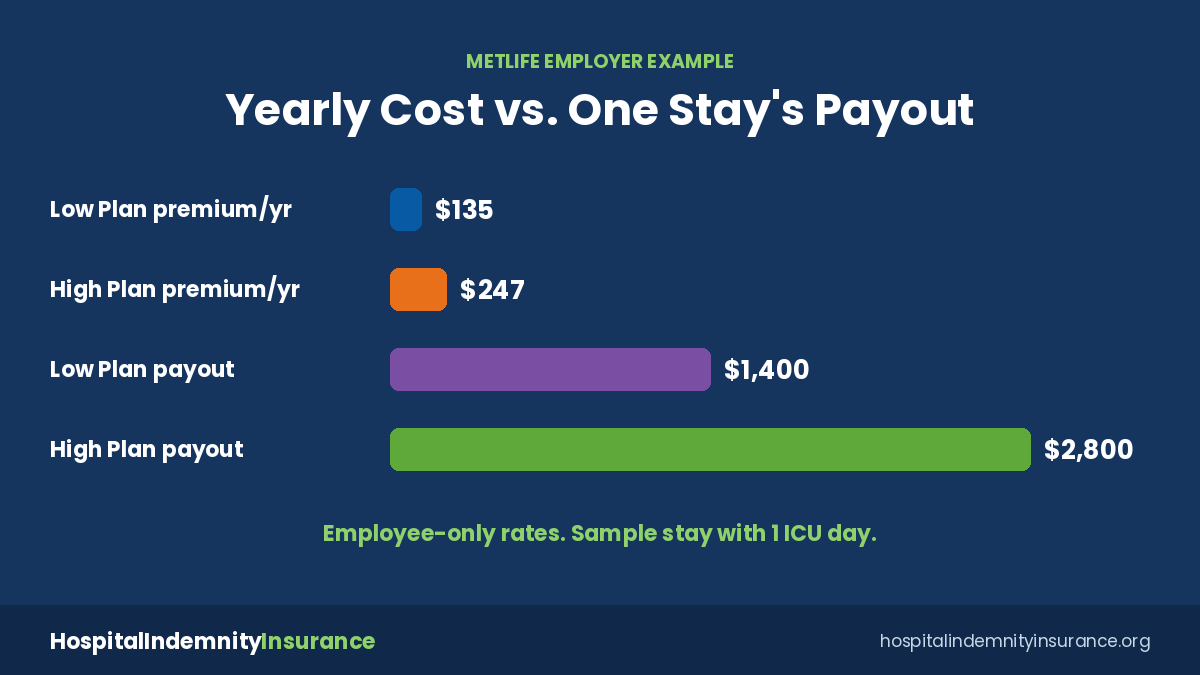
Using the MetLife example, the High Plan costs an employee $9.34 more per month, or about $112 more per year. In return, it pays $500 more on every admission plus $100 more for every hospital day.

Low Plan High Plan
Yearly premium (employee only) About $135 About $247
Brochure example: stay with 1 ICU day and 3 regular days $1,400 $2,800
Extra cash from that one stay $1,400 more

High Plan payout is MetLife’s own brochure example. Low Plan payout applies the Low Plan amounts to the same stay.

In this example, one hospital stay would cover more than 12 years of the extra premium. But if you never go to the hospital, the extra $112 a year buys nothing. The question is how likely a stay is and how badly a large bill would hurt.

Compare Low and High Plan Quotes Near You

Which Level Fits You?

A low plan may fit if… You have savings to cover a deductible, your health plan has low hospital costs, you already have Medigap, or you mainly want a basic cushion at the lowest price.

A high plan may fit if… You have a high-deductible health plan, a Medicare Advantage plan with daily hospital copays, a baby on the way, a chronic condition, or little savings.

Families. Family premiums rise faster on high plans. Weigh how many people are likely to need a hospital stay.

Self-employed workers. If you have no paid sick leave, a high plan’s larger daily benefit can help replace lost income.

On Medicare Advantage? Many plans charge a daily copay for the first several days of an inpatient stay. A daily benefit close to that copay can offset much of it, which often points to a higher level. Expecting a baby? A delivery usually means a two- to four-day stay, so a larger admission benefit can matter more than a larger daily amount.

A simple rule: pick the level that covers most of your deductible or hospital copays from one typical stay. People with high-deductible health plans often find the high plan closes that gap best.

How to Compare Low and High Plans Step by Step

1

Know your exposure. Write down your health plan deductible, hospital copays and out-of-pocket maximum.

2

Line up the benefits. Put both levels side by side and compare admission, daily, ICU and observation amounts.

3

Find the yearly price gap. Multiply the monthly difference by 12 for your coverage tier.

4

Run one example stay. Add up what each level would pay for a three-day stay and compare it with your costs.

5

Check the fine print. Confirm waiting periods, pre-existing condition rules, readmission rules and any age-based reductions.

Broker tip: Before buying two low plans to get more cash, compare that with one high plan. You can often hold more than one policy, but one higher benefit is usually simpler to manage. Learn more: can you have more than one hospital indemnity insurance plan.

Bottom Line

Hospital indemnity insurance low vs high plans usually cover the same events; the high plan pays more cash for a higher premium. In one MetLife example, the high plan cost about $112 more a year and paid $1,400 more on a single sample stay. Match the level to your deductible or hospital copays, then compare quotes side by side.

Get Free Hospital Indemnity Insurance Quotes

Hospital Indemnity Low vs. High Plans — Frequently Asked Questions

➤ What is the difference between low and high hospital indemnity plans?

Both usually cover the same events, such as hospital admissions and daily stays. The high plan pays larger cash amounts for each event and has a higher monthly premium.

➤ Does a high plan cover more types of care?

Usually not. Most insurers use the same benefit list for both levels. Some benefits, like an observation benefit, may even pay the same amount on both.

➤ How much more does a high hospital indemnity plan cost?

It varies. In one 2026 MetLife employer plan, the employee-only premium was $11.21 per month for the Low Plan and $20.55 for the High Plan.

➤ Does a high plan always pay double?

No. Some plans double every benefit, while others raise only certain benefits. One Aetna employer plan raised the daily hospital benefit from $150 to just $200.

➤ Which plan is better if I have a high-deductible health plan?

A high plan often makes more sense, because one stay can cost most of your deductible. Pick the level that covers a large share of it.

➤ Is a low plan worth it?

It can be if you want a basic cash cushion at a low price, have savings, or already have coverage like Medigap that pays most hospital costs.

➤ Can I switch from low to high later?

With workplace plans, you can usually change levels only at open enrollment or after a qualifying life event. Individual plans may require a new application.

➤ Is hospital indemnity health insurance?

No. At any level, it is a limited-benefit plan that pays fixed cash amounts. It does not replace health insurance or meet ACA minimum essential coverage.

Hospital Indemnity Quotes

Call a Licensed Agent Now

Compare hospital indemnity plans from several insurance companies in one call. Any age.

☎ 1-888-891-0229

No obligation to enroll

Find & Compare Plans Online

Speak with a licensed insurance agent

1-888-891-0229

ZRN Health & Financial Services, LLC, a Texas limited liability company