





Speak with a licensed insurance agent

1-888-891-0229

UnitedHealthcare Hospital Indemnity Low vs High: Side-by-Side Benefits, Costs and Break-Even Math

Reviewed by Russell Noga, Licensed Insurance Agent — Last updated October 28, 2026

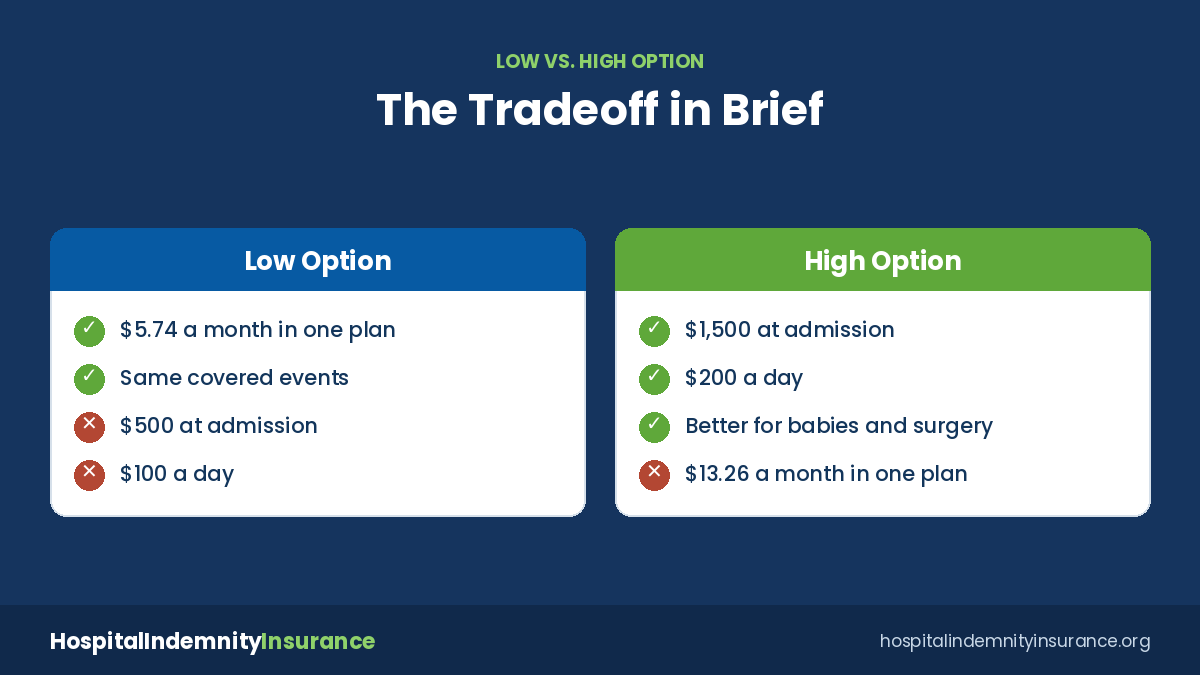
In UnitedHealthcare hospital indemnity low vs high, both options usually pay for the same hospital events, but the high option pays about two to three times more cash per stay for a few dollars more a month. In one 2026 employer plan, the low option paid $500 at admission plus $100 a day, while the high option paid $1,500 plus $200 a day.

When your employer offers UnitedHealthcare’s Hospital Indemnity Protection plan, you often get to choose a benefit level. Some employers call them low and high, others Plan A and Plan B, or Options A, B and C. The covered events are usually the same; the dollar amounts and premiums are what change.

This page puts the options side by side, prices the difference and shows the break-even point. For a deeper look at the richer option alone, see our UnitedHealthcare hospital indemnity high plan guide.
Compare Hospital Indemnity Plans in Your Area

Low vs. High: What Actually Changes

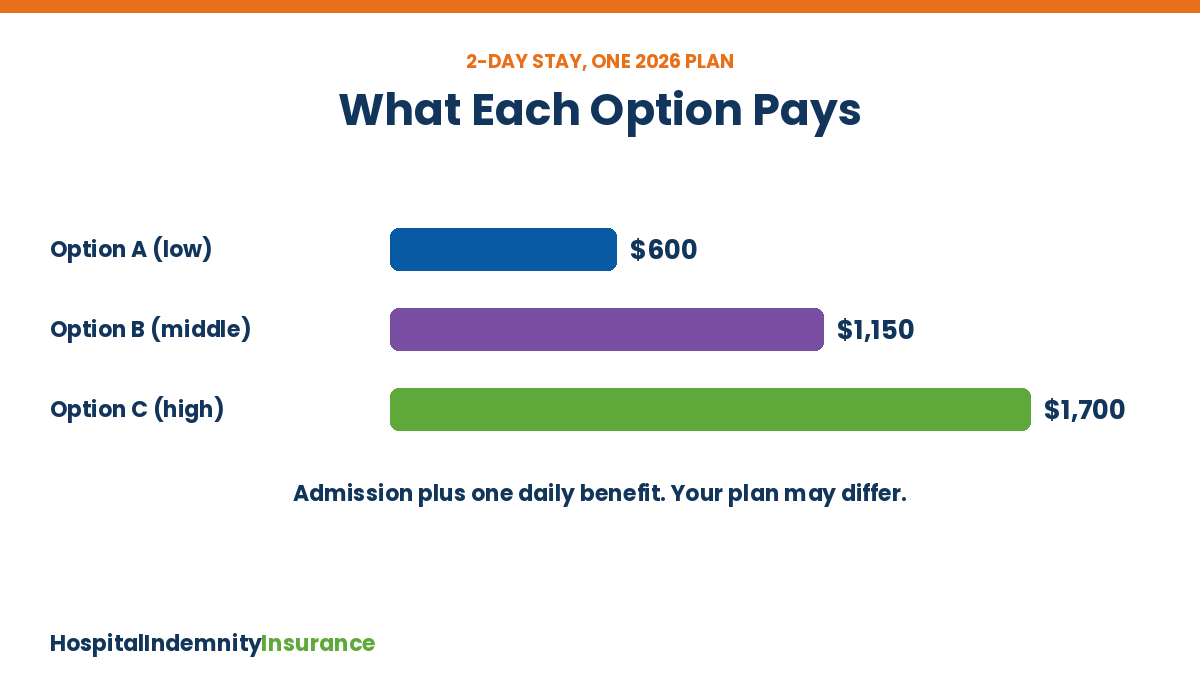
UnitedHealthcare hospital indemnity low vs high payout for a two-day hospital stay

UnitedHealthcare does not sell one national low plan and one national high plan. Each employer sets its own schedule, but the pattern is consistent across the benefit summaries we reviewed.

Same triggers. Both levels pay for a hospital admission, each day of confinement and ICU care, under the same rules.

Bigger checks on high. The high option raises the admission and daily amounts, often doubling or tripling them.

Same enrollment rules. Both are guaranteed issue for eligible employees who are actively at work, and both are portable if you leave.

Because the triggers match, the choice is purely about money: how much premium you want to pay every month versus how much cash you want in hand if someone in your household is admitted. The benefit is paid to you, not the hospital, so it can go toward a deductible, coinsurance, lost wages, childcare or rent.

Important: Low or high, this is a limited-benefit plan that pays fixed cash amounts. It is NOT health insurance, does not replace your health plan and does not meet ACA minimum essential coverage.

Hospital Indemnity Quotes

Call a Licensed Agent Now

Compare hospital indemnity plans from several insurance companies in one call. Any age.

☎ 1-888-891-0229

No obligation to enroll

Side-by-Side Benefits From a 2026 UnitedHealthcare Plan

This 2026 benefit summary from a public university system offers three levels. Option A is the low plan and Option C is the high plan.

Benefit Option A (low) Option B (middle) Option C (high)
Hospital admission, once per plan year $500 $1,000 $1,500
Hospital confinement, per day from day 2 $100 $150 $200
ICU admission, once per plan year $500 $1,000 $1,500
ICU confinement, per day from day 2 $100 $150 $200
Wellness screening, per year $50 $50 $50

Source: one employer’s 2026 UnitedHealthcare Hospital Indemnity Protection benefit summary. Daily benefits up to 364 days per plan year.

An older UnitedHealthcare small-group design shows the same idea with two levels: Plan A paid $500 at admission and $100 a day, and Plan B paid $1,000 and $150. Note that the wellness benefit did not change between levels in the 2026 plan. Only the hospital and ICU money did.

What Each Option Costs Each Month

The same 2026 plan published its monthly rates. Employees paid the full premium.

Coverage tier Option A (low) Option C (high) Extra per year for high
Employee only $5.74 $13.26 $90.24
Employee and spouse $11.34 $26.30 $179.52
Employee and children $9.61 $23.07 $161.52
Family $16.15 $38.52 $268.44

Source: one employer’s 2026 UnitedHealthcare benefit summary. Rates at your job will differ.

For one employee, the high option cost $7.52 more a month. To see how UnitedHealthcare pricing compares more broadly, read United Healthcare hospital indemnity insurance cost.

What about the middle option? When an employer offers three levels, the middle one splits the difference. In this plan, Option B cost $9.50 a month for one employee and paid $1,000 at admission plus $150 a day. It can make sense if the high premium feels like a stretch but $500 at admission would barely dent your deductible.

Sample Payouts: Low vs. High

UnitedHealthcare hospital indemnity low vs high option tradeoffs

These illustrations use the 2026 schedule above. Admission pays on day 1 and the daily benefit starts on day 2.

Hospital stay Option A (low) Option C (high) Difference
2-day stay, such as a vaginal birth $600 $1,700 $1,100
3-day stay $700 $1,900 $1,200
5-day stay $900 $2,300 $1,400

Illustrations only. Actual payment depends on your certificate and whether the stay qualifies.

Break-even math: One 2-day stay on the high option pays $1,100 more than the low option. At $90.24 a year in extra premium for one employee, that one stay covers about 12 years of the difference.

More examples are in our UnitedHealthcare hospital indemnity payout chart.

Compare Low and High Hospital Plans Near You

Who Should Pick Low and Who Should Pick High

Pick the low option if Pick the high option if
Your health plan deductible is low or you have solid savings You have a high-deductible plan or HSA plan
You mainly want basic cash for a surprise stay You or your spouse plan to have a baby
Every dollar of take-home pay counts right now You have a planned surgery or chronic condition
You are covering only yourself You are covering a spouse or children

Young single workers often do fine with low. Families, people expecting a baby and older workers, who are more likely to be admitted, usually get more value from high. Our guide to hospital indemnity for high-deductible plans shows how to size the benefit to your deductible.

Broker tip: If you are on the fence, count the people you are covering. Each extra family member is another chance for a hospital stay, and the high option pays more for every one of them.

Rules That Apply to Both Levels

Picking high does not change the fine print. Check these points in the certificate before you enroll.

Admission limits. In the 2026 plan, the admission benefit paid once per plan year, so a second stay would pay daily benefits only.

Pre-existing rules. These vary by plan. One older small-group design used a 12/12 pre-existing condition rule; ask your HR team which applies.

Exclusions. Cosmetic surgery, self-inflicted injury, care outside the U.S. and routine newborn nursery care are excluded on both levels.

Switching levels. You can usually change options only at open enrollment or after a qualifying life event.

1

Find your deductible. Look up your health plan’s deductible and out-of-pocket maximum.

2

Price the gap. Subtract the low premium from the high premium for your tier.

3

Picture one stay. Compare what each option pays for a 2- or 3-day admission.

4

Choose and compare. If your job has no plan, compare individual hospital indemnity quotes instead.

Bottom Line

In UnitedHealthcare hospital indemnity low vs high, the covered events are the same and only the cash amounts and premiums change. In one 2026 plan, the high option cost $7.52 more a month for one employee but paid $1,100 or more extra per stay. If you have a high deductible, a growing family or a planned stay, high usually wins.

Get Free Hospital Indemnity Insurance Quotes

UnitedHealthcare Hospital Indemnity Low vs High — Frequently Asked Questions

➤ What is the difference between UnitedHealthcare hospital indemnity low and high?

Both options usually pay for the same events, such as admission, daily stays and ICU care. The high option pays larger amounts and costs more each month.

➤ How much more does the high option pay?

In one 2026 plan, the high option paid $1,500 at admission and $200 a day, versus $500 and $100 on the low option. That is $1,100 more for a 2-day stay.

➤ How much more does the high option cost?

In that plan, $13.26 a month for employee-only coverage on high versus $5.74 on low, a difference of $7.52 a month.

➤ Is the high option worth it?

Usually yes if you have a high deductible, expect a baby or have a planned surgery. One covered stay can cover many years of the extra premium.

➤ Do both options cover childbirth?

In the 2026 plan we reviewed, routine labor and delivery in the hospital counted as a covered stay on every option. The high option simply paid more.

➤ Can I switch from low to high later?

Usually only during open enrollment or after a qualifying life event, such as marriage or a birth. Check your employer’s rules.

➤ Do I need to answer health questions for the high option?

Workplace plans are usually guaranteed issue for eligible employees who are actively at work, on either level.

➤ Is UnitedHealthcare hospital indemnity health insurance?

No. Both options are fixed indemnity plans that pay set cash amounts. They do not replace health insurance and do not meet ACA minimum essential coverage.

Hospital Indemnity Quotes

Call a Licensed Agent Now

Compare hospital indemnity plans from several insurance companies in one call. Any age.

☎ 1-888-891-0229

No obligation to enroll

Find & Compare Plans Online

Speak with a licensed insurance agent

1-888-891-0229

ZRN Health & Financial Services, LLC, a Texas limited liability company