





Speak with a licensed insurance agent

1-888-891-0229

How to Apply for Hospital Indemnity Insurance: Where to Buy, What They Ask and Whether You Should

Reviewed by Russell Noga, Licensed Insurance Agent — Last updated November 19, 2026

To apply for hospital indemnity insurance, you either elect it on your employer’s enrollment screen or fill out an individual application with an insurer or licensed agent, answer a short set of health questions, choose a daily benefit and pay the first premium. Workplace plans often skip the health questions at first eligibility, while individual plans can usually be bought any month of the year.

2027 by the Numbers

18 to 85

issue ages on LifeSecure’s individual Hospital Indemnity 4.0 plan (LifeSecure)

2 years

look-back on LifeSecure’s knockout health questions (LifeSecure underwriting guide)

60 to 79

ages that get guaranteed issue on Wellabe’s hospital indemnity plan (Wellabe)

$1,736

2026 Medicare Part A deductible per benefit period (CMS)

Shopping for this coverage is mostly paperwork and timing. The plan itself is simple: it pays you a set cash amount when you are admitted to a hospital. The harder part is knowing which door to use, what the form will ask, and when the policy actually starts paying.

This page walks through the buying process from start to finish, then helps you decide if the purchase makes sense for your household. If you already own a policy and want to file a claim, see how to use hospital indemnity insurance instead.
Compare Hospital Indemnity Plans You Can Apply for Today

Three Places to Buy Hospital Indemnity Insurance

Where to buy hospital indemnity insurance and how to apply through each channel

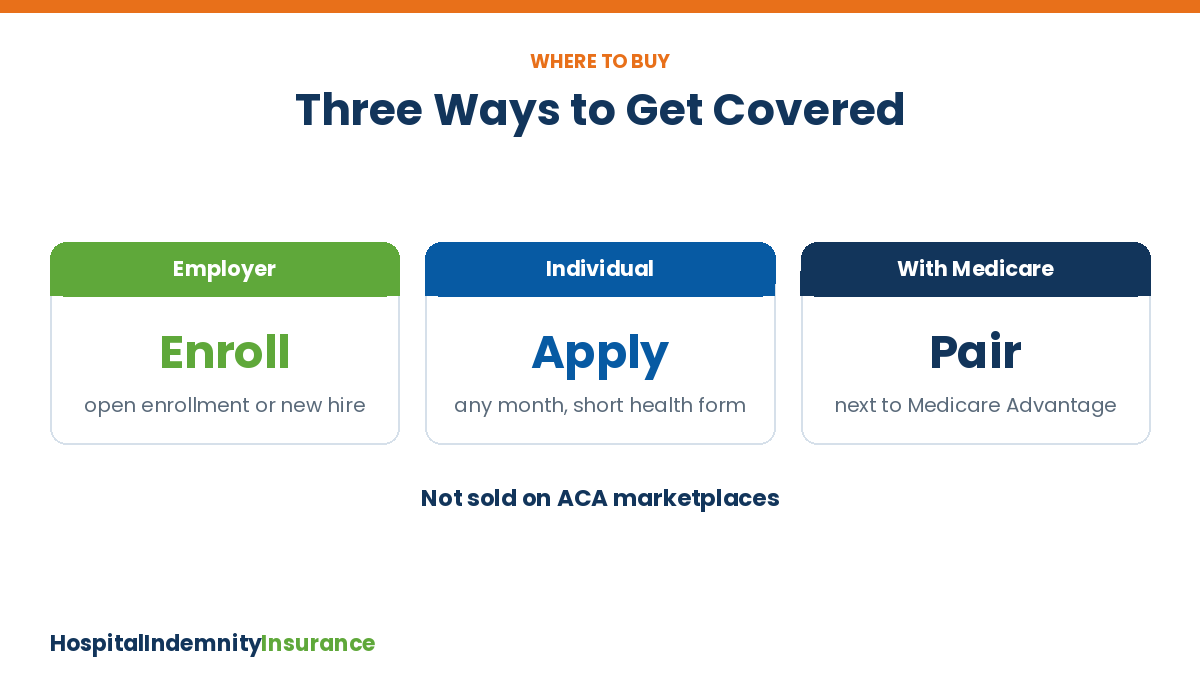
There is no single store for this product. It is not sold on HealthCare.gov or state ACA marketplaces, because it is a limited-benefit plan rather than major medical coverage. Instead, most people reach it through one of three routes.

Your employer. Many workplaces offer it as an optional benefit during open enrollment, when you are newly hired, or after a qualifying life event like marriage or a birth. MetLife, for example, says its workplace plans need no medical exam or health questions while you are actively at work.

An individual policy. You can apply directly with an insurer or through a licensed agent who represents several carriers. Individual policies are not tied to an enrollment season, so you can usually apply in any month.

Alongside Medicare Advantage. Some insurers design plans to sit next to a Medicare Advantage plan and help with its daily hospital copays. Aetna describes its HIP Flex plan as built to complement Medicare Advantage. You buy it separately from your Medicare plan.

Coverage reminder: Hospital indemnity is a limited-benefit plan that pays fixed cash amounts. It is not health insurance, does not replace a major medical plan or Medicare and does not count as ACA minimum essential coverage.

Hospital Indemnity Quotes

Call a Licensed Agent Now

Compare hospital indemnity plans from several insurance companies in one call. Any age.

☎ 1-888-891-0229

No obligation to enroll

What the Hospital Indemnity Application Asks

Individual applications are short compared with life insurance. There is usually no exam or blood draw. The insurer uses a few yes-or-no questions, and one yes can end the application. LifeSecure publishes its list for agents, which gives a clear look at what insurers screen for.

Question type Example from LifeSecure’s knockout list What a yes usually means
Pending care Advised to have surgery, inpatient therapy or tests that are not yet done Decline until the care is finished
Current status Pregnant, bedridden, in a nursing home or getting home health care Decline at that time
Recent hospital use Hospitalized 3 or more times Decline
Serious conditions Insulin-treated diabetes, kidney failure, cancer, heart failure, stroke, COPD Decline
Height and weight Checked against a build chart Outside the range is a decline

Source: LifeSecure underwriting knockout guide for its Hospital Recovery and Hospital Indemnity 4.0 plans. The look-back for the questions is 2 years, and questions vary by state and by insurer.

Other insurers use their own lists, so a decline from one company does not mean every company will say no. Answer every question accurately. Like other health policies, these contracts generally let the insurer contest a misstatement on the application for a set period after issue, often two years, which can mean a denied claim later.

Guaranteed Issue, Look-Back Periods and When Coverage Starts

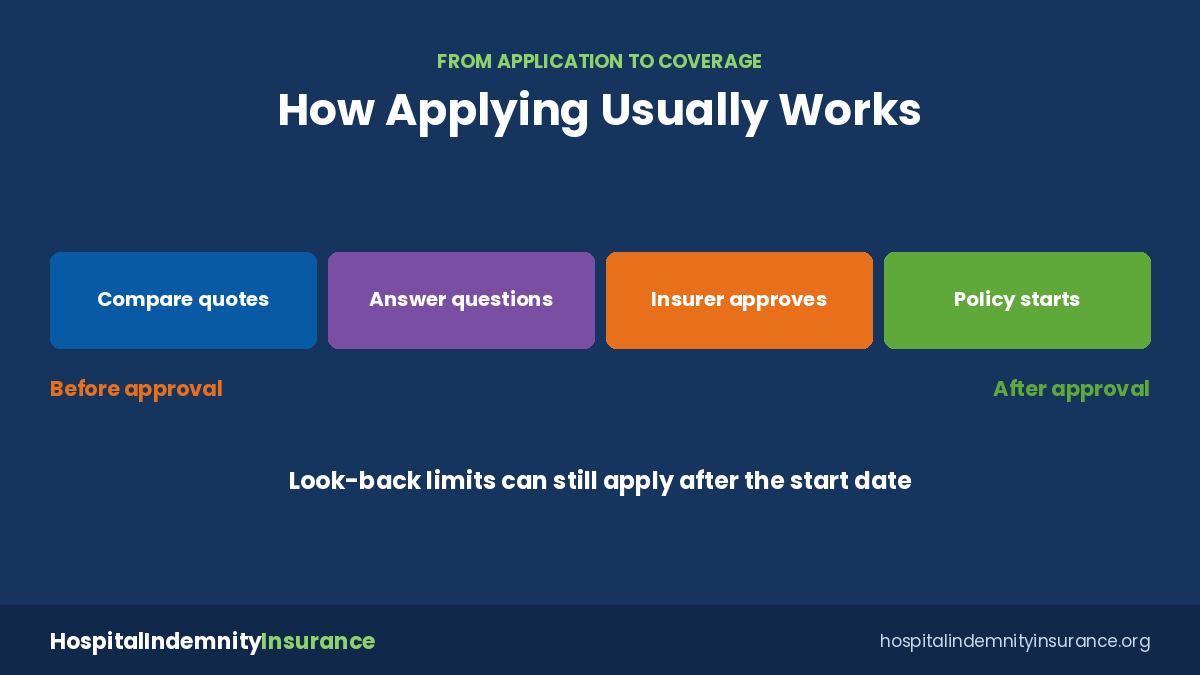
Two rules shape what you get after you are approved. The first is whether health questions applied at all. The second is the pre-existing condition limit, which can hold back benefits for a recent illness even when you were accepted.

Plan (from carrier documents) Who can apply When health questions are skipped Pre-existing rule
LifeSecure Hospital Indemnity 4.0 (individual) Ages 18 to 85 Ages 64.5 to 66 in most states Conditions from the 12 months before the start date are not covered for the first 6 months
Wellabe hospital indemnity (individual) Ages 18 to 85 Ages 60 to 79 (guaranteed issue) See the policy for your state
Aetna HIP Flex (Medicare-focused) Ages 18 to 89; 64 in California A guaranteed acceptance age window that varies by state See the policy for your state
MetLife workplace plans Employees actively at work and eligible family At enrollment, no health questions May apply to sickness benefits

Compiled from LifeSecure, Wellabe, Aetna and MetLife product materials. Ages, windows and rules vary by state and can change.

LifeSecure’s own state notes show how much location matters: in Kansas and Wyoming the look-back is 6 months instead of 12, and in North Carolina the limit does not apply to policyholders age 65 or older. For more on this topic, read our guide to hospital indemnity insurance and pre-existing conditions.

Timing note: Coverage starts on the effective date printed on your policy, not the day you sign. Many plans also give a free look window to cancel for a refund. Wellabe lists 30 days from receipt, minus any claims paid, and the length varies by state.

How to Apply for Hospital Indemnity Insurance, Step by Step

How to apply for hospital indemnity insurance from quote to effective date
1

Pull up your current health plan. Write down your deductible, out-of-pocket maximum and, on Medicare Advantage, the daily hospital copay and how many days it applies.

2

Check work before you shop. Look for a hospital plan in your benefits portal and note the next enrollment date. If you are inside a new-hire window, that may be your only no-questions chance for a year.

3

Get individual quotes for comparison. Price depends on age, state, daily amount, number of days and riders. Quotes from two or three carriers show the spread.

4

Pick the benefit you can afford to keep. LifeSecure, for example, lets you choose $100 to $900 a day for 3, 6, 10 or 21 days. A plan you drop after a year protects no one.

5

Complete the application. Answer the health questions, list family members you want covered, name a payer and choose bank draft or card billing.

6

Read the policy when it arrives. Confirm the effective date, the pre-existing rule and the free look deadline before that window closes.

Expecting a baby? Many individual plans exclude normal pregnancy or decline applicants who are already pregnant, so timing matters more than usual. See the hospital indemnity pregnancy waiting period guide before you apply.

See Which Hospital Indemnity Plans Are Sold in Your ZIP Code

Should I Buy Hospital Indemnity Insurance? A Quick Decision Test

The purchase makes the most sense when one hospital stay would cost more than you could comfortably pay from savings.

Your deductible. KFF reports the 2025 average single deductible for workers with one was $1,886, and 34% of covered workers had $2,000 or more. Compare your own figure with your cash cushion.

Your Medicare cost per stay. Original Medicare charged a $1,736 Part A deductible per benefit period in 2026. Medicare Advantage members should look up their plan’s daily inpatient copay.

Your income if you are admitted. Self-employed people and hourly workers lose pay during a stay, and the cash benefit can be spent on anything, including rent.

Your health history. If you have a condition on the knockout list, a workplace plan or a guaranteed issue age window may be the only way in.

If most of those answers point to a gap, the premium may be worth weighing. If you have a low out-of-pocket maximum or enough savings, it may not be. For a deeper cost-versus-payout look, read is hospital indemnity insurance worth it.

Buying Mistakes That Cost People Benefits

Applying after the diagnosis. Look-back rules mean a plan bought after symptoms start may not pay for that condition in the first months.

Missing the new-hire window. Workplace plans that skip health questions at first eligibility may ask them later, or make you wait for the next enrollment.

Worrying about an HSA for no reason. IRS rules list insurance that pays a fixed amount per day of hospitalization as permitted coverage, so it does not by itself end HSA eligibility.

Treating it as health insurance. It pays set cash amounts only. You still need a major medical plan or Medicare for the hospital bill itself.

Fine-print flag: Guaranteed renewable means the insurer cannot cancel the policy because your health changes, as long as premiums are paid on time. It does not lock the premium, which can still rise for a whole class of policyholders.

Bottom Line

Buying hospital indemnity insurance comes down to the right door, honest answers on a short health form and a start date that lands before you need it. Check your workplace options and enrollment dates first, compare them with individual quotes, and decide based on your real deductible, copays and savings.

Get Free Hospital Indemnity Quotes Before You Apply

Buying Hospital Indemnity Insurance — Frequently Asked Questions

➤ Should I buy hospital indemnity insurance?

It is worth considering if a hospital stay would leave you with a deductible or copays you could not easily pay, or if a stay would cut your income. If your health plan has a low out-of-pocket maximum or you have savings set aside, the premium may not be worth it.

➤ Can I apply for hospital indemnity insurance online?

Many insurers and agents take applications online or by electronic signature, and workplace plans are chosen in the benefits portal. Some carriers still complete the application with a licensed agent or representative.

➤ Can I buy hospital indemnity insurance any time of year?

Individual policies usually can be bought in any month. Workplace plans are limited to open enrollment, the new-hire window or a qualifying life event.

➤ Will I be turned down for a health condition?

On individual plans, a yes to a knockout question, such as recent cancer treatment or three or more hospital stays, can lead to a decline. Workplace plans and guaranteed issue age windows may accept you without health questions.

➤ How soon after I apply does coverage start?

Coverage starts on the effective date shown on the policy. Even then, a pre-existing condition limit can delay benefits for a recent condition, such as 6 months on LifeSecure’s individual plan.

➤ Can I buy hospital indemnity insurance if I am pregnant?

Some individual plans decline current pregnancy or exclude normal delivery, so buying before pregnancy matters. Workplace plans may accept you, but some still have a waiting period for birth benefits.

➤ Can I add my spouse and children?

Most plans offer family coverage tiers. On LifeSecure’s plan, a family member added later gets a fresh 6-month pre-existing period from the date of the change.

➤ Does hospital indemnity insurance affect my HSA?

IRS rules treat a policy that pays a fixed amount per day of hospitalization as permitted insurance, so it does not by itself end your HSA eligibility. Confirm your plan pays fixed amounts, not a share of the bill.

Hospital Indemnity Quotes

Call a Licensed Agent Now

Compare hospital indemnity plans from several insurance companies in one call. Any age.

☎ 1-888-891-0229

No obligation to enroll

Find & Compare Plans Online

Speak with a licensed insurance agent

1-888-891-0229

ZRN Health & Financial Services, LLC, a Texas limited liability company