





Speak with a licensed insurance agent

1-888-891-0229

Does Hospital Indemnity Cover Observation Stays? Inpatient vs. Observation Explained

Reviewed by Russell Noga, Licensed Insurance Agent — Last updated October 27, 2026

Some hospital indemnity plans cover observation stays, but many only pay when you are formally admitted as an inpatient. Observation is billed as outpatient care, even if you stay overnight, so whether you get paid depends on your policy’s definition of a hospital stay and whether it includes an observation or emergency room benefit.

You can spend a night in a hospital bed and still not be an inpatient. Hospitals often place patients in observation status while doctors decide whether to admit them. That label affects your health plan bill, and it can decide whether a hospital indemnity policy pays you anything.

This guide explains inpatient vs. observation status, the Medicare rules behind it, how policies treat observation and what to ask before you buy. New to this coverage? Start with what hospital indemnity insurance is.
Compare Hospital Indemnity Plans in Your Area

Inpatient Admission vs. Observation Status

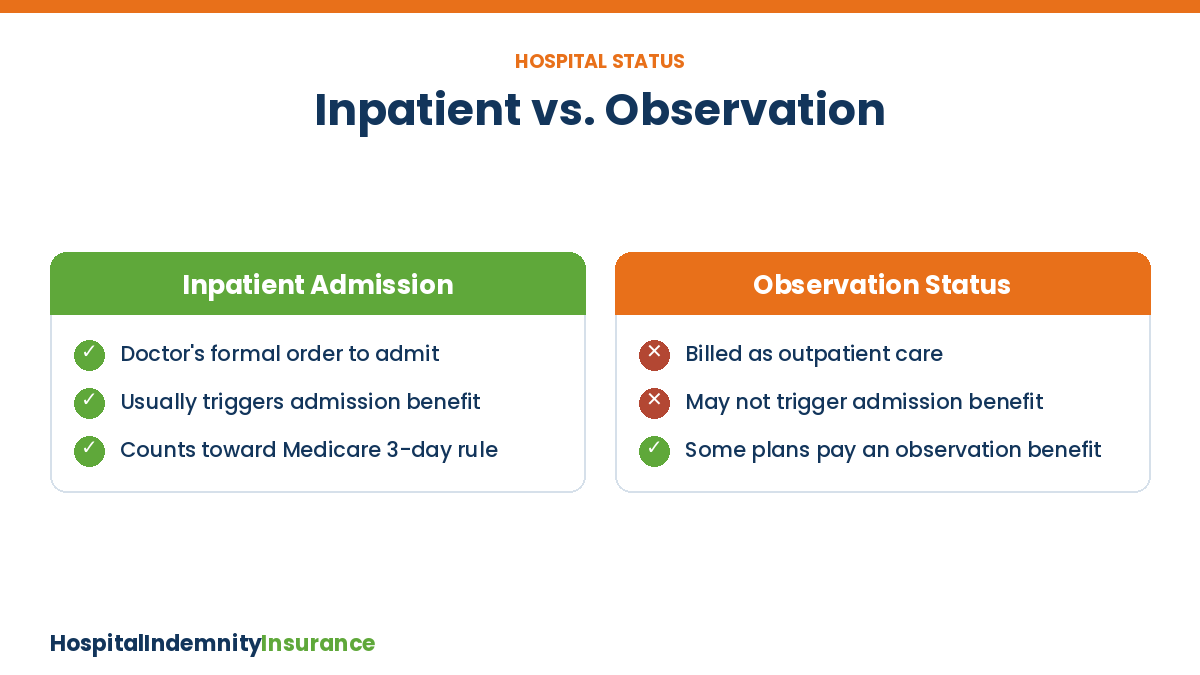
Does hospital indemnity cover observation stays comparison of inpatient admission and observation status

An inpatient admission starts when a doctor writes a formal order to admit you. Observation is short-term care, often in the emergency department or a separate unit, while the care team decides whether to admit you or send you home. That decision is usually made within about 24 hours, and generally within 48.

Question Inpatient admission Observation status
How it is billed Inpatient hospital care Outpatient care, even if you stay overnight
What starts it A doctor’s formal order to admit you An order for observation services
How long it lasts As long as you need inpatient care Usually under 24 to 48 hours
Typical cost sharing Often one inpatient copay or deductible Often separate charges for each service
Hospital indemnity admission benefit Usually triggers it May not, unless the policy says so

Rules vary by insurer and plan. Ask the hospital which status you are in.

Observation is billed as outpatient care under Medicare and most private insurers. You may be in a regular room overnight and still be an outpatient on paper.

Hospital Indemnity Quotes

Call a Licensed Agent Now

Compare hospital indemnity plans from several insurance companies in one call. Any age.

☎ 1-888-891-0229

No obligation to enroll

Medicare Rules: The Two-Midnight Rule and the MOON Notice

Medicare has specific rules about when a hospital should admit you, and they also apply to Medicare Advantage.

The two-midnight rule. Inpatient admission is generally appropriate when your doctor expects you to need medically necessary hospital care spanning at least two midnights. Shorter stays are often observation.

Medicare Advantage follows it too. Since January 1, 2024, CMS requires Medicare Advantage plans to follow the two-midnight rule.

The MOON notice. If you have Medicare, including Medicare Advantage, and receive observation services for more than 24 hours, the hospital must give you a Medicare Outpatient Observation Notice (MOON) no later than 36 hours after observation starts.

The three-day rule. Original Medicare generally covers skilled nursing facility care only after three days as an inpatient. Observation days do not count toward that requirement.

Good to know: If you have Original Medicare and were admitted as an inpatient but then switched to observation during your stay, you may have the right to a fast appeal for hospital stays on or after February 14, 2025. The hospital should give you a Medicare Change of Status Notice explaining how.

How Hospital Indemnity Policies Treat Observation

Hospital indemnity insurance is a limited-benefit plan that pays fixed cash amounts when a covered event happens. It is not health insurance, it does not replace health insurance, and it does not count as minimum essential coverage under the Affordable Care Act. Because it pays on events, the exact wording of the policy is what decides an observation claim.

Benefit type How it may treat observation
Admission benefit (lump sum) Many policies pay only for a formal inpatient admission and exclude emergency room and outpatient treatment
Daily confinement benefit Some policies count observation as a hospital stay after a set number of hours, such as 20 or 24 continuous hours
Observation benefit Some plans include a separate, smaller payment for short observation stays, often with a yearly limit
Emergency room rider Some plans offer an optional ER rider for an added premium that pays a set amount per visit, usually with a yearly limit

Based on sample policy brochures and certificates we reviewed. Benefits, riders and definitions vary by insurer, plan and state.

For example, one employer group certificate we reviewed treats observation of 20 or more continuous hours as a confinement and pays a smaller benefit for shorter stays. One Medicare-market plan we reviewed pays its lump sum for stays of 24 hours or more, including observation. Others have no observation benefit at all. See hospital indemnity and emergency room visits for more on ER coverage.

How to File a Claim After an Observation Stay

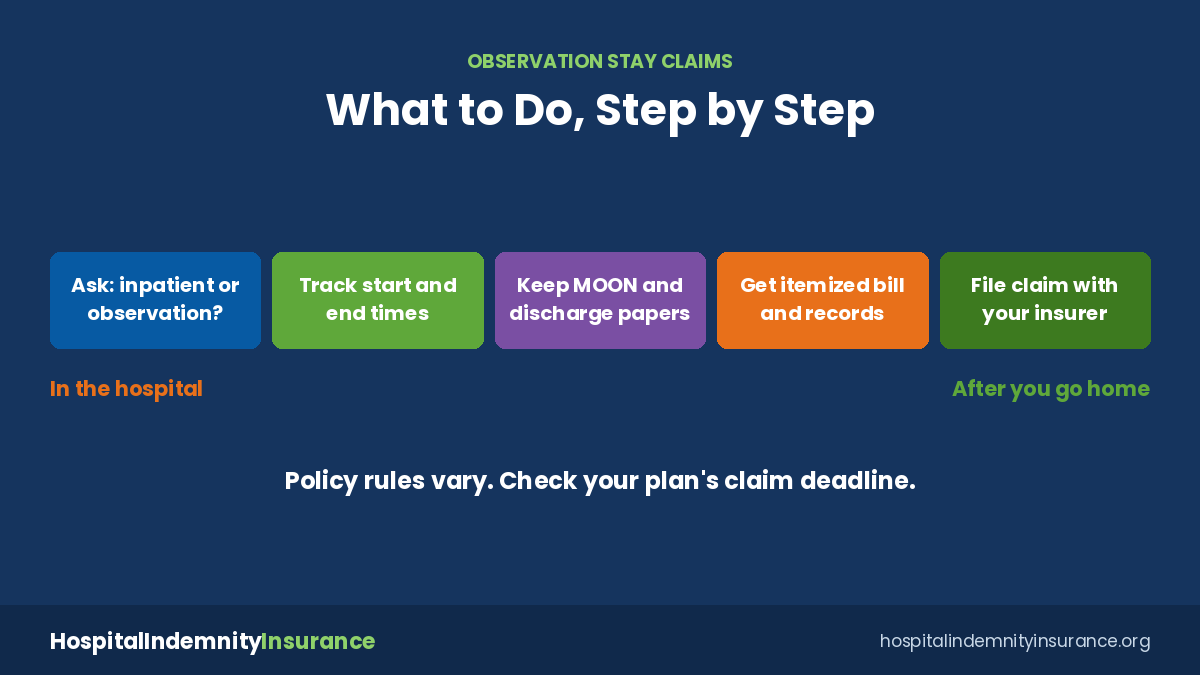
Does hospital indemnity cover observation stays claim timeline from hospital stay to filing

Even if you are not sure an observation stay qualifies, it is often worth filing a claim. These steps help.

1

Ask about your status. While you are in the hospital, ask each day whether you are an inpatient or under observation, and ask to be told if it changes.

2

Track the hours. Write down when observation started and when you were admitted or discharged. Some policies pay based on hours, not nights.

3

Keep your notices. Save the MOON, any change of status notice and your discharge papers.

4

Request your records. Get an itemized bill and records that show dates, status and diagnosis.

5

Submit the claim. Send the claim form and documents to your insurer as soon as you can, and keep copies of everything.

Our step-by-step guide on how to file a hospital indemnity claim covers forms, deadlines and common reasons claims are delayed.

See Plans With Observation and ER Benefits

How Observation Affects Different Health Plans

Observation status affects your main health plan bill too, and that is where a cash payout often helps most.

Employer plans. Observation is usually billed under outpatient benefits, so you may owe separate copays or coinsurance for each service instead of one inpatient charge.

ACA Marketplace plans. Observation usually counts toward your deductible and out-of-pocket maximum as outpatient care. A cash benefit can help until you reach your limit.

High-deductible plans. With a high deductible, even a short observation stay can mean a large bill. See our guide to hospital indemnity for high-deductible plans.

Medicare Advantage. Many plans charge a daily inpatient copay, while observation may carry its own copay. Many Medicare Advantage plans have waived the three-day rule for skilled nursing care, but check your plan. Learn more about hospital indemnity insurance with Medicare Advantage.

What to Ask Before You Buy a Hospital Indemnity Plan

The time to find out whether a plan covers observation stays is before you enroll, not after a hospital visit. Read the outline of coverage and ask these questions.

How is a hospital stay defined? Ask whether the plan requires a formal inpatient admission or counts observation after a set number of hours.

Is there an observation benefit? Find out how much it pays, whether it is in the base plan and how often it pays each year.

Is there an ER or outpatient rider? Riders can add payments for emergency room visits or outpatient surgery for an extra premium.

Are there waiting periods or pre-existing limits? Many plans limit benefits for pre-existing conditions or sickness for a set time after coverage starts.

Broker tip: Two plans with the same daily benefit can pay very differently after a short hospital visit. If you or a family member has frequent ER trips or overnight stays, compare the observation and ER language side by side, not just the price.

Bottom Line

Hospital indemnity may or may not cover an observation stay, because observation is billed as outpatient care. Some plans count longer observation stays or add an observation or ER benefit, while others pay only for a formal inpatient admission. Read the policy definitions before you buy, and keep your hospital notices to file a claim.

Get Free Hospital Indemnity Insurance Quotes

Hospital Indemnity and Observation Stays — Frequently Asked Questions

➤ Does hospital indemnity cover observation stays?

It depends on the policy. Some plans count observation as a hospital stay after a set number of hours or pay a separate observation benefit, while many pay only for a formal inpatient admission.

➤ What is observation status in a hospital?

Observation is short-term outpatient care while doctors decide whether to admit you or send you home, even if you stay overnight.

➤ Is an observation stay considered a hospital admission?

No. Observation is billed as outpatient care under Medicare and most private insurers. An admission requires a doctor’s formal order to admit you as an inpatient.

➤ What is the two-midnight rule?

It is a Medicare rule that says inpatient admission is generally appropriate when your doctor expects you to need hospital care spanning at least two midnights. Medicare Advantage plans must follow it too.

➤ What is a MOON notice?

It is a Medicare Outpatient Observation Notice that explains you are an outpatient and how that can affect your costs. Hospitals must give it to people with Medicare under observation for more than 24 hours.

➤ Do observation days count toward Medicare’s three-day rule?

No. Original Medicare generally requires three inpatient days before covering skilled nursing facility care, and observation days do not count. Many Medicare Advantage plans waive this rule.

➤ Does hospital indemnity pay for emergency room visits?

Some plans include an ER benefit or offer it as an optional rider. Many base plans do not pay for an ER visit unless you are admitted.

➤ Is hospital indemnity the same as health insurance?

No. Hospital indemnity is a limited-benefit plan that pays fixed cash amounts. It does not replace health insurance and does not count as minimum essential coverage under the Affordable Care Act.

Hospital Indemnity Quotes

Call a Licensed Agent Now

Compare hospital indemnity plans from several insurance companies in one call. Any age.

☎ 1-888-891-0229

No obligation to enroll

Find & Compare Plans Online

Speak with a licensed insurance agent

1-888-891-0229

ZRN Health & Financial Services, LLC, a Texas limited liability company