





Speak with a licensed insurance agent

1-888-891-0229

How Much Does an Ambulance Cost? Ground and Air Prices, With and Without Insurance

Reviewed by Russell Noga, Licensed Insurance Agent — Last updated November 2, 2026

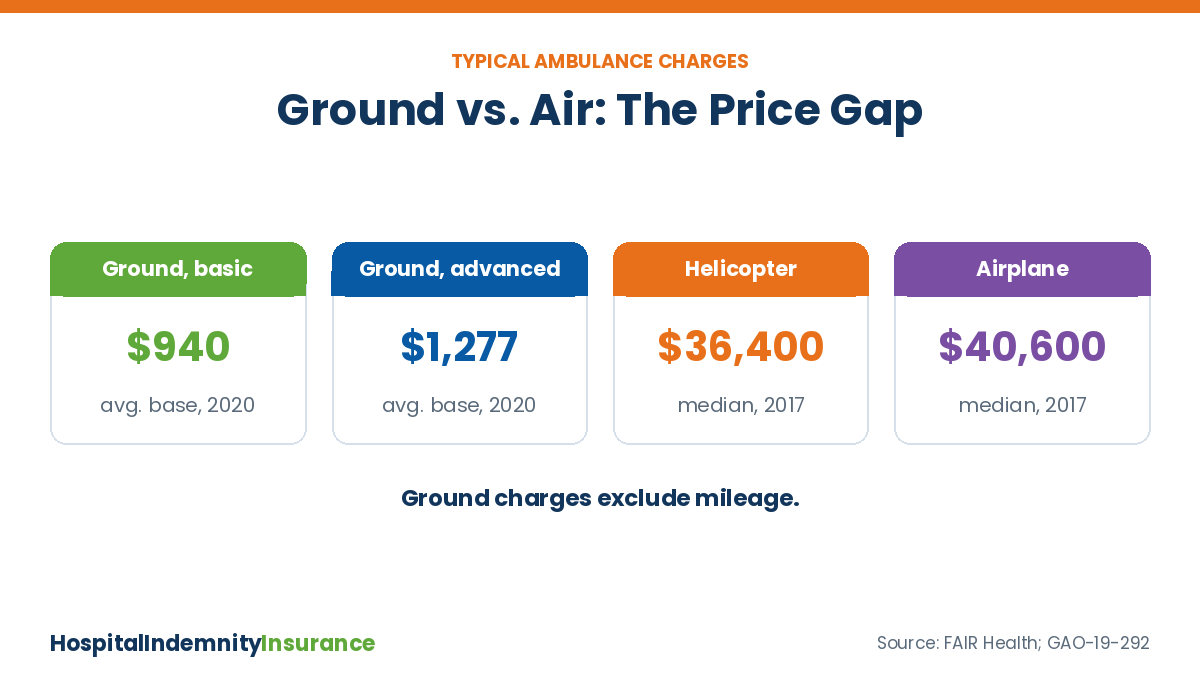
A ground ambulance ride typically costs about $940 to $1,300 before mileage, and an air ambulance often costs $36,000 to $41,000 or more. FAIR Health put 2020 average base charges at $940 for basic life support and $1,277 for advanced life support, while the GAO found 2017 median air ambulance charges of about $36,400 by helicopter and $40,600 by airplane.

2027 by the Numbers

$1,277

average ALS emergency ground ambulance charge, 2020 (FAIR Health)

$36,400

median helicopter air ambulance charge, 2017 (GAO)

62%

emergency ground ambulance claim lines billed out of network, 2022 (FAIR Health)

22

states with some ground ambulance surprise-bill protection, Feb. 2026 (Commonwealth Fund)

Nobody shops for an ambulance. The bill arrives weeks later, shaped by things you never chose: the level of care, the miles driven, whether you flew and whether the company had a contract with your health plan.

Below are real figures for each, the surprise-billing rules that protect you and where they stop, and how a fixed-cash plan can help. For the second bill, see how much an ER visit costs without insurance.
Compare Plans That Pay Cash for Ambulance Rides

Ground vs. Air Ambulance: What the Ride Itself Costs

How much does an ambulance cost: average ground ambulance charges and median air ambulance charges

Ground ambulance bills usually have two main lines: a base rate for the level of care and a mileage charge for each loaded mile. Basic life support (BLS) means an EMT crew with standard equipment. Advanced life support (ALS) adds a paramedic who can give IV drugs, read heart rhythms and manage airways, and it costs more.

Type of transport Average or median charge What insurers paid Data year
Ground, BLS emergency (base rate) $940 average $522 average 2020
Ground, ALS emergency (base rate) $1,277 average $758 average 2020
Air, helicopter About $36,400 median Not reported in study 2017
Air, fixed-wing airplane About $40,600 median Not reported in study 2017

Sources: FAIR Health private claims (ground); GAO-19-292 (air, one insurer data set). Ground figures exclude mileage.

Price check: Charges on the bill and what a health plan pays are two different numbers. In 2020, private insurers paid about 56% to 59% of the average ground ambulance charge, per FAIR Health. A patient with no plan starts from the full charge.

Hospital Indemnity Quotes

Call a Licensed Agent Now

Compare hospital indemnity plans from several insurance companies in one call. Any age.

☎ 1-888-891-0229

No obligation to enroll

Who Pays What: Ambulance Cost With Insurance and Without

Your share depends more on your coverage and which rule applies than on the ride. No single source lays out ground and air side by side, so we built this matrix.

Your coverage Ground ambulance Air ambulance
No insurance Full charge; ask for a self-pay discount or payment plan Full charge; often tens of thousands of dollars
Private plan, in-network company Plan copay or coinsurance after deductible Plan copay or coinsurance after deductible
Private plan, out-of-network company Possible balance bill; No Surprises Act does not apply, so state law decides No Surprises Act limits you to in-network cost sharing
Self-funded employer plan State ground ambulance laws generally cannot reach it No Surprises Act applies
Original Medicare (Part B) 20% of the approved amount after the Part B deductible Same 20%, if ground transport could not meet the need
Medicare Advantage Plan copay, which varies by plan Plan copay, which varies by plan

Compiled by HospitalIndemnityInsurance.org from CMS, Medicare.gov and Commonwealth Fund research. Applies to covered, medically necessary transports.

Out-of-network is common. FAIR Health found 62% of emergency ground ambulance claim lines were out of network in 2022.

Half face a possible surprise charge. Peterson-KFF found about half of emergency ground rides for privately insured people carried an out-of-network charge.

Air is the protected one. CMS says surprise bills are generally prohibited for covered air ambulance services.

Medicare Part B Rules for Ambulance Rides

Original Medicare covers ambulance trips under Part B when other transport could endanger your health. You pay 20% of the Medicare-approved amount after the yearly Part B deductible, which is $283 in 2026 and Medicare.gov says ambulance companies generally cannot charge more than that plus any unmet deductible.

1

Nearest appropriate facility. Medicare pays for a trip to the closest facility that can treat you. Choose a farther hospital and you may owe the extra distance.

2

Air only when ground will not work. A helicopter or plane is covered when the pickup site is hard to reach by road, or distance or traffic would delay urgent care.

3

Non-emergency trips need a doctor’s order. Scheduled rides require a written order saying other transport is unsafe for you.

4

Watch for an ABN. If a non-emergency ride may not be covered, the company must give you an Advance Beneficiary Notice before charging you. It will not ask you to sign one in an emergency.

Medicare Advantage members pay their plan’s ambulance copay instead, and those copays differ from plan to plan. A fixed-cash plan can help with that copay and with inpatient days; see hospital indemnity with Medicare Advantage.

Miles and State Lines: Why the Same Ride Costs More in Some Places

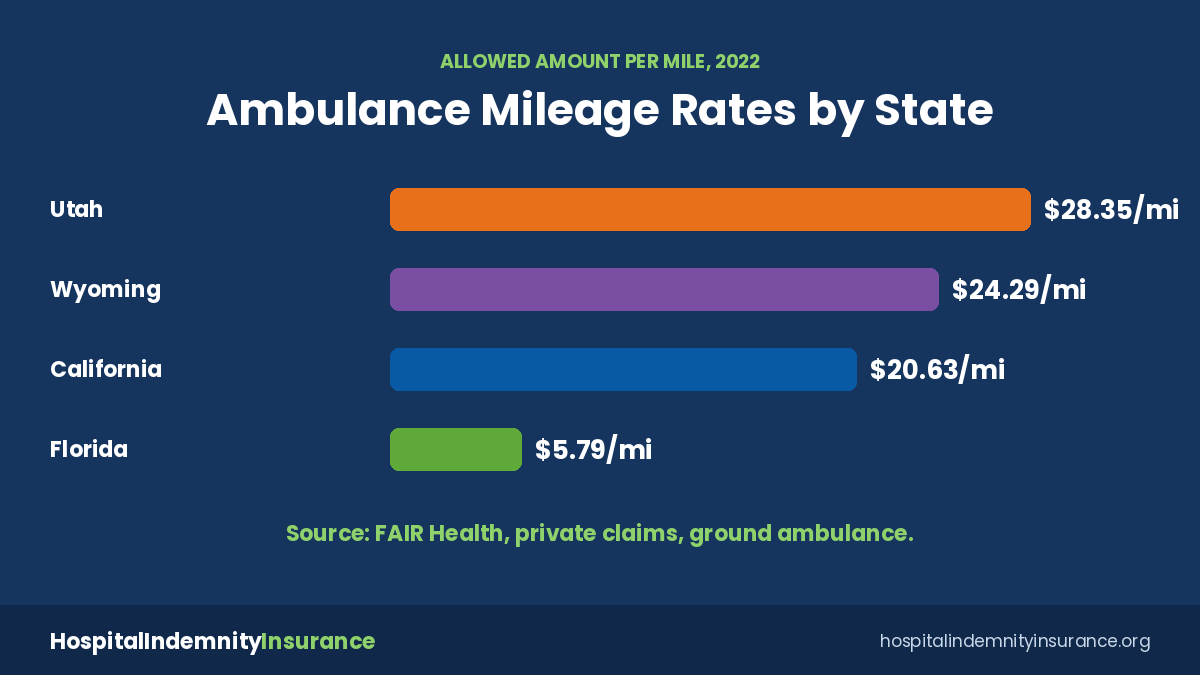
Ambulance cost per mile by state: allowed amounts in Utah, Wyoming, California and Florida

Mileage is where geography shows up. FAIR Health found the average ground trip ran 33.8 miles in Vermont but only 7.9 miles in Washington, DC, from 2018 to 2022. The rate per mile varies even more: insurers allowed $28.35 per mile in Utah in 2022, compared with $5.79 in Florida.

State example Ground ambulance rule Who it protects
North Dakota Caps charges at 250% of the Medicare rate People in state-regulated plans
Utah Insurers pay the full state-set rate, so no balance is left People in state-regulated plans
Illinois Cost sharing limited to the lesser of the normal copay or 10% of the cost People in state-regulated plans
New Hampshire Law effective January 1, 2026, for emergency and non-emergency rides People in state-regulated plans
Texas Existing protection extended until September 1, 2027 People in state-regulated plans

Sources: Commonwealth Fund and Georgetown CHIR, Feb. 2026; FAIR Health (mileage). Self-funded employer plans are generally outside state law.

Federal status: A federal advisory committee recommended in 2023 that Congress cap patient copays for ground ambulance rides at $100. As of early 2026, Congress had not acted, so ground ambulance surprise billing is still left to the states.

Find Ambulance Benefit Options by ZIP Code

What Hospital Indemnity and Accident Plans Pay Toward an Ambulance

Some limited-benefit plans pay a set dollar amount when a licensed ambulance carries you, no matter what the ambulance company billed. The cash goes to you, so it can cover a deductible, a copay or a balance bill. We compared three filed plans that list ambulance benefits.

Plan (brochure or policy) Ground ambulance Air ambulance Limits
Aflac Hospital Advantage (A49000), Option 2 and up $100 $1,000 Sickness or injury; 2 trips per year per person
LifeSecure HI 4.0, Emergency Room and Ambulance rider $150 $500 Optional rider; 1 ambulance service per year
Aflac Accident Insurance, Option 1 (A38000, Arizona) $300 $2,000 (air or water) Injuries only; 2 trips per covered accident

Compiled by HospitalIndemnityInsurance.org from each insurer’s brochure or policy form. Amounts and riders vary by state, option and plan version.

Set those payments against the bills above: a $100 to $300 ground benefit can cover a large share of an in-network ambulance copay but not a full $1,277 charge. Accident plans tend to pay more per trip but only for injuries, a tradeoff explained in accident insurance vs. hospital indemnity.

Coverage limits: Hospital indemnity is a limited-benefit plan that pays fixed cash amounts. It is not health insurance, does not replace it and does not meet ACA minimum essential coverage.

After the Ride: Lowering the Bill and Choosing a Cash Benefit

1

Match the bill to your EOB. Wait for your plan’s explanation of benefits and compare it with the bill.

2

Check network status and plan type. For an out-of-network ground ride, ask whether your plan is state-regulated or self-funded, and file a complaint with your state insurance department if a protection applies.

3

Ask for a lower rate. Ambulance services, including those run by cities or fire districts, may offer hardship discounts or payment plans if you ask.

4

File the cash claim. Send the ambulance company’s statement and trip details to your indemnity insurer; the fixed benefit is paid regardless of what health insurance paid.

Working adults on high-deductible plans. An ambulance ride often lands before the deductible is met. See hospital indemnity for high-deductible plans.

Families with active kids. Injury-heavy households may get more from an accident plan’s higher ambulance payment.

Rural residents. Longer trips and air transport are more likely, so the air benefit amount matters.

Ambulance riders add premium, so price them with the core plan; typical ranges are on hospital indemnity insurance cost.

Bottom Line

A ground ambulance usually costs about $940 to $1,300 before mileage and an air ambulance often tops $36,000. Federal law protects insured patients from out-of-network air ambulance bills, but ground rides depend on your state and plan type. A hospital indemnity or accident plan with an ambulance benefit pays fixed cash toward the gap, alongside real health insurance.

Get Free Hospital Indemnity Insurance Quotes

Ambulance Cost — Frequently Asked Questions

➤ How much does an ambulance ride cost without insurance?

Expect the full charge, often about $940 to $1,277 plus mileage for a ground emergency ride, and $36,000 or more by air. Ask about self-pay discounts and payment plans.

➤ How much is an ambulance with insurance?

In-network, you pay your plan’s copay or coinsurance after the deductible. Out-of-network ground rides can bring a balance bill unless your state bans it and your plan is state-regulated.

➤ Does the No Surprises Act cover ground ambulances?

No. CMS states ground ambulance services are not covered by the No Surprises Act. Air ambulances are covered, and 22 states had some ground ambulance protection as of February 2026.

➤ Why is an air ambulance so expensive?

Aircraft, crews and round-the-clock readiness are costly. The GAO found median helicopter charges roughly doubled, from about $15,000 to $30,000, between 2010 and 2014.

➤ Does Medicare pay for an ambulance?

Part B covers medically necessary ambulance rides to the nearest appropriate facility. You pay 20% of the approved amount after the Part B deductible.

➤ Can I be billed if the ambulance did not take me anywhere?

Yes. Some services bill for treatment at the scene without transport, and FAIR Health counted those as about 2% of claim lines in 2022.

➤ Does hospital indemnity insurance pay for an ambulance?

Some plans or riders do. Aflac Hospital Advantage Option 2 and up lists $100 for ground and $1,000 for air, paid in cash for covered sickness or injury.

➤ Is an accident plan better than hospital indemnity for ambulance costs?

For injuries, often yes, since Aflac’s Arizona Accident Option 1 lists $300 ground and $2,000 air. It pays nothing for an illness, which hospital indemnity may cover.

Hospital Indemnity Quotes

Call a Licensed Agent Now

Compare hospital indemnity plans from several insurance companies in one call. Any age.

☎ 1-888-891-0229

No obligation to enroll

Find & Compare Plans Online

Speak with a licensed insurance agent

1-888-891-0229

ZRN Health & Financial Services, LLC, a Texas limited liability company