





Speak with a licensed insurance agent

1-888-891-0229

Is Hospital Indemnity Insurance Worth It? The Premium vs. Payout Math

Reviewed by Russell Noga, Licensed Insurance Agent — Last updated November 16, 2026

Hospital indemnity insurance is worth it when one hospital stay would leave you owing more than you could pay from savings, because a single covered admission typically pays back four to six years of premiums on the plans we checked. It is a poor value if your health plan already limits what a stay costs you or your cash cushion covers your deductible, since most years you pay in and collect nothing.

2027 by the Numbers

$3,297

average U.S. hospital expense per adjusted inpatient day, 2024 (KFF)

$8,700

2027 out-of-pocket ceiling for an HSA-eligible plan, self-only (IRS)

$12,000

2027 ACA in-network out-of-pocket limit, self-only (HHS)

7.9%

of people had an overnight hospital stay in a year (CDC, 2018 survey)

Every insurance policy is a bet you hope to lose. With hospital indemnity the stakes are visible: a fixed premium against a fixed cash payment if you are admitted, so you can run the numbers first.

Below is that math on real published plans, plus where the payout comes up short. One rule throughout: hospital indemnity is a limited-benefit plan that pays set dollar amounts. It is not health insurance, it does not pay the hospital, and it does not count as ACA minimum essential coverage. If you want the full list of benefits these plans can include, see hospital indemnity insurance coverage.
Compare Hospital Indemnity Premiums and Payouts

Is Hospital Indemnity Insurance Worth It? What Five Real Plans Cost vs. Pay

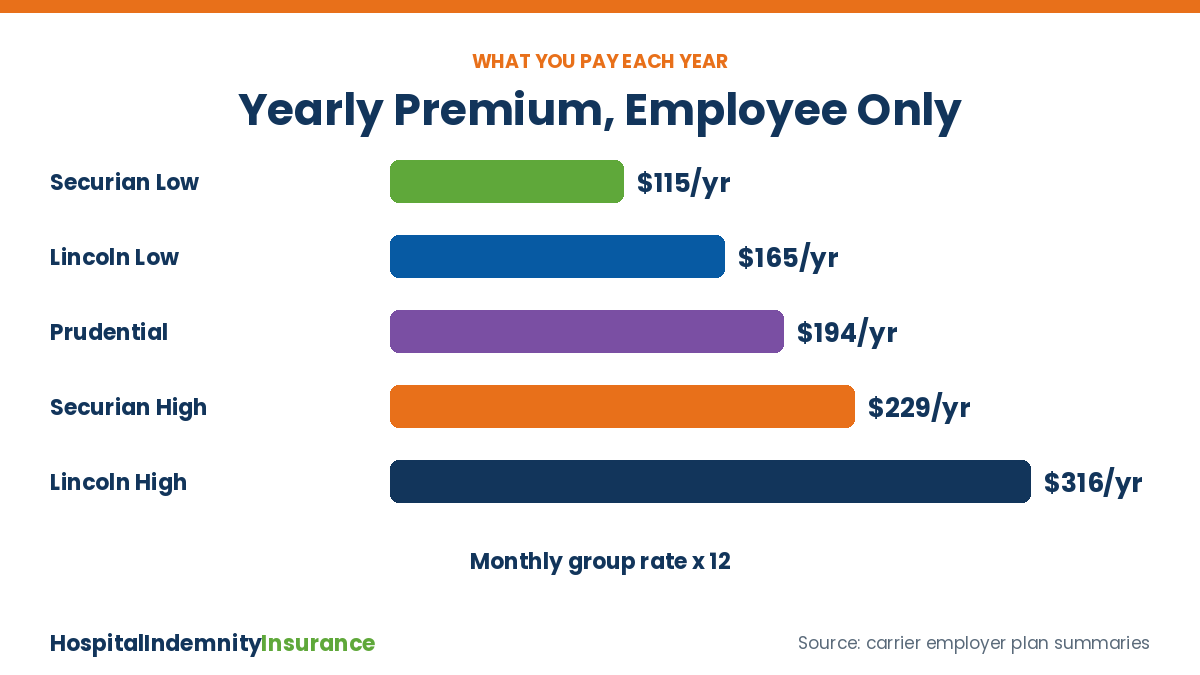
Is hospital indemnity insurance worth it: yearly employee-only premiums on five published employer plans

To test value, we pulled three employer plan summaries that publish both rates and benefits: Lincoln Financial for Johns Hopkins staff, Prudential’s 2026 plan for UC Riverside and Securian for the University of Texas System. Two offer a low and high option, giving five price points.

Plan (insurer, employer group) Employee-only premium per year Admission benefit Daily benefit Years of premium one admission repays
Securian, UT System Low $115 $500 $100 4.4
Lincoln, Johns Hopkins Low $165 $1,000 $100 from day 2 6.0
Prudential, UC Riverside $194 $1,200 $200 6.2
Securian, UT System High $229 $1,000 $200 4.4
Lincoln, Johns Hopkins High $316 $2,000 $200 from day 2 6.3

Our analysis of the carriers’ published employer plan summaries. Yearly premium = monthly employee-only rate x 12, rounded. Last column = admission benefit divided by yearly premium. Group rates; individual policies are priced by age and state and often cost more.

On these group plans, the admission payment alone covers four to six years of premiums, and a longer stay pays back more. Prices vary with age, state and benefit level, so check current figures on hospital indemnity insurance cost before you compare.

Math check: A ratio above 1.0 only means one claim beats one year of premiums. Value depends on how many years you pay before a claim ever happens.

Hospital Indemnity Quotes

Call a Licensed Agent Now

Compare hospital indemnity plans from several insurance companies in one call. Any age.

☎ 1-888-891-0229

No obligation to enroll

When Is Hospital Indemnity Insurance Worth It? Three Break-Even Tests

Worth it comes down to three numbers: what a stay would cost you, what cash you have, and how long you would pay premiums before a claim.

1

The gap test. Find your health plan’s deductible plus inpatient coinsurance or per-day copays. For 2027, an HSA-eligible plan can have a self-only deductible as low as $1,750 and out-of-pocket costs up to $8,700. ACA plans can reach $12,000. The bigger your share of a stay, the more an indemnity check matters.

2

The cash test. Compare that gap with money you could spend tomorrow without borrowing. If savings already cover your full out-of-pocket maximum, the policy mostly duplicates that cushion.

3

The time test. Divide the payout for a typical stay by the yearly premium. That number is how many years you can go claim-free and still come out even. On the plans above, a five-day stay repays roughly 8 to 10 years of premiums.

Plan Payout for a 5-day stay 10 years of premiums Ahead or behind after one stay in 10 years
Securian Low $900 $1,147 Behind about $250
Lincoln Low $1,400 $1,655 Behind about $255
Prudential $2,000 $1,943 About even
Securian High $1,800 $2,294 Behind about $495
Lincoln High $2,800 $3,162 Behind about $360

Calculated by HospitalIndemnityInsurance.org from published benefits: admission benefit plus the daily benefit for days 2 through 5, counted the same way on every plan to stay conservative. Assumes level premiums; one stay in five years leaves every plan ahead.

Should I Pay for Hospital Indemnity Insurance If I Rarely Get Sick? The Candid Odds

Here is the honest version. Insurers price these plans to collect more in premiums than they pay out across all buyers. A CDC survey found 7.9% of people had an overnight hospital stay in 2018, so in a typical year most policyholders file nothing. Averaged over everyone, you should expect to get back less than you pay.

That does not make it a bad buy. You are paying for timing: a $1,000 to $2,800 check lands the week bills and missed shifts hit at once. Real hospital costs dwarf these payouts. KFF puts average hospital expense at $3,297 per adjusted inpatient day in 2024, from about $1,400 in Mississippi to about $4,744 in California.

Low odds, low stakes. Healthy, solid savings, a plan with a small inpatient copay. The premium is likely a net cost with little upside.

Low odds, high stakes. Healthy but thin savings and a high deductible. One unlikely stay could mean a credit card balance, which is the case where the bet makes sense.

Higher odds. A planned surgery, pregnancy or chronic condition raises the chance of a claim, but waiting periods and pre-existing condition rules may block the very stay you expect.

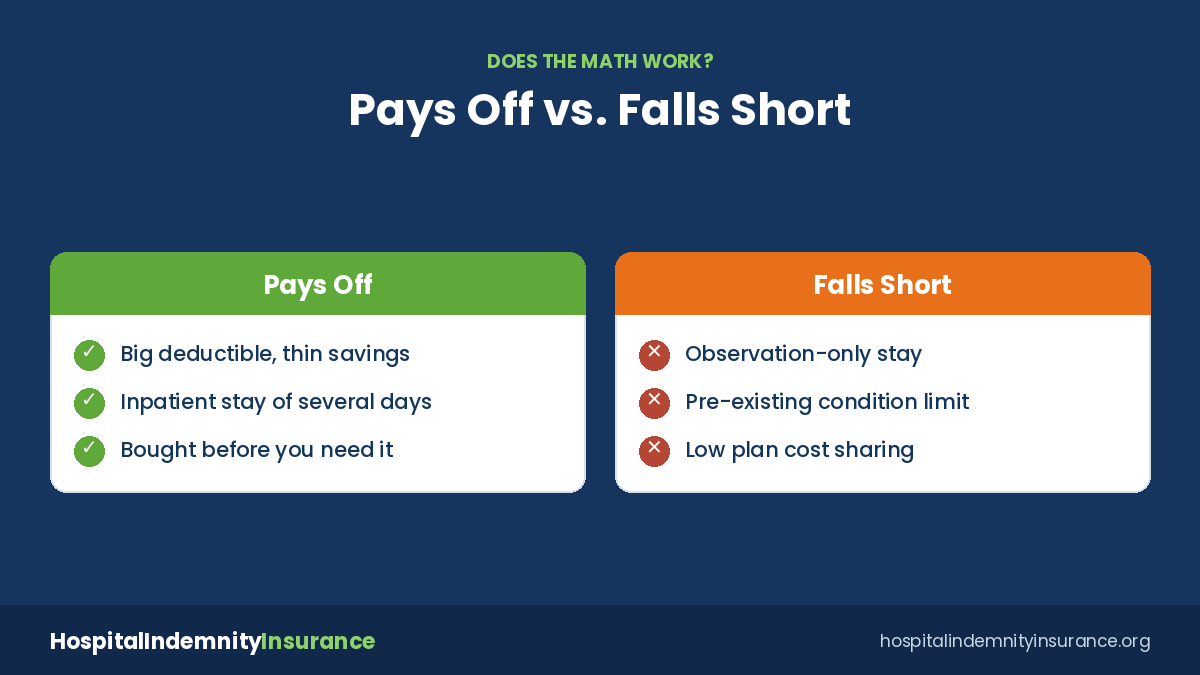
Reality check: Buying after you learn a hospital stay is coming rarely works. Many policies exclude conditions treated before coverage began or impose a waiting period, so the value comes from buying before you need it.

Where the Payout Falls Short: Fine Print That Shrinks the Value

When hospital indemnity insurance is worth it versus when the payout falls short

Two plans with the same price can pay very differently. These details decide whether the math holds.

Observation status. Lincoln’s Johns Hopkins plan defines an admission as being accepted for inpatient services for more than 20 hours. A night spent under observation is billed as outpatient care and may pay nothing on plans with similar wording.

Yearly admission caps. The Lincoln plan pays its admission benefit up to 2 times per calendar year and treats a readmission within 90 days for the same cause as one stay. Prudential’s UC Riverside plan allows up to 10 confinements a year. Frequent stays favor the higher cap.

Day limits. Daily benefits stop at 30 days on all three plans, counted per calendar year on the Lincoln plan and per admission or confinement on the other two. Long rehab-style stays outrun the benefit.

Starting day. Some plans pay the daily amount from day 2 because the admission benefit covers day 1. A two-day stay may collect only one daily payment.

Fine-print flag: Check the outline of coverage for how confinement is defined, whether illnesses that began before the effective date are excluded (the Lincoln summary says it pays nothing for those), any childbirth waiting period and ICU or step-down rates. Prudential’s plan lists a separate $100 daily step-down benefit.

Check Hospital Indemnity Rates Where You Live

Hospital Indemnity Insurance Worth It? Pros, Cons and Value at a Glance

Pros Cons
Pays cash directly to you, to spend on any bill or living cost Fixed amounts rarely cover a full hospital bill
Low group premiums, about $10 to $26 a month for one person on the plans reviewed Most years you pay premiums and collect nothing
Pays on top of your health plan, not instead of it Not health insurance and not ACA minimum essential coverage
Group plans can be guaranteed issue: all three plans reviewed here ask no health questions Pre-existing condition limits, waiting periods and observation-stay gaps
Easy to compare: benefits are stated in dollars Value shrinks if your health plan already has low inpatient cost sharing

Premium range from the five employer plan options reviewed above, employee-only coverage.

For a longer look at each trade-off, see hospital indemnity insurance pros and cons.

Is It Good to Have Hospital Confinement Indemnity Insurance? The Value Verdict

Hospital confinement indemnity is the formal name some insurers use for the same product: a set amount for each day you are confined as an inpatient. The verdict depends on your gap compared with the premium, not the name.

Usually worth getting. Your share of one stay is several thousand dollars, savings would not cover it, and the yearly premium is a small fraction of one admission payment.

Borderline. Your gap is moderate and you could cover it with some strain. A low option with a strong admission benefit may be enough.

Usually not worth it. Your plan caps inpatient costs at a low amount, or cash on hand already covers your full out-of-pocket maximum.

If you are on a high-deductible plan, review hospital indemnity for high-deductible plans. To see which life situations tend to fit, read who should get hospital indemnity insurance.

Bottom Line

Hospital indemnity insurance is worth it when a hospital stay would cost more than you can comfortably pay and the premium is small next to one admission payment. On the five plans reviewed, one admission repaid four to six years of premiums, while one stay a decade left most slightly behind. Buy it for cash-flow protection, never in place of real health coverage.

Get Free Hospital Indemnity Insurance Quotes

Is Hospital Indemnity Insurance Worth It? Frequently Asked Questions

➤ Hospital indemnity insurance: is it worth it?

It is worth it if your share of a hospital stay would exceed your savings and the premium is small next to the admission benefit. It is usually not worth it if your health plan has low inpatient costs or you could cover your out-of-pocket maximum in cash.

➤ How many hospital stays does it take to break even?

Often just one in the first several years. On the group plans reviewed here, one admission repaid about 4 to 6 years of premiums and a five-day stay about 8 to 10.

➤ Is hospital indemnity insurance worth getting with a high-deductible plan?

It can be. In 2027 an HSA-eligible plan can leave up to $8,700 in self-only out-of-pocket costs, and a fixed cash benefit can help fill that. Confirm the policy keeps you eligible to contribute to an HSA.

➤ Do most people get back more than they pay in premiums?

No. Most policyholders have no hospital stay in a typical year, and insurers price plans to pay out less than they collect. The value is protection when a stay happens.

➤ Is hospital confinement indemnity insurance worth it compared with regular hospital indemnity?

Generally they are the same product under different names. Compare the admission and daily amounts, day limits and premium, not the label.

➤ Is it good to get hospital indemnity insurance with Medicare Advantage?

It can help if your plan charges a daily copay for the first several days of an inpatient stay. See hospital indemnity with Medicare Advantage to compare the two.

➤ Does hospital indemnity pay if I am kept under observation?

Often not. Many plans pay only for an inpatient admission, so a stay billed as observation may not qualify. Check how your policy defines admission and confinement.

➤ Can hospital indemnity replace my health insurance?

No. It is a limited-benefit plan that pays fixed cash amounts, does not pay doctors or hospitals and does not meet ACA minimum essential coverage rules.

Hospital Indemnity Quotes

Call a Licensed Agent Now

Compare hospital indemnity plans from several insurance companies in one call. Any age.

☎ 1-888-891-0229

No obligation to enroll

Find & Compare Plans Online

Speak with a licensed insurance agent

1-888-891-0229

ZRN Health & Financial Services, LLC, a Texas limited liability company