





Speak with a licensed insurance agent

1-888-891-0229

Is Supplemental Insurance Worth It? A Buyer's Guide to Hospital, Accident, Critical Illness and Cancer Plans

Reviewed by Russell Noga, Licensed Insurance Agent — Last updated November 3, 2026

Supplemental insurance is worth it if a hospital stay, injury or serious diagnosis would leave you with a deductible or lost income you could not pay from savings, and it is usually not worth it if you already have a solid emergency fund and low out-of-pocket costs. For most buyers, hospital indemnity is the broadest place to start, with accident, critical illness or cancer coverage added only when a specific risk fits your household.

2027 by the Numbers

63%

of adults would cover a $400 surprise with cash or its equivalent (Federal Reserve, 2025)

$12,000

2027 ACA out-of-pocket limit, self-only (HealthCare.gov)

$1,750

2027 minimum deductible for an HSA-eligible plan, self-only (IRS)

$3,297

average hospital expense per adjusted inpatient day, 2024 (KFF)

Supplemental health insurance is a family of small policies that pay you cash when something specific happens: a hospital admission, an injury, a heart attack or stroke, or a cancer diagnosis. Whether one is a smart buy depends less on the product and more on your savings, your deductible and your household’s real risks.

This guide compares the four main products as a group, shows who tends to collect and who tends to overpay, and gives you a simple way to decide. If hospital coverage is your main question, see our deeper look at whether hospital indemnity insurance is worth it.
Compare Supplemental Hospital Plans in Your Area

Four Products, One Question: What Sets Off the Payment?

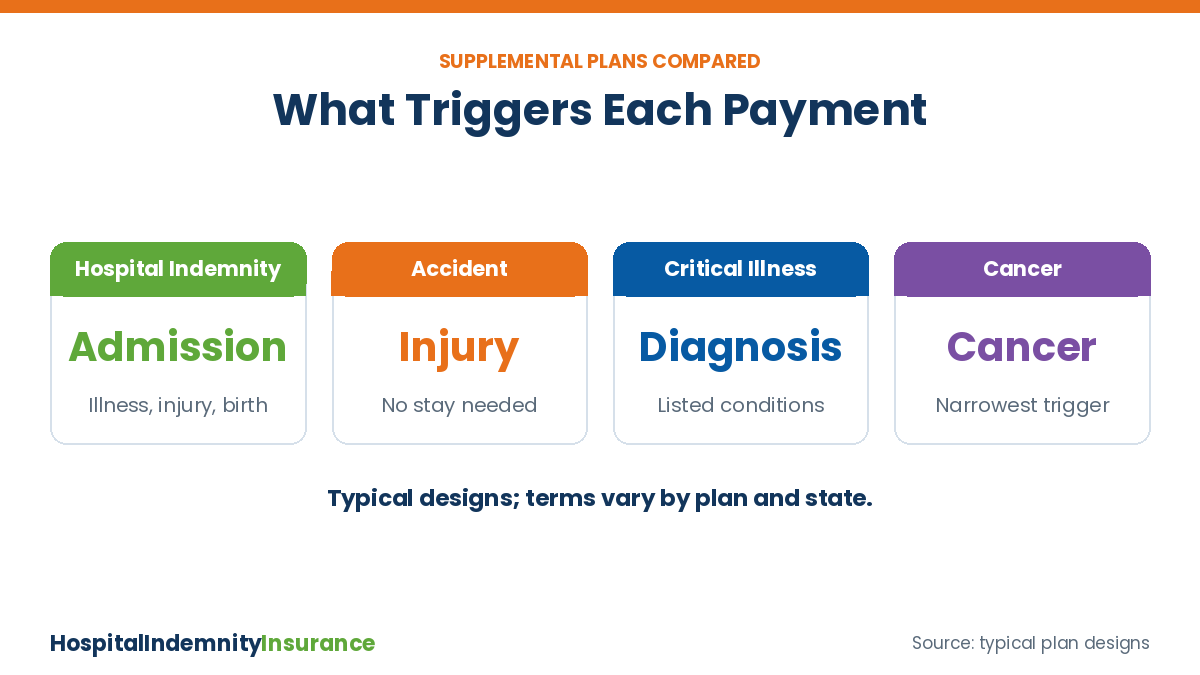
Is supplemental insurance worth it: what hospital indemnity, accident, critical illness and cancer plans each pay on

Every supplemental plan pays on a trigger, and the broader the trigger, the more ways you can collect. Hospital indemnity pays on an admission for almost any cause; the other three pay only when a narrower event happens.

Product Pays when How it pays Best fit Main catch
Hospital indemnity You are admitted for illness, injury or, on many plans, childbirth Set amount per admission and per day High deductibles, daily inpatient copays, pregnancy Usually nothing without an admission unless you add riders
Accident A covered injury from an accident Set amount per injury or treatment Active kids, contact sports, physical jobs Pays nothing for illness
Critical illness A covered diagnosis such as heart attack, stroke or cancer One lump sum, sometimes partial for less severe cases Family history, a breadwinner who cannot miss work Only listed conditions count
Cancer A cancer diagnosis or cancer treatment Lump sum and/or per-treatment amounts Strong family history of cancer Narrowest trigger of the four

Typical designs only. Benefits, definitions and limits vary by insurer, plan and state.

Know this first: All four are limited-benefit plans that pay fixed cash amounts. None of them is health insurance, none replaces your medical plan or Medicare, and none meets ACA minimum essential coverage.

Hospital Indemnity Quotes

Call a Licensed Agent Now

Compare hospital indemnity plans from several insurance companies in one call. Any age.

☎ 1-888-891-0229

No obligation to enroll

Households That Tend to Come Out Ahead

Value shows up where two things overlap: a real chance of the covered event and a real gap between your bills and your bank balance. The Federal Reserve’s 2025 household survey found that 63% of adults would cover a $400 surprise with cash or its equivalent, which means more than a third would not. A hospital deductible is usually far bigger than $400.

Families with kids in sports. Sprains, fractures and ER trips are common, and accident insurance pays even when no one is admitted.

HDHP and HSA holders with a thin cushion. For 2027, an HSA-eligible plan needs a deductible of at least $1,750 (self-only) or $3,500 (family). If your HSA balance is still small, a hospital indemnity check can bridge the gap. See hospital indemnity for high-deductible plans.

Anyone planning a pregnancy. A delivery is usually an admission, so hospital indemnity is the product that can pay for it, provided you enroll before any waiting period would block the claim.

Self-employed workers. No paid sick leave means a hospital stay costs you twice: the bill and the lost income.

Medicare Advantage members. Many Medicare Advantage plans charge a daily copay for the first several days of an inpatient stay, the per-day cost hospital indemnity is built to offset. See hospital indemnity with Medicare Advantage.

When Your Premium Does More Somewhere Else

Supplemental coverage is a bet on a specific event. For some households, the same monthly dollars work harder in savings or in broader coverage.

You can already absorb your out-of-pocket maximum. If your savings cover your plan’s yearly cap, which can reach $12,000 for self-only ACA-compliant coverage in 2027, a cash plan mostly duplicates protection you already have.

Your medical plan has very low cost sharing. Rich employer plans or Medicaid leave little gap for a fixed benefit to fill.

You are stacking narrow policies. Owning both critical illness and cancer coverage can mean paying twice for the same diagnosis while still having nothing for a pneumonia admission. Fill the broad gap first.

Payout vs. Premium: Loss Ratios and Workplace vs. Individual Pricing

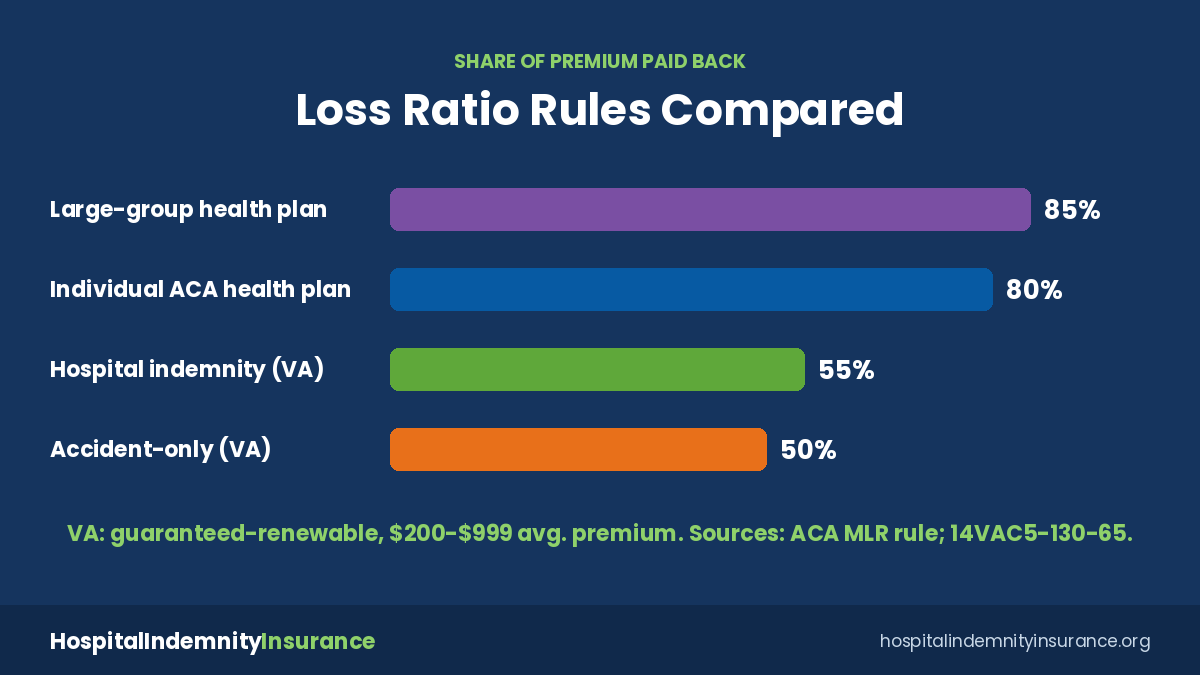
Is supplemental insurance worth it: ACA medical loss ratio rules vs Virginia supplemental loss ratio standards

A loss ratio is the share of premium an insurer expects to pay back as claims. ACA major medical plans must spend at least 80% (individual and small group) or 85% (large group) of premium on care and quality. Supplemental plans are excepted benefits, so that rule does not apply; many states set lower anticipated loss ratio standards for individual policies instead.

Virginia is one example. Its rules call for a 55% anticipated loss ratio on a guaranteed-renewable hospital confinement indemnity policy with an average annual premium of $200 to $999, and 50% for a guaranteed-renewable accident-only or specified disease policy in that range. In plain terms, buyers as a group may get back only about half of what they pay in, so these plans reward a real need, not buying just in case.

Pricing factor Workplace (group) plan Individual plan
Health questions Often few or none at first eligibility Varies; some plans ask, some do not
Price drivers Group rate set for the whole employee pool Your age, state, benefit level and who is covered
Choice The plan your employer picked Shop several insurers and benefit levels
If you leave May end; some plans are portable Stays while you pay premiums

General patterns only. Rates and terms vary by insurer, employer and state.

Look it up: Many states publish insurers’ rate filings through the public SERFF Filing Access system or the insurance department website. Filings for supplemental products often state the anticipated loss ratio, which tells you how much of the premium the insurer projects to pay back.

See Hospital Indemnity Prices for Your ZIP Code

Fine Print That Decides Whether You Collect

Two plans with the same price can pay very differently. Check these terms for each product before you sign. For the two diagnosis-based plans, see cancer insurance vs critical illness.

Term to check What to look for
Waiting period Critical illness and cancer plans often wait before a diagnosis counts; some hospital plans wait on sickness or childbirth.
Pre-existing condition limit Many individual plans will not pay for a condition treated or diagnosed shortly before coverage started, for a set time after it starts.
Observation stays Some hospital indemnity plans pay nothing for a night under observation because it is not an inpatient admission.
Condition list Critical illness pays only for listed diagnoses; a partial benefit may apply to early-stage cancer.
On-the-job injuries Some accident plans cover off-the-job injuries only.

Exact rules are in the policy or certificate and the outline of coverage.

A Five-Step Way to Decide

1

Write down your gap. Find your deductible and out-of-pocket maximum, then subtract what you could pay from savings today. No gap means little need.

2

Match the gap to a trigger. Ask which event is most likely to open that gap for your household: an admission, an injury or a serious diagnosis.

3

Start broad. Hospital indemnity pays on the widest trigger, so price it first. Add accident or critical illness insurance only for a specific risk.

4

Price one claim against a year of premium. Add the admission benefit to a few days of daily benefit and compare it with 12 months of premium.

5

Compare workplace and individual quotes. Check the same benefit level both ways, including the waiting period and pre-existing terms.

Quick check: A plan earns its keep when one likely claim would replace several years of premiums and cover a bill you could not otherwise pay. If neither is true, savings are usually the better tool.

Bottom Line

Supplemental insurance is worth it when a likely event would leave a bill you cannot cover from savings. Start with hospital indemnity, the broadest trigger, add accident, critical illness or cancer coverage only for a specific risk, and remember none of these plans replaces health insurance.

Get Free Hospital Indemnity and Supplemental Quotes

Is Supplemental Insurance Worth It — Frequently Asked Questions

➤ Is supplemental insurance worth it?

It is worth it if a hospital stay, injury or diagnosis would leave you with costs you could not pay from savings. If you can already cover your out-of-pocket maximum, the value is usually small.

➤ Which supplemental plan should I buy first?

For most people, hospital indemnity, because it pays on an admission for nearly any cause. Add the narrower plans only for a specific risk.

➤ Is supplemental health insurance the same as a Medicare Supplement plan?

No. A Medicare Supplement (Medigap) plan pays part of your Original Medicare bills. Supplemental health plans like hospital indemnity pay you fixed cash and work with many kinds of coverage, including Medicare Advantage.

➤ Will supplemental insurance affect my HSA?

Generally no. Federal rules treat accident coverage, specified disease coverage and fixed per-day hospital coverage as permitted insurance, so they do not by themselves end HSA eligibility.

➤ What is a loss ratio on a supplemental plan?

It is the share of premium an insurer expects to pay out in claims. Many states set minimum anticipated loss ratios for individual supplemental policies, often in the 50% to 60% range depending on the product and premium.

➤ Is supplemental insurance cheaper through work?

Sometimes. Group plans often skip health questions at first eligibility, but an individual quote can cost less at some ages and lets you shop several insurers.

➤ Can I carry hospital indemnity, accident and critical illness together?

Yes. They pay on different triggers, so one serious event can trigger more than one. Avoid paying twice for the same narrow risk.

➤ Should I drop a supplemental plan if I never file a claim?

Not automatically. Check whether your savings now cover your deductible. Dropping and rebuying later can restart waiting periods and pre-existing limits.

Hospital Indemnity Quotes

Call a Licensed Agent Now

Compare hospital indemnity plans from several insurance companies in one call. Any age.

☎ 1-888-891-0229

No obligation to enroll

Find & Compare Plans Online

Speak with a licensed insurance agent

1-888-891-0229

ZRN Health & Financial Services, LLC, a Texas limited liability company