





Speak with a licensed insurance agent

1-888-891-0229

MetLife Hospital Indemnity Insurance: The Employer Plan, Explained

Reviewed by Russell Noga, Licensed Insurance Agent — Last updated November 22, 2026

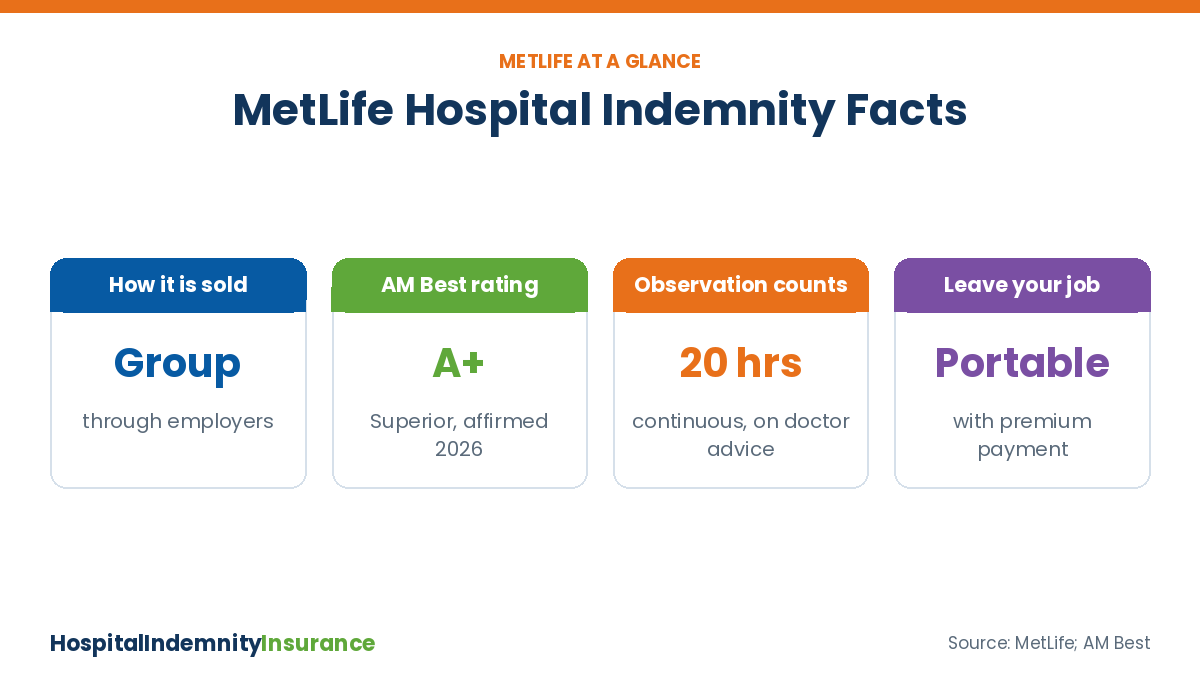
MetLife hospital indemnity insurance is a group plan you get through an employer: Metropolitan Life Insurance Company pays you a set cash amount when you are admitted to a hospital, plus a daily amount while you stay. Your employer picks the benefit amounts, you pay the premium at work, and the coverage can usually be kept if you leave the job.

2027 by the Numbers

A+

AM Best financial strength rating for Metropolitan Life Insurance Company, affirmed 2026 (AM Best)

20 hours

observation time MetLife counts as a hospital confinement (MetLife)

90 days

readmission window with no second admission benefit for the same cause (MetLife plan summaries)

If you searched for MetLife hospital indemnity, you probably saw it on a benefits enrollment screen at work. That is where nearly all of it is sold. MetLife describes the product as a limited benefit group insurance policy, and its consumer pages tell readers to get rates by enrolling through work rather than offering a public quote tool.

This hub explains who issues the plan, how its benefits fit together, what three published employer designs actually pay, the rules that reduce a payout, and what happens to the coverage when you change jobs. Deeper topics have their own pages, such as the MetLife hospital indemnity payout chart. One rule applies everywhere: this is a fixed cash, limited-benefit plan. It is not health insurance, does not replace a medical plan and does not count as ACA minimum essential coverage.
Compare Hospital Indemnity Plans Available Where You Live

Who Issues MetLife Hospital Indemnity and Who Can Buy It

MetLife hospital indemnity insurance key facts: group plan, A+ AM Best rating, 20-hour observation rule, portable coverage

The insurer on the certificate is Metropolitan Life Insurance Company of New York, New York. MetLife’s employer pages list the group policy forms behind the product, including GPNP13-HI and GPNP16-HI, and note that some states are still pending approval for certain versions. MetLife calls itself the largest nonmedical commercial benefits carrier in the U.S., which explains why its hospital coverage shows up so often in workplace enrollment.

Sold through work. An employer, union, university, public agency or PEO sets up a group policy. Employees and eligible family members join during enrollment.

No retail version found. MetLife’s public pages describe only group coverage. We found no individual MetLife hospital indemnity policy offered for direct purchase.

Not a Brighthouse product. MetLife’s U.S. retail life and annuity business became Brighthouse Financial, which completed its separation on August 4, 2017. Brighthouse sells annuities and life insurance, not hospital indemnity.

Good to know: Because each employer negotiates its own group, two coworkers at different companies can both have MetLife hospital indemnity with different benefit amounts, day limits and premiums. The plan summary from your own employer is the only reliable source for your numbers.

Hospital Indemnity Quotes

Call a Licensed Agent Now

Compare hospital indemnity plans from several insurance companies in one call. Any age.

☎ 1-888-891-0229

No obligation to enroll

How the MetLife Hospital Indemnity Benefits Fit Together

MetLife builds each plan from a short list of benefit lines. An employer chooses which lines to include and the dollar amount for each. All payments go to the covered person, by check or electronic transfer, and can be spent on anything.

Admission benefit. A lump sum when you are admitted as an inpatient for a covered sickness or injury. Plans cap how many admissions pay per year or per cause.

Daily confinement benefit. A fixed amount for each day you remain in the hospital. Some designs start this on day two when an admission benefit is paid.

ICU supplemental benefits. An extra admission payment and an extra daily amount when the stay includes intensive care, paid on top of the base lines.

Add-on lines. Depending on the employer: inpatient rehab days, newborn nursery days for a healthy baby, and in some plans a yearly health screening benefit.

MetLife counts a stay as a confinement when you are given an inpatient bed on a doctor’s advice, or when you are kept in observation for at least 20 continuous hours. Emergency room visits and outpatient treatment do not trigger the admission benefit, and nursing homes, convalescent care and extended care facilities are not hospitals under the plan.

Three Published MetLife Plan Designs, Side by Side

To show how much designs differ, we lined up three employer plan summaries posted on MetLife and university websites. No single source compares them; the table below is our own side-by-side from those filed documents.

Benefit line IBM 2026 (Low / High) Univ. System of New Hampshire 2026 Carnegie Mellon University
Admission $1,000 / $2,000, 5 times a year $500, up to 4 times a year $1,000, once per sickness or injury
Daily confinement $100 / $120, up to 31 days a year $100, up to 365 days per confinement $100, up to 365 days a year
ICU admission add-on $1,000 / $2,000 $500 $1,000
ICU daily add-on $100 / $120, up to 31 days $100, up to 31 days $100, up to 90 days
Inpatient rehab $100 / $200, 15 days a year $100, 30 days a year $100, 15 days a year
Newborn nursery $100 / $200, 3 days Healthy newborn covered $100, 3 days
Health screening Not listed Not listed $50 once a year

Source: each employer’s MetLife hospital indemnity plan summary (IBM 07/2026; USNH 2026; CMU). Amounts are examples of group designs, not quotes, and vary by employer and state.

Pattern to notice: The biggest differences are not the headline admission amounts but the limits: one plan pays daily benefits for up to 31 days a year, another for up to 365 days per confinement. A long stay can pay several times more under the second design.

Many employers offer two levels of the same design. The trade-offs between them are covered in MetLife hospital indemnity low vs high, and typical payroll rates are on the MetLife hospital indemnity insurance cost page.

Fine-Print Rules That Can Shrink a MetLife Hospital Indemnity Claim

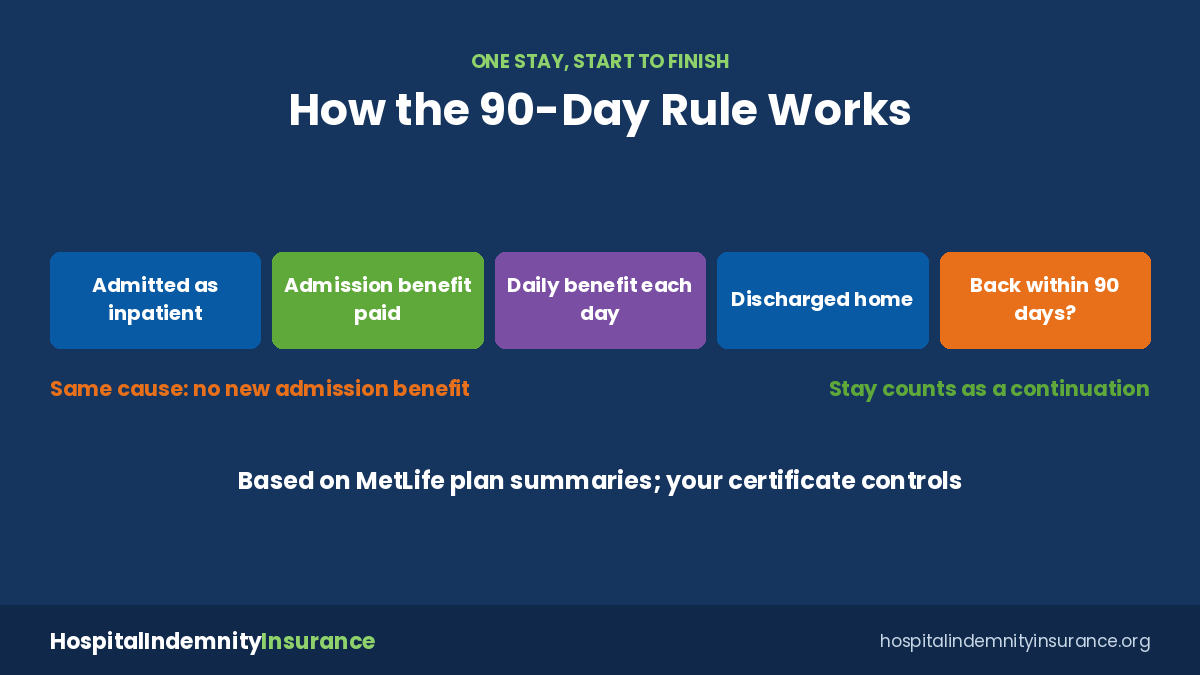
MetLife hospital indemnity insurance claim timeline showing admission, daily benefit and the 90-day readmission rule

MetLife’s own disclosures list several conditions that apply across its group plans. Each one is worth checking in your certificate before you count on a payment.

Rule What MetLife’s documents say Why it matters
Pre-existing condition limit May apply to hospital sickness benefits A stay for a condition treated before coverage began may not pay at first
Age 65 reduction Benefits may be reduced beginning at age 65 Older workers and spouses may receive less per event
Prior confinement May be required for certain benefits Rehab-type lines can depend on an earlier inpatient stay
Readmission No new admission benefit within 90 days for the same or a related cause A return trip is treated as a continuation of the first stay
Medical coverage Some states require you to have medical coverage to enroll The plan sits on top of health insurance, not in place of it

Sources: MetLife hospital indemnity product and enrollment pages; employer plan summaries. Your certificate controls.

Pregnancy is the area where the pre-existing wording draws the most questions, because the timing of conception relative to the coverage start date can matter. The MetLife hospital indemnity pregnancy coverage guide walks through it, and the full list of excluded causes is on the MetLife hospital indemnity exclusions page.

No MetLife Plan at Work? See Individual Options by ZIP Code

Taking MetLife Hospital Indemnity With You When You Leave a Job

Portability is one of the stronger features of the MetLife design. The certificate includes a provision called Continuation of Insurance with Premium Payment, which lets a covered employee keep the plan after a job change, subject to eligibility rules and limits.

Same benefits continue. Plan summaries say coverage carries on as long as you keep paying the premium, now billed to you directly instead of through payroll.

When it ends. Continued coverage stops if premiums stop, or if the employer cancels the group policy and replaces it with similar coverage from another insurer.

Act quickly. Continuation has to be requested within a limited window after employment ends; the exact deadline is in your certificate.

Before you resign: Ask the benefits office for the continuation form and the direct-bill premium. Payroll rates and direct-bill rates are not always the same, and missing the request window usually means the coverage simply ends.

How to Enroll in MetLife Hospital Indemnity at Work

1

Find your plan summary. Many employers have a MetLife benefits page or a document in the HR portal listing the benefit lines, limits and payroll rates.

2

Pick a level and a tier. Choose Low or High if both are offered, then cover yourself, a spouse, children or the whole family.

3

Enroll at the right time. Sign up during annual open enrollment, when first eligible as a new hire, or after a qualifying life event your employer recognizes.

4

Meet the at-work rule. Acceptance is guaranteed with no health questions or exam, as long as you are actively at work and dependents meet the plan’s conditions.

5

Know the claim steps. One claim form covers each accident or illness. MetLife says clean claims are generally processed within 10 business days.

Working adults with a high-deductible plan, parents expecting a hospital birth and older employees all buy this coverage, but the math differs for each. If your employer does not offer MetLife, individual hospital indemnity plans from other insurers are sold in most states, including to self-employed people and seniors on Medicare Advantage.

Bottom Line

MetLife hospital indemnity is a workplace benefit from an A+ rated insurer that pays you fixed cash for hospital stays. Your employer’s design sets the real value, so compare the day limits, the pre-existing wording and the age 65 rule before choosing a level, and keep your medical plan in place.

Get Free Hospital Indemnity Quotes From Several Insurers

MetLife Hospital Indemnity Insurance — Frequently Asked Questions

➤ Can I buy MetLife hospital indemnity on my own without an employer?

MetLife’s public pages describe only group coverage offered through employers and similar organizations, and we found no individual retail version. If you have no access through work, other insurers sell individual hospital indemnity plans.

➤ Is MetLife hospital indemnity sold by Brighthouse Financial?

No. Brighthouse Financial is the former MetLife U.S. retail unit that became independent in August 2017, and it focuses on annuities and life insurance. MetLife’s hospital indemnity is issued by Metropolitan Life Insurance Company.

➤ Does MetLife hospital indemnity pay for an observation stay?

It can. MetLife counts observation of at least 20 continuous hours on a doctor’s advice as a confinement. Shorter observation periods, ER visits and outpatient care do not trigger the admission benefit.

➤ Is there a waiting period on MetLife hospital indemnity?

MetLife’s product page says there is no waiting period, but a pre-existing condition limitation may apply to hospital sickness benefits. Check your certificate for the look-back and limitation periods.

➤ Who underwrites MetLife hospital indemnity and how strong is it?

Metropolitan Life Insurance Company underwrites it. AM Best affirmed its financial strength rating of A+ (Superior) with a stable outlook in 2026.

➤ Do MetLife hospital indemnity benefits change at 65?

They may. MetLife’s disclosures state that benefits may be reduced beginning at age 65, so older employees and spouses should read the reduction schedule in the certificate.

➤ Can I use MetLife hospital indemnity with a high-deductible health plan?

Yes. It pays cash on top of whatever your medical plan pays, which can help with a deductible. Some states require enrollees to have medical coverage, and the plan is not ACA minimum essential coverage.

➤ How do I get paid after a MetLife hospital indemnity claim?

You file one claim form per accident or illness, and payment goes to you by check or electronic transfer. MetLife says clean claims are generally processed within 10 business days.

Hospital Indemnity Quotes

Call a Licensed Agent Now

Compare hospital indemnity plans from several insurance companies in one call. Any age.

☎ 1-888-891-0229

No obligation to enroll

Find & Compare Plans Online

Speak with a licensed insurance agent

1-888-891-0229

ZRN Health & Financial Services, LLC, a Texas limited liability company