





Speak with a licensed insurance agent

1-888-891-0229

How Much Is an ER Visit Without Insurance? Typical Bills, Fees and Ways to Pay Less

Reviewed by Russell Noga, Licensed Insurance Agent — Last updated November 1, 2026

An ER visit without insurance usually costs from about $1,000 to more than $3,000: Peterson-KFF found the middle half of emergency room visits cost between $970 and $3,043 in 2019, with an average of $2,453. Those figures reflect discounted rates insurers paid, and uninsured patients are often billed the hospital’s higher list price, so a visit with scans, lab work or an ambulance ride can run well past that average.

2027 by the Numbers

$2,453

average total cost of an ER visit, 2019 (Peterson-KFF)

$3,043+

cost of the priciest one in four ER visits (Peterson-KFF)

$713

average ER facility fee in 2021, up from $113 in 2004 (Peterson-KFF)

20%

share of ER facility claims coded level 5 in 2021, up from 5% (Peterson-KFF)

Emergency rooms rarely post one price. Two people with the same sprained ankle can get bills hundreds of dollars apart, depending on the hospital, the level the visit is coded at and the tests run. Without an insurer negotiating for you, the starting point is the hospital’s full list price.

Below, the emergency room visit cost without insurance is broken down line by line, along with federal rules that can shrink the bill afterward. For people with a large deductible, it also shows what several insurers’ hospital indemnity insurance plans actually pay for an ER trip.
Compare Hospital Indemnity Plans With ER Benefits

Two Bills, Five Levels: How an ER Charge Is Built

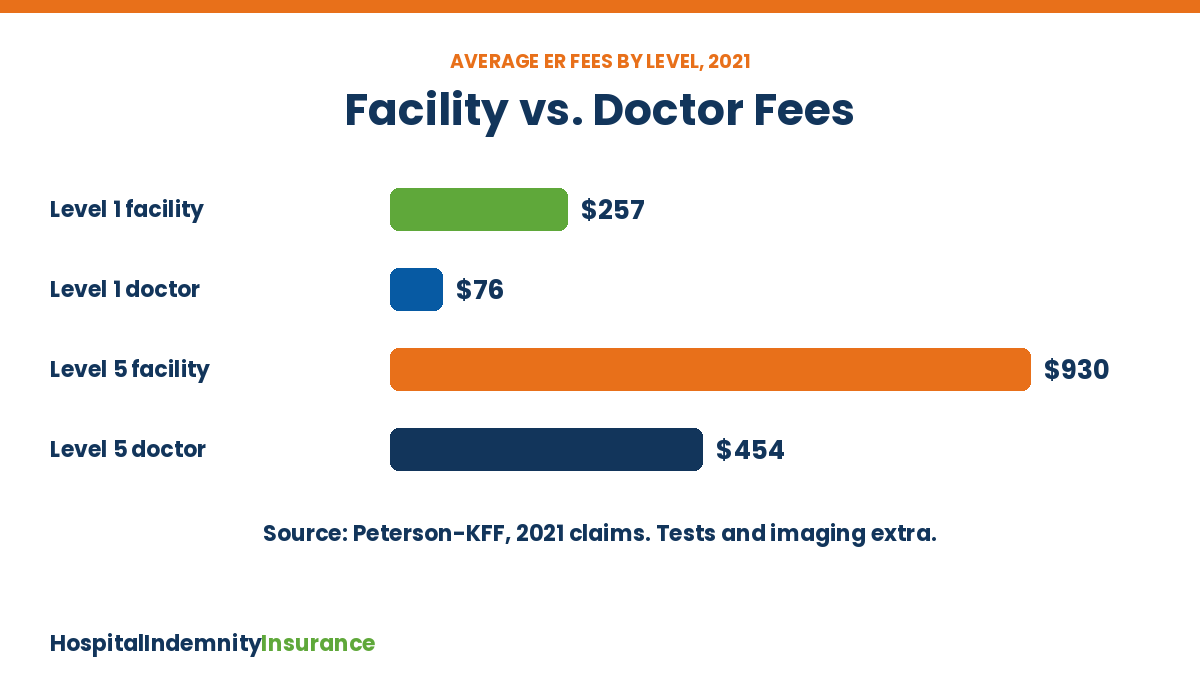
How much is an ER visit without insurance: average facility and doctor fees at ER level 1 and level 5

Most emergency visits produce two charges: a hospital facility fee for keeping the ER staffed around the clock, and a professional fee from the emergency physician, often billed by a separate group. Both use a five-level scale, from level 1 (simple) to level 5 (complex or life-threatening).

ER charge Level 1 (least complex) Level 5 (most complex)
Facility fee, average $257 $930
Physician fee, average $76 $454
Both together About $333 About $1,384

Source: Peterson-KFF Health System Tracker analysis of 2021 large-employer claims. Amounts paid by insurers and patients, not list prices; tests, imaging, medicine and ambulance are extra.

Tests and imaging. Blood work, X-rays and CT scans are separate lines and can outweigh the visit fees.

Medicine and supplies. IV fluids, injections, splints and stitches are usually billed one by one.

Ambulance. Billed by the ambulance service as its own bill.

Hospital Indemnity Quotes

Call a Licensed Agent Now

Compare hospital indemnity plans from several insurance companies in one call. Any age.

☎ 1-888-891-0229

No obligation to enroll

Average Emergency Room Visit Cost Without Insurance

The most cited national figures come from Peterson-KFF’s study of 2019 large-employer claims. They reflect negotiated rates, so treat them as a floor for an uninsured patient, not a ceiling.

Share of ER visits Total cost per visit (2019)
Least expensive 25% $970 or less
Average visit $2,453
Most expensive 25% $3,043 or more
Patient share for insured enrollees $646 on average

Source: Peterson-KFF Health System Tracker, Merative MarketScan 2019 data. Excludes any hospital stay that followed the ER visit.

Coding has pushed prices up too. From 2004 to 2021, level 5 facility claims rose from 5% to 20% of the total, and level 4 claims nearly doubled from 18% to 35%. One level higher can add hundreds of dollars, so the level is one of the first lines on the bill worth questioning.

Worth knowing: If the ER visit turns into an admission, daily room charges begin and the bill becomes an inpatient bill.

Per-day figures for that case are on the overnight hospital stay cost page.

Hospital ER vs. Freestanding ER vs. Urgent Care

A freestanding ER can look like an urgent care clinic from the parking lot, but it is licensed as an emergency facility and typically bills emergency-level facility fees.

Setting Facility fee? Open 24/7? Best for
Hospital ER Yes, by level 1 to 5 Yes Chest pain, stroke signs, severe injury, trouble breathing
Freestanding ER Usually yes, at ER rates Yes Emergencies when no hospital is close
Urgent care Usually no ER facility fee Extended hours Minor cuts, sprains, fevers, ear or urinary infections

Pricing varies by facility and state. Texas law requires freestanding ERs to post a notice that they charge rates comparable to a hospital emergency room and may charge a facility fee.

Before you drive: Chest pain, stroke symptoms, heavy bleeding or a serious head injury belong in the ER regardless of cost. Federal law (EMTALA) requires hospital ERs to screen and stabilize anyone with an emergency.

Rules That Can Shrink an Uninsured ER Bill

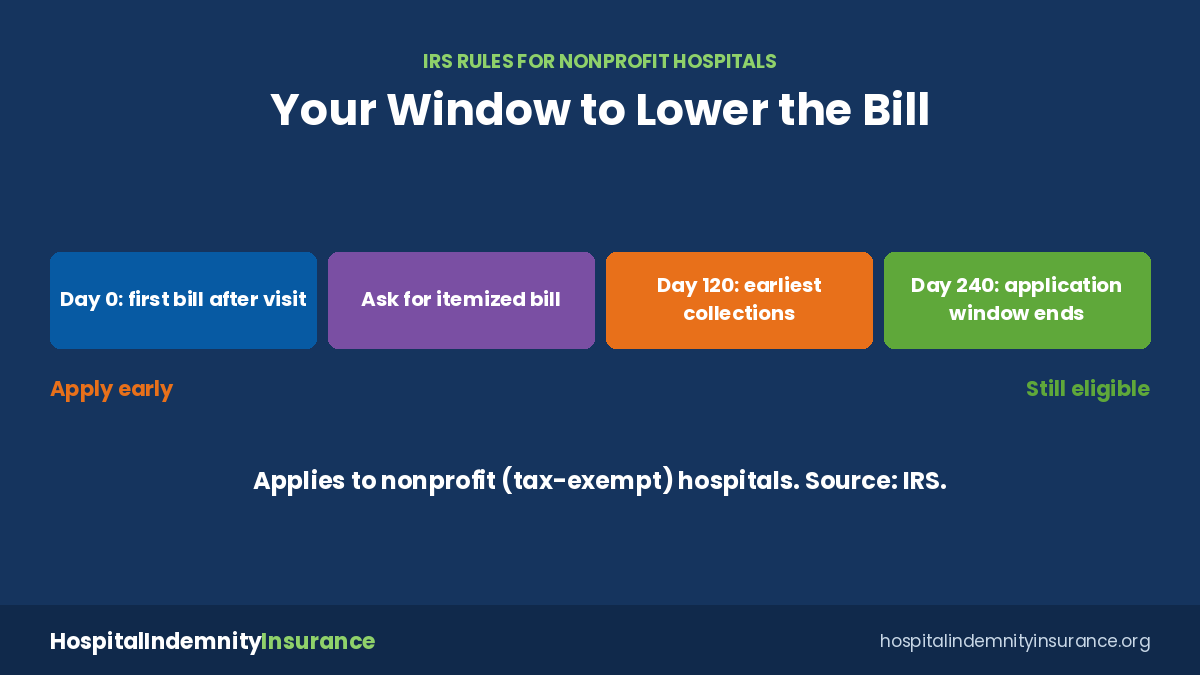
Nonprofit hospital financial assistance timeline for an uninsured ER visit cost: 120 and 240 day rules

The first total on an uninsured bill is rarely final. Several federal rules leave room to lower it, each with a clock or condition attached.

1

Get the line-item version. The itemized version shows each code, including the ER level. Compare the level with what actually happened.

2

Look up the hospital’s own prices. Federal price transparency rules require hospitals to post a machine-readable file of standard charges, including gross list prices and any discounted cash price. Ask billing to match the posted cash price.

3

Apply for financial assistance, even after billing. Under IRS Section 501(r), a nonprofit hospital cannot charge a patient who qualifies for its assistance policy more than the amounts generally billed to insured patients for emergency care.

4

Watch the 120 and 240 day marks. A nonprofit hospital must wait at least 120 days after the first post-discharge bill before extraordinary collection actions, and must accept assistance applications for 240 days from that bill.

5

Do not count on a Good Faith Estimate. The No Surprises Act estimate for self-pay patients covers care scheduled at least 3 business days ahead. Federal guidance says emergency services are generally not part of it.

Each hospital sets its own income limits for assistance, so applying is worth it even if you assume you earn too much. For other charges that commonly slip past coverage, see common hospital expenses not covered by insurance.

See ER Benefit Options in Your ZIP Code

If You Have a High Deductible: What Hospital Indemnity Pays for an ER Trip

Insured people pay the full negotiated ER price until they meet their deductible. Some hospital indemnity plans pay fixed cash for an ER visit; many pay only after an admission. The table compiles what insurers’ own brochures and plan summaries list.

Insurer and plan ER visit benefit Yearly limit or catch
Aflac individual hospital policy (B40100 series) $100 per ER treatment 2 times a year per covered person
LifeSecure hospital indemnity, ER and Ambulance rider $150 per day Up to 2 days a year; optional rider
ManhattanLife Hospital Indemnity Select $150 per treatment in an ER or urgent care Injuries only; up to 6 days a year
MetLife group hospital indemnity (state employer plan) $0 for ER treatment alone Pays only after admission or 20+ hours of observation
Cigna individual hospital indemnity No stand-alone ER benefit listed Ambulance and outpatient X-ray riders available in some states

Compiled by HospitalIndemnityInsurance.org from each insurer’s brochure, outline of coverage or employer plan summary. Benefits, riders and availability vary by state and plan version.

Key limit: Hospital indemnity is a limited-benefit plan that pays fixed cash amounts. It is not health insurance, does not count as ACA minimum essential coverage and cannot replace a health plan for someone who is uninsured.

A $100 to $150 ER benefit will not cover a $2,000 visit, but paired with a high-deductible health plan it can offset part of the deductible, and admission benefits pay far more if the visit leads to a stay. The full rundown of covered and excluded ER scenarios is on does hospital indemnity cover ER visits.

Sizing an ER Benefit Against Your Own Risk

Count your likely visits. A household expecting more than one ER trip a year gets more from a higher yearly cap.

Check sickness vs. injury. Some ER benefits pay only for accidents, not a fever or kidney stone.

Know your deductible. With a low deductible, a small ER benefit adds little.

Compare the premium. Weigh a year of premiums against the most the benefit could pay.

Working adults, parents, self-employed people and Medicare Advantage members all buy these plans. For anyone with no health coverage, major medical comes first; an indemnity plan is a supplement, not a substitute.

Bottom Line

An ER visit without insurance usually runs from about $1,000 to more than $3,000, and complex visits cost far more. Get the itemized bill, check the ER level, compare it with the posted cash price and apply for assistance within 240 days. With a high-deductible plan, an ER benefit adds fixed cash but never replaces health insurance.

Related: how much does an ambulance cost Ground and air ambulance prices, surprise-bill rules and cash benefits that help.

Get Free Hospital Indemnity Insurance Quotes

ER Visit Cost Without Insurance — Frequently Asked Questions

➤ How much does an ER visit cost on average?

Peterson-KFF put the average at $2,453 in 2019, based on what insurers and patients paid. Uninsured patients may be billed more, starting from list price.

➤ Why is the ER facility fee so high?

It pays for keeping emergency staff and equipment ready around the clock. The average reached $713 in 2021, more than six times the 2004 level, per Peterson-KFF.

➤ What does ER level 5 mean on my bill?

It is the highest of five complexity codes and usually means a severe or complicated problem. In 2021, the average level 5 facility fee was $930, compared with $257 at level 1.

➤ Is a freestanding ER cheaper than a hospital ER?

Usually not. Freestanding ERs are licensed as emergency facilities and typically charge ER-level facility fees, and Texas requires them to post a notice saying so.

➤ Can a hospital give me a price before treating my emergency?

Generally no. Good Faith Estimates for self-pay patients apply to care scheduled at least 3 business days ahead, and emergency services are generally outside that requirement.

➤ How long do I have to ask for financial help with an ER bill?

At a nonprofit hospital, at least 240 days from the first post-visit bill, and extraordinary collection actions cannot start for at least 120 days.

➤ Will hospital indemnity pay my ER bill if I have no insurance?

Some plans pay a fixed amount, such as $100 to $150 per ER visit in the plans compared above, far below a typical bill. Hospital indemnity is not health insurance and does not meet ACA minimum essential coverage.

➤ Does an ER benefit pay for illness or only injuries?

It depends on the plan. Aflac’s individual policy pays for a covered sickness or injury, while ManhattanLife’s Hospital Indemnity Select lists its ER benefit for injuries only.

Hospital Indemnity Quotes

Call a Licensed Agent Now

Compare hospital indemnity plans from several insurance companies in one call. Any age.

☎ 1-888-891-0229

No obligation to enroll

Find & Compare Plans Online

Speak with a licensed insurance agent

1-888-891-0229

ZRN Health & Financial Services, LLC, a Texas limited liability company