





Speak with a licensed insurance agent

1-888-891-0229

Fixed Indemnity Health Insurance: How a Fixed Indemnity Plan Pays, the Federal Rules and How to Buy One Safely

Reviewed by Russell Noga, Licensed Insurance Agent — Last updated November 5, 2026

Fixed indemnity health insurance is a limited-benefit plan that pays you a preset cash amount, such as a daily hospital benefit of $100 to $1,000, no matter how large or small the actual bill is. It is not health insurance in the ACA sense and is not minimum essential coverage, so it belongs alongside a major medical, employer, Marketplace or Medicare Advantage plan; carriers such as ManhattanLife, LifeSecure and Mutual of Omaha sell individual versions, and many employers offer one as a voluntary benefit.

2027 by the Numbers

$100–$1,000

daily hospital benefit choices, Mutual of Omaha Hospital Protection (2025 launch)

12 months

pre-existing condition wait, ManhattanLife Hospital Indemnity Select policy

Dec. 4, 2024

date a federal court vacated the 2024 fixed indemnity notice (E.D. Texas)

With a fixed indemnity plan, the payout is set in the policy before you ever get sick, and the hospital’s charges never change it. A $200-a-day policy pays $200 a day whether the room costs $2,000 or $9,000.

That helps with deductibles and lost income, and hurts when someone mistakes it for real coverage. Below: the federal rules, where the 2024 notice rule stands, three insurers’ filed terms and how to shop safely. For the basics of the most common type, see hospital confinement indemnity insurance.
Compare Fixed Indemnity Plans in Your Area

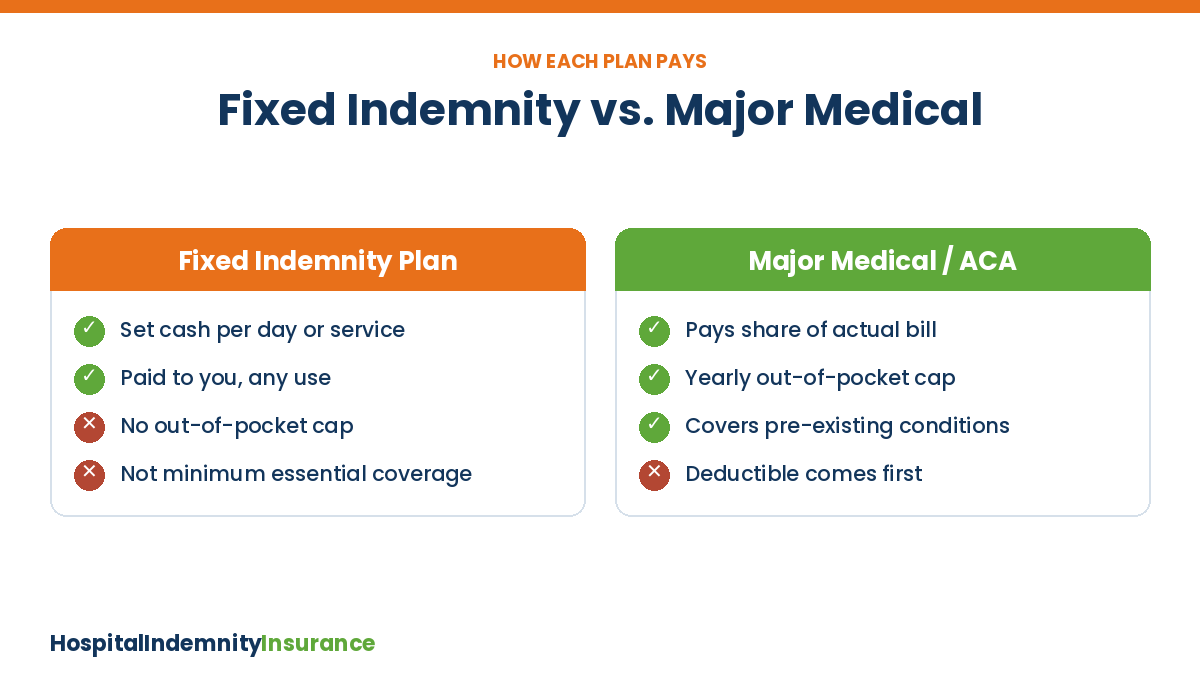
Fixed Indemnity vs. Major Medical: Same Stay, Two Different Checks

Fixed indemnity health insurance compared with major medical coverage: cash per day vs. share of the bill

Major medical coverage pays a share of the provider’s bill after your deductible, and an ACA plan caps what you owe in a year. A fixed indemnity plan pays a dollar amount listed in the policy, usually to you rather than the hospital, and stops at its own day or dollar limits.

Feature Fixed indemnity plan ACA or major medical plan
What sets the payment Amount written in the policy The actual bill and your plan’s cost sharing
Who gets paid Usually you, in cash Usually the doctor or hospital
Out-of-pocket maximum None; you owe what the benefit doesn’t cover Yes, a yearly cap on in-network costs
Pre-existing conditions Can be excluded for a set period Must be covered
Counts as minimum essential coverage No Yes
When you can buy Often any time of year Open enrollment or a special enrollment period

Fixed indemnity is a federal excepted benefit, so core ACA rules do not apply to it.

Hospital Indemnity Quotes

Call a Licensed Agent Now

Compare hospital indemnity plans from several insurance companies in one call. Any age.

☎ 1-888-891-0229

No obligation to enroll

Types of Fixed Indemnity Coverage: Hospital Confinement Is Just One

Federal excepted-benefit rules describe hospital or other fixed indemnity insurance as paying a fixed dollar amount per day or other period of hospitalization or illness, regardless of the expenses incurred. Carriers build several products on that frame.

Hospital confinement indemnity. Pays per day you are admitted, sometimes plus a lump sum at admission. The most common fixed indemnity design.

Hospital and doctor indemnity. Adds set amounts for office visits, tests or outpatient care, sold mostly in the individual market.

Accident and sickness plans. Bundle hospital days with injury or illness benefits; see the accident and sickness hospital indemnity plan guide.

Lump-sum diagnosis policies. Cancer and critical illness plans pay once per diagnosis and were not covered by the 2024 per-day notice rule.

Federal Fixed Indemnity Rules: What Stands and What Was Struck Down

In March 2024, the Departments of Health and Human Services, Labor and the Treasury finalized a new fixed indemnity consumer notice for plan years starting January 1, 2025. Insurers sued, leaving a patchwork.

Rule or event Date Status now
2014 HHS notice for individual policies 2014 Still required; a court left it in force
Requirement that buyers already have minimum essential coverage 2014 Struck down by the D.C. Circuit in 2016
2024 group and individual notice (14-point font) Final rule March 28, 2024 Vacated December 4, 2024 by the Eastern District of Texas
Federal appeal of that decision Filed February 2025 Dismissed at the agencies’ request June 10, 2025
Proposed tax change for employer fixed indemnity payments Proposed 2023 Not finalized in the 2024 rule
Short-term plan limits from the same 2024 rule Effective September 1, 2024 Agencies said August 7, 2025 they will not prioritize enforcement pending new rulemaking

Case: ManhattanLife Insurance and Annuity Co. v. HHS, No. 6:24-cv-00178. Status as of November 2026; check for new federal rulemaking before relying on it.

State layer: States can still require their own wording. Colorado Bulletin B-4.143 (December 12, 2024) requires a Colorado notice in at least 14-point font, shown before the federal notice, stating the policy is a fixed indemnity policy and not comprehensive coverage.

Fixed Indemnity Plan Terms Compared: Three Insurers' Filed Documents

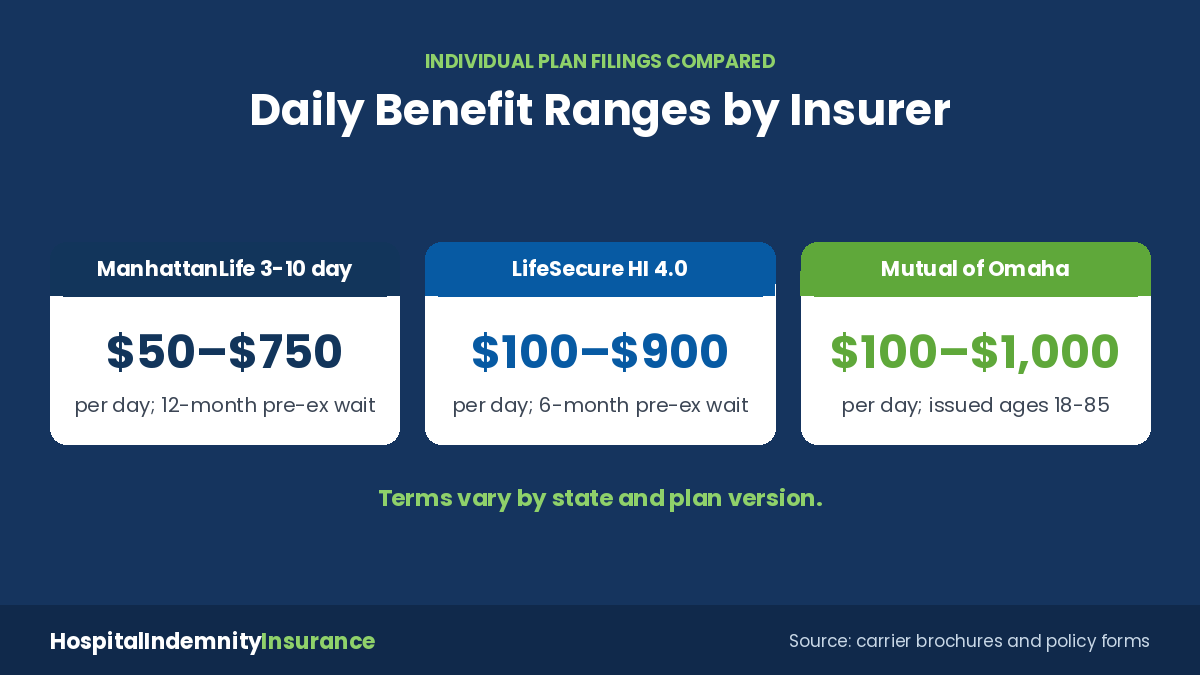
Fixed indemnity plan daily hospital benefit and pre-existing rules at ManhattanLife, LifeSecure and Mutual of Omaha

Daily amounts, day limits and pre-existing rules differ more between carriers than quote pages show. Here are individual-market terms from each insurer’s own documents.

Insurer and plan Daily hospital benefit Issue ages Pre-existing condition rule
ManhattanLife Hospital Indemnity Select (form AN7003) 1-day plan $50 to $10,000 (ages 18 to 64½); 3, 6 or 10-day plans $50 to $750 a day (64½ to 89) 18 to 89; guaranteed issue 64½ to 70 Not covered until insured 12 months in a row; an existing pregnancy counts as pre-existing
LifeSecure Hospital Indemnity 4.0 (Idaho individual brochure) $100 to $900 a day in $10 steps; 3, 6, 10 or 21 days per confinement 18 to 85 Not covered unless care begins more than 6 months after the effective date
Mutual of Omaha Hospital Protection (launched August 2025) $100 to $1,000 a day in $10 steps 18 to 85; guaranteed issue 64 to 74 Not stated in launch materials; check the outline of coverage

Compiled by HospitalIndemnityInsurance.org from ManhattanLife brochure HIS-BR 1024 and policy HIS-RTI 0725, LifeSecure brochure LS-HI4, and Mutual of Omaha launch materials. Terms vary by state and version.

The gaps matter. A buyer with a recent diagnosis waits half as long under the LifeSecure design as under ManhattanLife’s, and the same $300 daily benefit can stop after 3 days or run 21 depending on the day limit chosen. Our guide to hospital indemnity and pre-existing conditions explains lookback periods.

See Fixed Indemnity Options by ZIP Code

The Risk of a Fixed Indemnity Plan Sold as Health Insurance

Because the 2024 federal notice is gone, the clearest warning label many group buyers see is whatever the insurer or state requires. A 2020 Brookings Institution analysis described a Texas man who faced about $67,000 in hospital bills after a heart attack while his employer’s fixed indemnity plan paid about $400.

Cheap health insurance, any time. A plan pitched that way with no open enrollment is often an excepted benefit.

No out-of-pocket cap. ACA plans list a yearly maximum. Fixed indemnity has none.

Per-service payouts. A schedule of $50 a visit means you pay the rest of each bill.

Health questions or a pre-existing clause. ACA plans cannot use either to limit coverage.

Plain fact: A fixed indemnity plan is not health insurance, does not replace it and does not meet ACA minimum essential coverage. Anyone without major medical coverage should start with a Marketplace, employer, Medicaid or Medicare plan.

Who Uses Fixed Indemnity Coverage and How to Buy It Safely

Buyers span every age: workers with a high-deductible health plan, parents expecting a birth, self-employed people protecting income, employees picking a voluntary benefit at open enrollment and Medicare Advantage members facing daily inpatient copays, covered in hospital indemnity insurance with Medicare Advantage.

1

Confirm your core coverage first. The plan should sit on top of major medical or Medicare, never in place of it.

2

Find the notice on page one. Individual policies must still carry the federal notice that the coverage is not major medical. Missing wording is a red flag.

3

Match the benefit to a real cost. Compare the daily amount with your deductible or Medicare Advantage inpatient copay per day.

4

Read the day limit and pre-existing clause. Note how many days pay per stay and how long a prior condition is excluded.

5

Check the seller. Ask for the insurer’s legal name and confirm it and the agent are licensed with your state insurance department.

Bottom Line

Fixed indemnity health insurance pays set cash amounts per day or service, not your actual bill, and it never counts as health insurance or minimum essential coverage. The 2024 federal notice was vacated in December 2024, so read each policy’s first page, day limits and pre-existing clause yourself. On top of real coverage it can soften a deductible; instead of it, it can leave large bills unpaid.

Get Free Fixed Indemnity Plan Quotes

Fixed Indemnity Health Insurance — Frequently Asked Questions

➤ Is fixed indemnity the same as health insurance?

No. It is a limited-benefit excepted benefit that pays preset cash amounts. It does not cap your costs, does not have to cover essential health benefits and is not minimum essential coverage.

➤ Is the 2024 fixed indemnity notice still required?

No. A federal court in Texas vacated the 2024 notice on December 4, 2024, and the government dropped its appeal in June 2025. The older 2014 notice for individual policies remains in effect.

➤ Can I buy a fixed indemnity plan without other health coverage?

Legally, yes in most cases, since a 2016 appeals court decision struck the requirement that buyers have minimum essential coverage. Doing so leaves you exposed to most of the cost of serious care.

➤ Does a fixed indemnity plan pay the hospital or me?

Most pay you directly, and you can use the money for bills, rent or travel. Check the claim section of the policy to confirm.

➤ Are fixed indemnity plans only for seniors?

No. Individual plans like LifeSecure’s and Mutual of Omaha’s are issued from age 18, and employers offer group versions to workers of all ages.

➤ Do fixed indemnity plans cover pre-existing conditions?

Many limit them for a set time. ManhattanLife’s Hospital Indemnity Select excludes them until you have been insured 12 months, while LifeSecure’s plan uses 6 months.

➤ Can I get a fixed indemnity plan through work?

Yes. Many employers offer it as a voluntary benefit paid by payroll deduction; see hospital indemnity through an employer for how group plans differ.

➤ How is a fixed indemnity plan different from a short-term health plan?

A short-term plan pays part of actual bills for a limited period, while fixed indemnity pays set amounts per day or service. Neither one is ACA-compliant coverage.

Hospital Indemnity Quotes

Call a Licensed Agent Now

Compare hospital indemnity plans from several insurance companies in one call. Any age.

☎ 1-888-891-0229

No obligation to enroll

Find & Compare Plans Online

Speak with a licensed insurance agent

1-888-891-0229

ZRN Health & Financial Services, LLC, a Texas limited liability company