





Speak with a licensed insurance agent

1-888-891-0229

Hospital Confinement Indemnity Insurance: How a Stay Turns Into a Payout

Reviewed by Russell Noga, Licensed Insurance Agent — Last updated November 19, 2026

Hospital confinement indemnity insurance pays you a fixed cash amount for each day you are formally admitted to a hospital as an inpatient, up to the number of days your plan allows per period of confinement. On the four carrier brochures we compared, daily amounts ran from $50 to $3,000 depending on the plan and day limit chosen, and all four reset the day count after about 60 days out of the hospital.

2027 by the Numbers

31 days

minimum days per period of confinement in the NAIC model rule

12 months

longest pre-existing exclusion the NAIC model allows for this coverage

24 hours

observation time that triggers Medicare’s MOON notice (Medicare.gov)

Two people can spend the same two nights in the same hospital bed and walk away with very different checks from the same kind of policy. The difference sits in a few words of the contract: admitted, inpatient, period of confinement, and the number of days the plan agreed to pay.

This guide follows a claim from the moment a doctor writes the order to the day the benefit count resets, using carrier brochures and state rules. If you want the benefit lines for ER trips, ambulance rides and doctor visits instead, our hospital care indemnity insurance guide lays those out.
Compare Hospital Confinement Indemnity Plans Near You

Admitted or Under Observation? The First Test of Every Confinement Claim

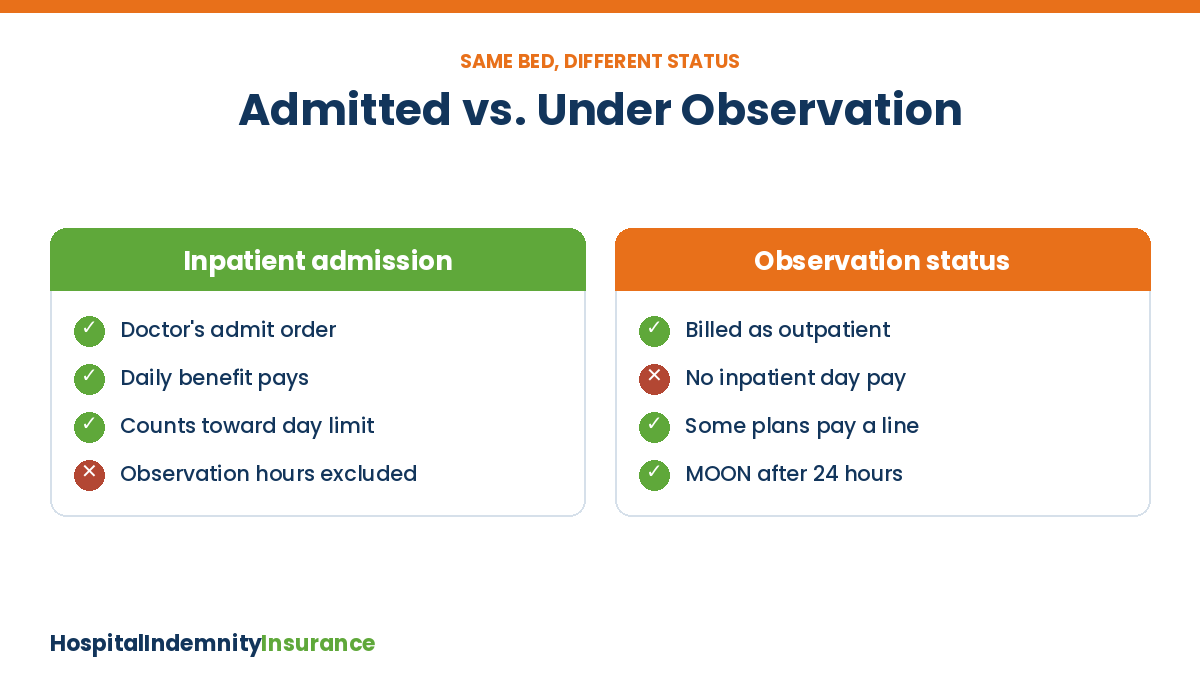
Hospital confinement indemnity insurance: inpatient admission compared with observation status

A confinement benefit starts with paperwork, not with the bed. Medicare.gov puts it plainly: you become an inpatient when you are formally admitted with a doctor’s order. Before that order, time spent in a hospital bed is outpatient observation, even if you stay overnight.

Inpatient admission. A doctor orders the admission and the hospital formally admits you. This is the event a pure confinement benefit is built around.

Observation status. Tests and monitoring while the doctor decides whether you need admission. Billed as outpatient care, so a plan that pays only inpatient days may pay nothing.

The 24-hour notice. Hospitals must hand Medicare patients the Medicare Outpatient Observation Notice (MOON) after more than 24 hours of observation care, explaining the outpatient status.

The two-midnight guide. Medicare treats admission as generally appropriate when a doctor expects you to need care across two or more midnights. Since 2024, CMS rules require Medicare Advantage plans to follow the same admission criteria.

Hospital Indemnity Quotes

Call a Licensed Agent Now

Compare hospital indemnity plans from several insurance companies in one call. Any age.

☎ 1-888-891-0229

No obligation to enroll

Hospital Confinement Indemnity Insurance Structures From Four Carrier Brochures

Each carrier writes its own rules for how days are counted, when they reset and whether observation counts. We placed four published plans side by side: Golden Rule Insurance Company’s AdvantageGuard (a UnitedHealthcare company), GTL Advantage Plus Elite 2.1, LifeSecure Hospital Indemnity 4.0 and Medico’s hospital indemnity plan (a Wellabe company).

Plan Daily inpatient benefit Day limit choices Observation rule Day count resets Pre-existing limit
UnitedHealthcare AdvantageGuard (Golden Rule) $50 to $3,000 on the 1-day plan; $50 to $1,000 on longer plans 1, 3, 4, 5, 6, 7 or 10 days per period of confinement 12 to 24 hours pays 100% of the inpatient amount, up to 4 days a year New period after 60 days from the prior stay Up to 6 months after the effective date
GTL Advantage Plus Elite 2.1 Up to $2,500 on the 1-day plan; up to $990 on 3 to 15-day plans 1, 3 to 10, or 15 days A 24-hour stay pays whether it is observation or confinement; 6 to 24 hours pays a short-stay benefit Fully restores after 60 days with no confinement 6 months (none in North Carolina)
LifeSecure Hospital Indemnity 4.0 $100 to $900, in $10 steps 3, 6, 10 or 21 days Observation unit pays the daily amount, up to 6 days a year, counted toward confinement days Resets after 60 days in a row out of the hospital 12-month look-back, covered after 6 months
Medico (Wellabe) Hospital Indemnity $100 to $600, in $25 steps 3, 6, 7, 8, 9, 10, 21 or 31 days Observation unit monitoring listed as a cash benefit Resets after 60 continuous days out of the hospital Not stated on the product page

Our side-by-side of each carrier’s own brochure or product page, checked November 2026. Ages, amounts and riders vary by state.

Pattern in the fine print: Every plan trades a higher daily amount for fewer days: 1-day designs pay most per stay, 10 to 31-day designs guard against long admissions.

Per-Day Pay, Day Caps and What a Long Stay Really Returns

A daily confinement benefit multiplies two choices: the dollar amount and the day limit. A short stay can use the whole benefit, while a long one can outrun it. The example below uses round numbers inside the ranges shown above, not a quote.

1

Pick the design. Say a plan pays $300 a day for up to 6 days per period of confinement.

2

Count admitted days. A 4-day inpatient stay pays 4 x $300 = $1,200. Hours in observation before the admission order do not count as inpatient days unless the plan has an observation line.

ICU days. None of the four base-plan summaries above prints a separate ICU amount, so an intensive care day generally counts like any other confinement day unless you add a rider that says otherwise.

Lump-sum add-ons. LifeSecure sells an optional admission rider of $500 or $1,000, once per calendar year, paid on top of the daily confinement benefit.

Benefits stack with other coverage. These plans pay a stated amount regardless of the actual bill, so the cash comes to you even when other insurance pays the hospital.

How State Rules Define Hospital Confinement Indemnity

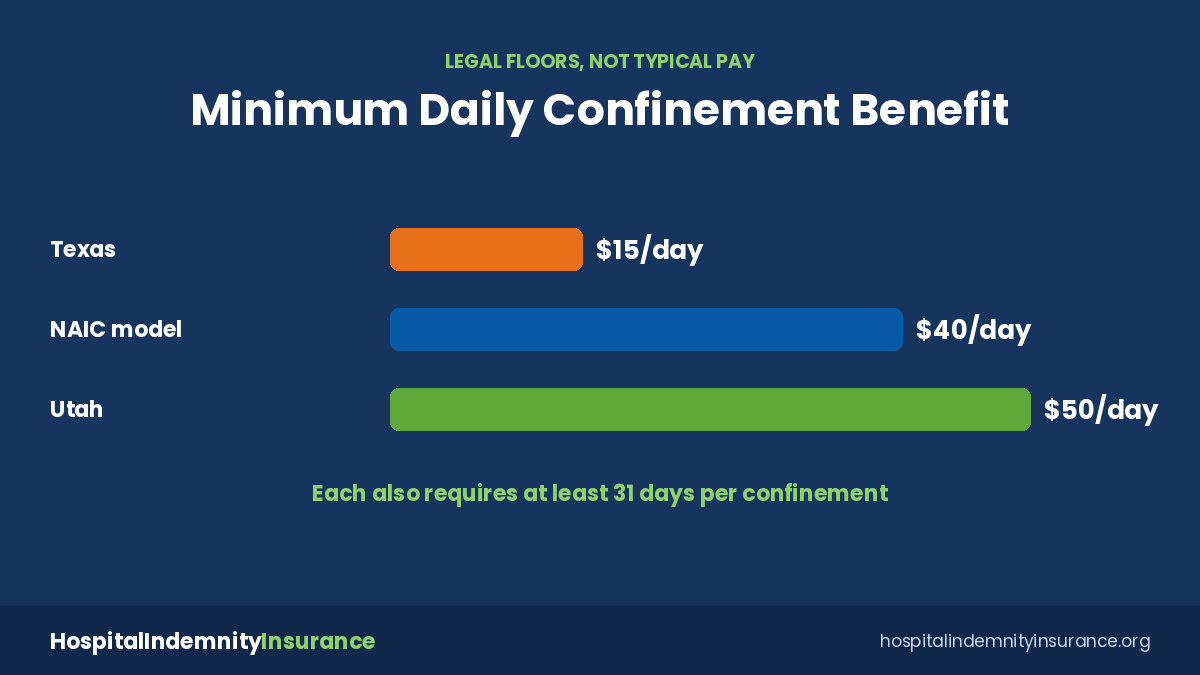
Hospital confinement indemnity insurance minimum daily benefits under Texas, the NAIC model and Utah

Hospital confinement indemnity is a named policy category in insurance law, not just marketing. The NAIC model regulation that sets minimum standards for accident and sickness policies describes it as coverage paying daily benefits for hospital confinement on an indemnity basis, at no less than a state-chosen amount (bracketed at $40 a day) for at least 31 days in each period of confinement.

Rule Minimum daily benefit Minimum days Other terms
NAIC model regulation [$40] a day, set by each state 31 per period of confinement Pre-existing exclusion no longer than 12 months; readmission within 90 days can count as one period
Texas, 28 TAC 3.3073 $15 a day or $100 a week 31 per period of confinement 1 or 2-day elimination period allowed on 31 to 364-day plans; 3 days on 365-day plans
Utah, R590-126-7 $50 a day 31 per period of confinement Must pay regardless of other insurance; renamed hospital fixed indemnity in March 2025

From the NAIC Model Regulation to Implement the Accident and Sickness Insurance Minimum Standards Model Act and each state’s administrative code, checked November 2026. These are legal floors, not typical benefit levels.

The model also sets a floor for what counts as a hospital: a licensed institution caring for sick or injured inpatients, with 24-hour nursing by or under registered nurses. Policies often exclude places that are not hospitals in that sense, such as hospice, skilled nursing and rehabilitation facilities, which GTL’s brochure lists by name.

See Which Confinement Plans Are Sold in Your ZIP Code

Separate Confinements, Elimination Days and Pre-Existing Limits

A second hospital stay does not always start a new benefit. Under the NAIC model, one period of confinement covers consecutive inpatient days plus any readmission within 90 days, a window a state may stretch to three times the plan’s day limit, capped at 180 days.

The 60-day reset. Every brochure in our table resets the day count after about 60 days out of the hospital, and AdvantageGuard ties its period of confinement to stays for the same or related causes.

Elimination days. Some designs skip the first day or two of a stay before paying. Texas law allows a 1 or 2-day elimination period on many plans, so read the schedule for a line that says benefits start on day 2 or 3.

Pre-existing limits. The NAIC model caps the exclusion at 12 months. The brochures we checked use 6 months, and LifeSecure looks back 12 months for conditions treated before coverage began.

Waiting periods. AdvantageGuard lists no waiting period on its standard benefits, while most of its optional riders carry a 30-day wait.

For how look-back periods and health questions interact, see hospital indemnity insurance and pre-existing conditions. Observation-only stays get their own walkthrough in does hospital indemnity cover observation stays.

Coverage reminder: Hospital confinement indemnity insurance is a limited-benefit plan that pays fixed cash. It is not health insurance, does not replace it and does not meet ACA minimum essential coverage.

Who Gets the Most From a Confinement-Based Plan, and Where It Is Sold

A plan that pays per admitted day helps most when your main coverage leaves a large bill per stay or per day.

Situation Why per-day confinement pay fits What to check
Working adults on a high-deductible plan One admission can use most of a deductible Whether a 1-day design or a multi-day design matches your deductible
Families and expecting parents A delivery stay or a child’s admission triggers daily pay How the policy treats pregnancy and any waiting period before maternity stays
Self-employed workers Cash replaces lost income while you are admitted Day limit long enough for a serious illness
Seniors on Medicare Advantage Many plans charge a daily inpatient copay for the first days of a stay Whether the daily amount and day count line up with your plan’s copay days

Plan terms vary by carrier and state.

Medicare Advantage members can match benefits to copays with our guide to hospital indemnity insurance with Medicare Advantage. Carriers file these plans state by state, so availability differs; see our pages for hospital indemnity insurance in Maine and hospital indemnity insurance in Vermont.

Bottom Line

Hospital confinement indemnity insurance pays by the admitted day, so the order that makes you an inpatient, the day limit you choose and the reset rule matter more than the headline amount. Compare how each plan treats observation and readmissions before you buy, and keep your health insurance in place, since this coverage is limited-benefit only.

Get Free Quotes on Hospital Confinement Coverage

Hospital Confinement Indemnity Insurance — Frequently Asked Questions

➤ What does hospital confinement mean in a policy?

It usually means you were formally admitted to a licensed hospital as an inpatient on a doctor’s order. Time in observation status is outpatient care, so it only pays if the plan has a separate observation benefit.

➤ Is hospital confinement indemnity the same as hospital indemnity insurance?

Mostly yes. Hospital confinement indemnity is the regulatory name many state rules use for policies that pay a daily cash benefit during an inpatient stay; some states, such as Utah, now call it hospital fixed indemnity.

➤ Will a confinement plan pay if I stayed overnight under observation?

Only if it names observation. AdvantageGuard pays 100% of its inpatient amount for 12 to 24 hours of observation, while a plan without that line pays nothing for an observation-only night.

➤ Does a second hospital stay start a new benefit?

Not always. Many plans treat readmissions as one period of confinement until you have been out of the hospital about 60 days, and the NAIC model allows readmissions within 90 days to count as one period.

➤ What is the minimum benefit a state requires?

It varies. Texas requires at least $15 a day or $100 a week, Utah requires $50 a day, and both require at least 31 days per period of confinement.

➤ Does an ICU stay pay more?

Not on the base plans we reviewed, which pay their regular daily amount for any confinement day. A higher ICU amount usually needs a rider, where one is offered.

➤ Can a pre-existing condition block a confinement claim?

For a while. The NAIC model caps the exclusion at 12 months, and the carrier brochures we checked limit it to 6 months after the effective date.

➤ Can I have hospital confinement coverage alongside Medicare Advantage or an employer plan?

Yes. The plan pays a stated amount regardless of your other coverage, but it is not health insurance and does not meet ACA minimum essential coverage.

Hospital Indemnity Quotes

Call a Licensed Agent Now

Compare hospital indemnity plans from several insurance companies in one call. Any age.

☎ 1-888-891-0229

No obligation to enroll

Find & Compare Plans Online

Speak with a licensed insurance agent

1-888-891-0229

ZRN Health & Financial Services, LLC, a Texas limited liability company