





Speak with a licensed insurance agent

1-888-891-0229

How Does Hospital Indemnity Insurance Work? Triggers, Day Counts and the Cash You Receive

Reviewed by Russell Noga, Licensed Insurance Agent — Last updated November 22, 2026

Hospital indemnity insurance works by paying you a preset cash amount after a covered hospital event, such as a formal inpatient admission and each day you stay, no matter what the hospital bills. You pay a premium, the plan’s waiting and pre-existing clocks run from the start date, and once a stay qualifies you file a claim and the insurer sends the money to you rather than to the hospital.

2027 by the Numbers

$3,297

U.S. hospital expenses per adjusted inpatient day, 2024; a cost measure, not a bill (KFF)

$1,750

2027 minimum self-only deductible for an HSA-qualified plan (IRS)

$12,000

2027 ACA out-of-pocket ceiling for self-only coverage (CMS)

This page covers the moving parts: the event that has to happen, the arithmetic that turns days into dollars, the dates that can block a payment and how the check sits next to your deductible. For definitions, see what hospital indemnity insurance is.

One rule shapes all of it: this is a limited-benefit, fixed cash policy. It is not health insurance, does not pay providers and does not count as ACA minimum essential coverage, so it belongs on top of a real medical plan.
Compare Hospital Indemnity Plans Sold in Your Area

How Hospital Indemnity Insurance Works, From First Premium to Payout

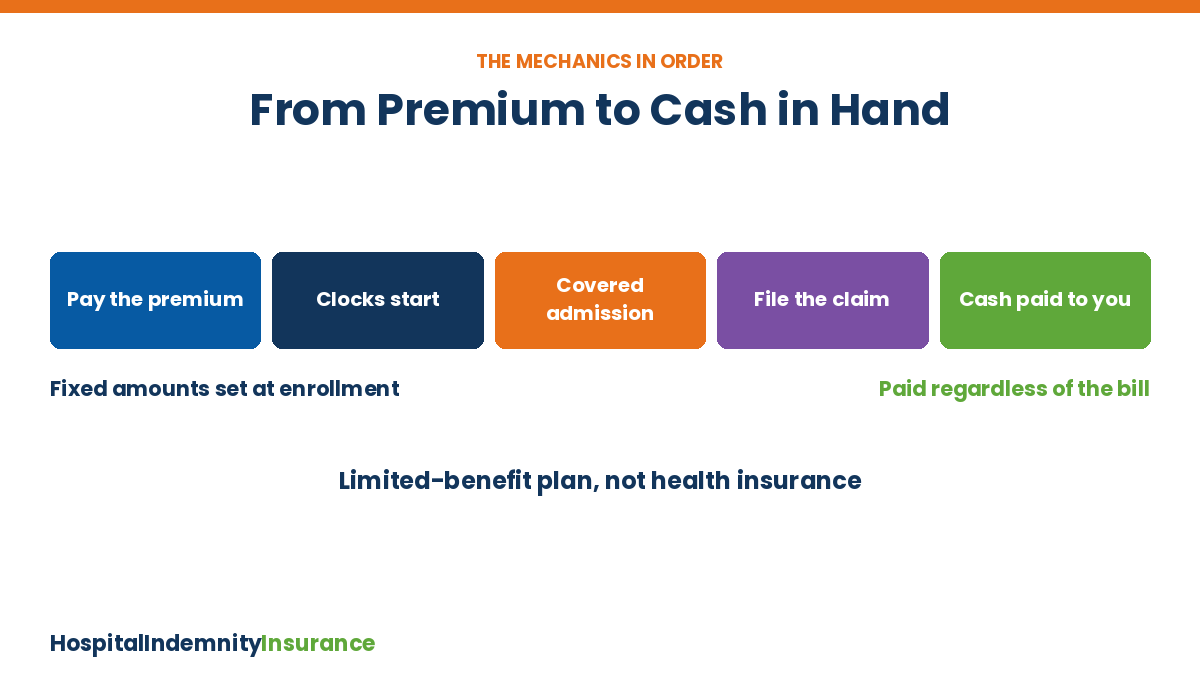
How does hospital indemnity insurance work: premium, waiting clocks, covered admission, claim and cash paid to you

Whether the plan comes through work or is bought on your own, the sequence is the same, and the amounts are fixed on the day you enroll.

1

You pick the numbers up front. Individual buyers usually choose a daily amount and a day limit. LifeSecure’s individual HI 4.0 brochure, for example, offers $100 to $900 a day in $10 steps with 3, 6, 10 or 21 days per stay. Employer plans often offer a low and a high option instead.

2

You pay a premium to keep it active. Coverage only pays for events while the policy is in force; a lapse before a stay means no claim.

3

The clocks start on the effective date. Any pre-existing condition limitation, employment waiting period or maternity delay counts forward from this date.

4

A covered event occurs. Most plans key on an inpatient admission. Some also pay for observation, ICU days, ER visits or surgery when those lines appear on the schedule of benefits.

5

You claim, and the insurer pays you. After the insurer confirms the event matches the policy wording, it pays the scheduled amounts to you, regardless of what other insurance pays.

Key distinction: Health insurance pays a share of a bill. Hospital indemnity pays a set amount per event. A $40,000 stay and a $9,000 stay of the same length can produce the identical hospital indemnity check.

Hospital Indemnity Quotes

Call a Licensed Agent Now

Compare hospital indemnity plans from several insurance companies in one call. Any age.

☎ 1-888-891-0229

No obligation to enroll

What Triggers a Payment: How a Hospital Indemnity Plan Works When You Reach the Hospital

The trigger is the part people misjudge most. Under Medicare’s published rules you become an inpatient only when a doctor orders the admission and the hospital formally admits you; ER time or a night under observation can still be outpatient care. Medicare adds that admission is generally appropriate when a patient is expected to need two or more midnights of medically necessary care. Private policies write their own definitions, but many use similar wording.

Where you end up Your hospital status Does a typical plan pay?
Formally admitted on a doctor’s order Inpatient Yes, this is the core trigger for the admission and daily benefits
Kept overnight while doctors decide Outpatient (observation) Only if the policy has an observation line; LifeSecure HI 4.0 pays its daily amount for up to 6 observation days a year
Short stay of 12 to 24 hours Often outpatient ManhattanLife Hospital Indemnity Select pays a short-duration stay benefit for this window
Treated in the ER and sent home Outpatient Only with an ER benefit or rider, such as LifeSecure’s $150-a-day ER rider
Moved to rehab or a nursing facility Not an acute hospital stay Usually not, unless a rehab or skilled nursing rider was added

Sources: Medicare.gov inpatient or outpatient status page; LifeSecure HI 4.0 individual brochure; ManhattanLife Hospital Indemnity Select brochure. Policy definitions vary by carrier and state.

Find the policy’s definition of confinement and check whether observation is named. Our guide to whether hospital indemnity covers observation stays goes deeper.

Daily Benefits vs. Admission Benefits: How the Check Is Calculated

Most payouts are built from two pieces, and which ones your plan has decides how the money scales with a longer stay.

Admission benefit. A single lump sum when you are admitted. It pays the same for a one-night stay as for a long one, so it helps most with short, expensive admissions.

Daily confinement benefit. A set amount for each day you are confined, capped by the day limit you chose. This piece grows with the length of the stay.

Extra lines. ICU days, observation, ER visits, outpatient surgery or ambulance, each paid only if listed on the schedule or added as a rider.

Scenario (example plan: $200 a day, 6-day limit, $1,000 admission rider) Math Cash paid to you
Admitted, 4 days $1,000 + 4 x $200 $1,800
Admitted, 9 days $1,000 + 6 x $200 (day limit reached) $2,200
ER visit, released the same day No admission, no ER rider $0

Illustration only, using amounts inside the ranges LifeSecure lists for HI 4.0 ($100 to $900 daily; $500 or $1,000 admission rider paid once per calendar year). Your schedule of benefits sets the real figures.

Watch the cap: In this example the ninth day pays nothing because the 6-day limit was used. Long stays reward a higher day limit more than a higher daily amount.

How Hospital Indemnity Stacks With a Health Plan Deductible

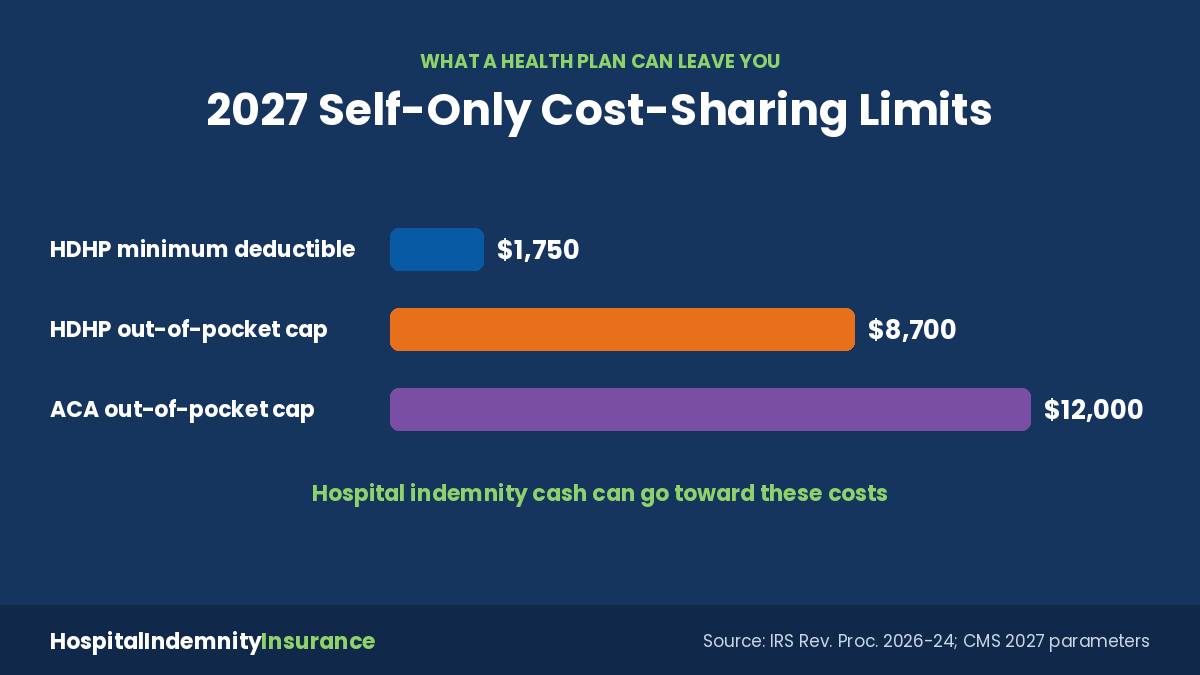
How hospital indemnity insurance works next to 2027 health plan cost sharing: HDHP deductible, HDHP and ACA out-of-pocket limits

Your health plan and the indemnity policy run on separate tracks. The medical plan applies its deductible, copays and coinsurance to the bill; the indemnity policy ignores the bill and pays you its fixed amounts. The cash can go toward that deductible, lost wages or rent.

High-deductible plan owners. For 2027 the IRS sets an HSA-qualified plan’s deductible at no less than $1,750 for one person or $3,500 for a family, with out-of-pocket costs capped at $8,700 and $17,400.

HSA eligibility. IRS Publication 969 lists insurance paying a fixed amount per day of hospitalization as coverage you may hold without losing HSA eligibility. Policies that also pay for doctor visits or other outpatient care may be treated differently, so check the policy before assuming.

Marketplace and job-based plans. For 2027, CMS caps in-network out-of-pocket costs at $12,000 for one person and $24,000 for a family. A hospital stay can use up a large share of that in one event.

To size a plan, compare the likely payout for a typical stay with your own deductible and inpatient copays; see hospital indemnity for high deductible plans. On Medicare, read how hospital indemnity works with Medicare.

Check Which Hospital Cash Plans Are Offered in Your ZIP Code

The Clocks That Decide Whether a Claim Pays

A stay can meet every definition and still pay nothing if it falls inside a timing rule. Carriers publish these terms in different documents; side by side they look like this.

Timing rule LifeSecure HI 4.0 (individual) ManhattanLife Hospital Indemnity Select Wellabe Hospital Indemnity Guardian (employer plans)
Pre-existing condition rule 12-month look-back; covered once care begins more than 6 months after the start date (6-month look-back in KS and WY) 12/12 limitation per ManhattanLife’s knowledge base Not stated on the product page; see the policy No benefit until a set treatment-free or coverage period passes; length set by the plan
Days restore after 60 consecutive days out of the hospital 60 days after discharge 60 continuous days out of the hospital Set by the employer plan
Maternity timing See policy See policy See policy Childbirth stays in the first 9 months not paid; complications covered
Issue ages 18 to 85 18 to 89 (CA 18 to 64 and a half) 18 to 85; guaranteed issue 60 to 79 Guaranteed issue at enrollment

Sources: LifeSecure HI 4.0 individual brochure; ManhattanLife HIS brochure and knowledge base; Wellabe product page; Guardian hospital indemnity how-it-works page. Terms vary by state and policy form; the issued policy controls.

Timing check: If a procedure is already planned or a condition was treated in the past year, compare those dates with the look-back and limitation period before applying. Pregnancy has its own rules, covered in how hospital indemnity insurance works for pregnancy.

How Do Hospital Indemnity Claims Pay Out?

After discharge, the insurer needs proof that the event fits the policy. It does not need the bill to set the amount, because the amount was never tied to it.

What gets checked. Admission and discharge dates, the facility type, the diagnosis and whether the cause falls under a pre-existing limit or an exclusion.

Who receives the money. You, by check or direct deposit, unless you choose to assign benefits to a provider.

How the days are counted. Days used on one stay come off the benefit period. They refill after the out-of-hospital stretch the policy names, often 60 days in the documents above.

Taxes on payouts. Payouts on policies you pay for with after-tax money are generally not taxed. The IRS has said benefits may be taxable when the premium was paid pre-tax through payroll, so check how your employer deducts it.

For the forms and the order to file them, use our step-by-step guide on how to file a hospital indemnity claim.

Bottom Line

Hospital indemnity insurance works as a simple contract with strict edges: a qualifying event, a fixed amount per admission or day, a day cap and a few clocks that start on the effective date. Check the confinement definition, the day limit and the pre-existing wording, and keep a real health plan underneath it.

Get Free Hospital Indemnity Quotes and Compare Benefit Designs

How Does Hospital Indemnity Insurance Work — Frequently Asked Questions

➤ How does a hospital indemnity plan work if I already have health insurance?

Both pay on separate tracks. Your health plan pays its share of the bill, and the indemnity plan pays you its fixed amounts without waiting on that payment.

➤ Does the size of my hospital bill change what I get?

No. The payout depends on the event and the number of covered days, not on the charges. A costly one-night stay and a cheaper one-night stay pay the same.

➤ Will a night under observation count as a hospital day?

Only if the policy names observation. Medicare treats observation as outpatient care even overnight, and many private policies require a formal admission.

➤ What happens if my stay runs longer than my day limit?

The daily benefit stops once you reach the limit you chose, such as 6 or 10 days. Days generally refill only after you have been out of the hospital for the stretch your policy names, commonly 60 days.

➤ How long after buying can I use the coverage?

Coverage generally begins on the policy’s effective date, but pre-existing condition limits can delay payment for known conditions, commonly 6 to 12 months, and some employer plans delay childbirth benefits for 9 months.

➤ How do hospital indemnity claims pay out to me?

The insurer pays you directly, usually by check or direct deposit, once it has proof of the admission and discharge. You can use the money for anything, including your deductible.

➤ Can I keep an HSA if I buy hospital indemnity coverage?

Generally yes for a plan paying a fixed amount per day of hospitalization, which IRS Publication 969 lists as permitted coverage. Plans that also pay for outpatient care can raise questions, so check first.

➤ Is hospital indemnity a substitute for a health plan?

No. It is limited-benefit, fixed cash coverage that does not pay providers or meet ACA minimum essential coverage rules. It works as an add-on to a medical plan, not a replacement.

Hospital Indemnity Quotes

Call a Licensed Agent Now

Compare hospital indemnity plans from several insurance companies in one call. Any age.

☎ 1-888-891-0229

No obligation to enroll

Find & Compare Plans Online

Speak with a licensed insurance agent

1-888-891-0229

ZRN Health & Financial Services, LLC, a Texas limited liability company