





Speak with a licensed insurance agent

1-888-891-0229

Hospital Indemnity Products: A Map of the Types, Hybrids and Hospital Indemnity Riders

Reviewed by Russell Noga, Licensed Insurance Agent — Last updated November 24, 2026

Hospital indemnity products are limited-benefit policies that pay you set cash amounts for hospital care, and they come in six main shapes: individual confinement policies, workplace group plans, hospital-and-doctor fixed indemnity, sickness riders on accident plans, Medicare-age policies and short-stay designs. Riders such as ambulance, outpatient surgery, ICU, skilled nursing and lump-sum admission pay change what each one returns, and none of them is health insurance or ACA minimum essential coverage.

2027 by the Numbers

$3,297

average U.S. community hospital expense per adjusted inpatient day, 2024 (KFF)

$100–$1,000

daily benefit choices on Mutual of Omaha Hospital Protection, launched August 2025

June 10, 2025

date the federal appeal over the 2024 fixed indemnity notice was dismissed (5th Cir.)

At a benefits fair or on an agent’s quoting screen, the phrase hospital indemnity can mean five or six different contracts. Some pay only when you are admitted, some pay for doctor visits too, and some are just a sickness add-on bolted to an accident plan.

This page sorts that shelf by product type and lines up the riders three insurers file side by side. For how a plan pays out in general, start with hospital indemnity insurance plans. Every product below pays fixed cash, is not health insurance and does not count as ACA minimum essential coverage.
Compare Hospital Indemnity Products in Your State

Types of Hospital Indemnity Products on the Market

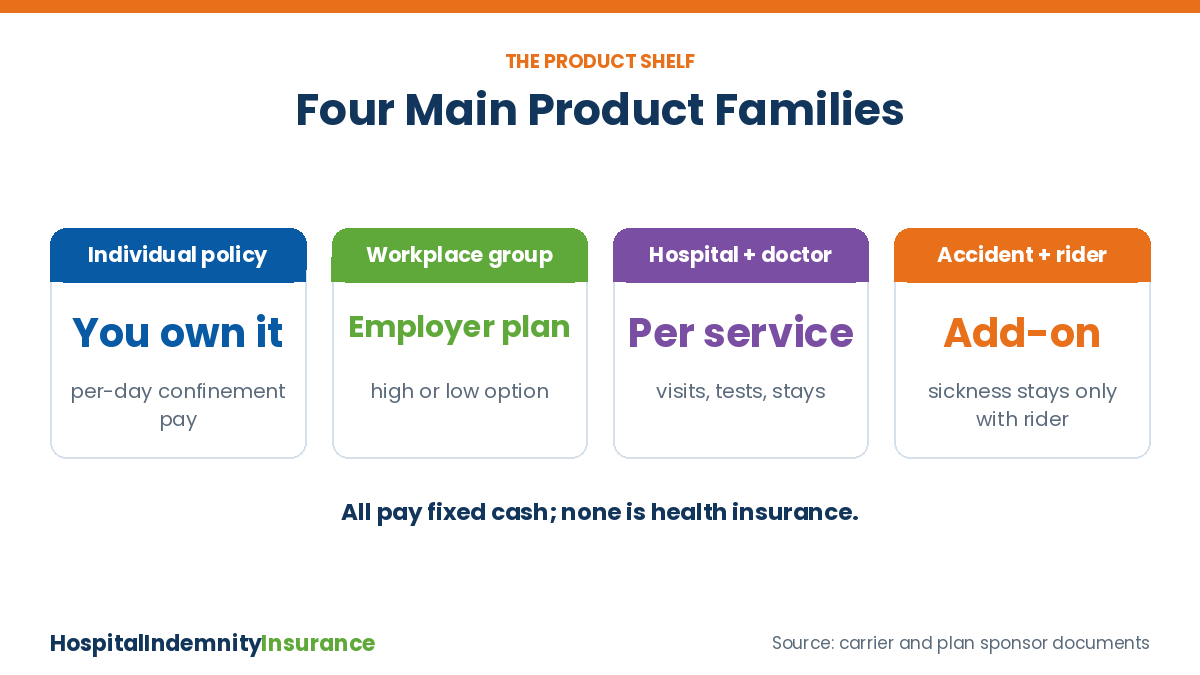
Hospital indemnity products map: individual, workplace group, hospital-and-doctor and accident-rider types

Every hospital indemnity product rests on the same federal frame: a fixed dollar amount per day or event, paid regardless of the bill. What changes is who buys it, what starts the payment and which extras ride along.

Product type How it is sold What starts a payment Filed example
Individual hospital confinement policy Directly or through an agent Inpatient admission, paid per day up to a day limit GTL Advantage Plus Elite (form G2150)
Workplace group or voluntary plan Employer enrollment, payroll deduction Admission benefit plus a daily amount New York Life group plan (GBS-HI-1000.00)
Hospital-and-doctor fixed indemnity Individual market Visits, tests, ER, surgery and hospital days, each with its own amount UnitedHealthcare Health ProtectorGuard
Sickness rider on an accident plan Added to a workplace accident policy Stay caused by illness, not injury NCFlex Accident Plan, Enhanced Option
Medicare-age individual policy Sold to people on Medicare Admission or daily inpatient stay Mutual of Omaha Hospital Protection (guaranteed issue 64 to 74)
1-day design Individual market One payment for a stay of about a day or more GTL 1-day plan, up to $2,500

From each insurer’s or plan sponsor’s published materials, checked November 2026. Availability varies by state.

Where the definitions live: The per-day confinement design is the most common type, with its own admission-versus-observation rules covered in the confinement guide linked at the end of this page.

Hospital Indemnity Quotes

Call a Licensed Agent Now

Compare hospital indemnity plans from several insurance companies in one call. Any age.

☎ 1-888-891-0229

No obligation to enroll

Individual Product vs. Group Hospital Indemnity Product: Who Holds the Contract

The first fork on the map is ownership. With an individual hospital indemnity product, you own the policy, pick the daily amount and keep it if you change jobs. With a group product, an employer owns a master policy and you choose from the levels it set. The mechanics of payroll deduction and porting are covered on our voluntary hospital indemnity page, and employer setup is on the group hospital indemnity insurance page.

Benefit menu. Individual policies work like a menu; GTL offers 1, 3 to 10 or 15 benefit days. Group plans usually come as a high and a low option.

ICU pay. ICU benefits show up more often in workplace designs. New York Life’s group sheet pays $600 or $400 a day in the ICU versus $300 or $200 for a regular room.

Newborn care. The same sheet pays a newborn benefit of $200 or $150 a day, worth checking for anyone expecting a baby.

Health questions. Individual products often ask a few, while GTL and Mutual of Omaha guarantee issue only within set age bands.

Hybrid Hospital Indemnity Products: Hospital-and-Doctor Plans and Accident Riders

Two product types blur the edges and are easy to buy by mistake.

Hospital-and-doctor fixed indemnity. UnitedHealthcare’s Health ProtectorGuard pays listed amounts per service, such as $100 per office visit and $200 per outpatient lab test on Choice Plus. A large hospital-day figure can make it look like major medical, but each service pays only its scheduled amount.

Sickness rider on an accident plan. North Carolina’s state-employee accident plan sells a Sickness Hospital Confinement Rider on its Enhanced Option: $200 a day for an employee or spouse and $150 for a child, up to 30 days, after a 30-day wait. Without such a rider, an accident policy pays nothing for a pneumonia admission.

Fact check before buying: Read the trigger column of the benefit schedule. If every line says accident or injury, an illness admission will not pay. If it lists doctor visits and prescriptions, it is a hospital-and-doctor plan, still a limited-benefit excepted benefit.

Hospital Indemnity Riders Compared Across Three Filed Products

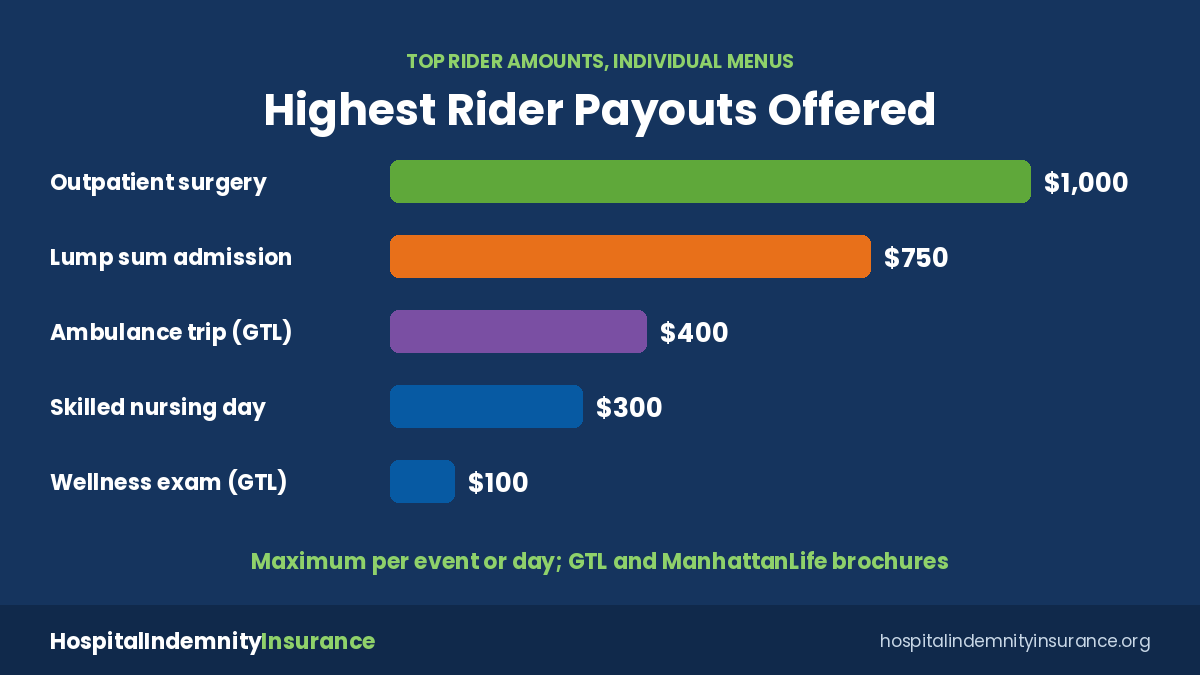
Hospital indemnity riders compared: top outpatient surgery, ambulance and lump sum rider amounts

Riders are where two policies with the same daily benefit drift far apart. No single source lines them up, so we compared the rider menus in three insurers’ own documents.

Rider or add-on GTL Advantage Plus Elite 2.1 ManhattanLife Hospital Indemnity Select Mutual of Omaha Hospital Protection
Ambulance $50 to $400 per trip, up to 4 a year, 12-trip lifetime cap $200 per trip, up to 4 a year, 15-trip lifetime cap Offered as a rider; amount not in launch summary
Outpatient surgery $250 to $1,000 per procedure, twice a year $250 to $1,000, twice a year (not in CT) Offered as a rider
Skilled nursing facility $100 to $300 a day, days 1 to 50 or 21 to 100 $100, $150 or $200 a day, same two day options Offered as a rider
Lump sum at admission $250, $500 or $750 per confinement $250, $500 or $750, up to 6 times a year (age 64½ and up) Built-in lump sum, set from $100 to $3,000
Wellness $100 a year for a physical exam Not listed Not listed
Observation or short stay 24-hour stay paid in base plan; short-stay rider pays 25% for 6 to 24 hours on 1-day plan 12 to 24 hours paid at 25% (1-day option) or 100% (other options) Observation stay built into base plan
Cancer lump sum $2,500 to $20,000 Not listed Offered as a rider

Our side-by-side of GTL brochure (form G2150), ManhattanLife brochure HIS-BR 1024 (form AN7003) and Mutual of Omaha’s August 2025 launch summary. State rules vary; the outline of coverage controls.

Two patterns stand out. Ambulance and skilled nursing riders look alike across carriers, down to the 3-day hospital stay needed before skilled nursing pays. Wellness and ICU riders barely appear on these individual menus, so a buyer who wants them is usually looking at a group product.

See Which Product Types Are Sold in Your ZIP Code

Matching a Hospital Indemnity Product to Your Situation

The right type depends on which bill you are trying to soften. KFF puts the average community hospital expense at about $3,297 per adjusted inpatient day in 2024, so even a short stay can push someone to their deductible or daily copay limit.

1

Workers with a high deductible. A group product with an admission lump sum lines up with a deductible due on day one.

2

Families planning a birth. Look for a newborn daily benefit and check any pregnancy waiting period against the due date.

3

Self-employed buyers. An individual confinement policy stays with you; add outpatient surgery if a procedure is likelier than a long stay.

4

Medicare Advantage members. Many plans charge a daily inpatient copay for the first several days, so size a per-day product to it; see hospital indemnity insurance with Medicare Advantage.

5

People without major medical. No hospital indemnity product fixes that gap. Start with a Marketplace, employer, Medicaid or Medicare plan.

Federal Notice Wording on Each Hospital Indemnity Product Type

In March 2024 the Departments of Health and Human Services, Labor and the Treasury finalized new notice text for fixed indemnity products. A federal court in the Eastern District of Texas vacated it on December 4, 2024 (ManhattanLife Insurance and Annuity Co. v. HHS), and the Fifth Circuit dismissed the government’s appeal on June 10, 2025. The result differs by product type.

Individual products. The court left the 2014 individual-market notice in place, so an individual policy should still state that it supplements, and does not replace, major medical coverage.

Group and voluntary products. No federal notice applies to workplace fixed indemnity after the ruling, though states or insurers may add one.

Short-term plans sold alongside. Fixed indemnity is sometimes bundled with short-term medical coverage. In August 2025 the agencies said they would not prioritize enforcing the 2024 short-term duration limits pending new rules, so check your state’s limits.

Status as of November 2026: This reflects court records and agency statements confirmed as of November 2026. New federal rulemaking could change it.

For how notices tie into the excepted-benefit test itself, see fixed indemnity health insurance, and for per-day confinement rules, see hospital confinement indemnity insurance.

Bottom Line

Hospital indemnity products range from per-day confinement policies to hospital-and-doctor schedules and sickness riders on accident plans, and the riders often matter more than the base daily amount. Identify the type, read each benefit’s trigger and keep it on top of real health coverage, never in its place.

Get Free Quotes on Hospital Indemnity Products

Hospital Indemnity Products — Frequently Asked Questions

➤ How many types of hospital indemnity products are there?

There is no official count, but six designs cover most of the market: individual confinement, workplace group, hospital-and-doctor, accident-plan sickness riders, Medicare-age policies and 1-day designs.

➤ Is a hospital indemnity product the same as health insurance?

No. Each one is a limited-benefit plan that pays fixed cash, has no out-of-pocket maximum and does not count as minimum essential coverage under the ACA.

➤ Which hospital indemnity riders are most common?

Ambulance, outpatient surgery, skilled nursing and lump-sum admission riders appear on both the GTL and ManhattanLife menus we compared, and Mutual of Omaha offers most of them too.

➤ Can I get an ICU benefit on an individual policy?

It is less common. The individual brochures we reviewed listed no ICU rider, while New York Life’s group sheet pays a higher daily ICU amount.

➤ Does an accident policy pay for a hospital stay caused by an illness?

Only if it carries a sickness confinement rider or similar benefit. North Carolina’s state-employee accident plan, for example, sells one only on its Enhanced Option.

➤ What is a hospital-and-doctor fixed indemnity plan?

It pays scheduled amounts for office visits, tests, ER care, surgery and hospital days. Each service pays only its listed amount, whatever the bill.

➤ Do I still get a notice saying the product is not major medical?

For individual policies, yes; the 2014 federal notice still applies. For workplace group products, no federal notice applies after the 2024 rule was vacated, though states may require one.

➤ Can I add riders after my policy is issued?

It depends on the insurer and state. GTL, for one, sells a guaranteed purchase option that raises the hospital benefit by 10% at set times without new underwriting.

Hospital Indemnity Quotes

Call a Licensed Agent Now

Compare hospital indemnity plans from several insurance companies in one call. Any age.

☎ 1-888-891-0229

No obligation to enroll

Find & Compare Plans Online

Speak with a licensed insurance agent

1-888-891-0229

ZRN Health & Financial Services, LLC, a Texas limited liability company