





Speak with a licensed insurance agent

1-888-891-0229

Voluntary Hospital Indemnity: An Employee's Guide to Enrolling, Paying and Keeping It

Reviewed by Russell Noga, Licensed Insurance Agent — Last updated November 18, 2026

Voluntary hospital indemnity is workplace hospital coverage that you choose and pay for yourself through payroll deduction, while your employer only selects the insurer and runs enrollment. It pays you a fixed cash amount when you or a covered relative is admitted to the hospital, and how your premium is deducted decides whether those payments can be taxed.

2027 by the Numbers

30 days

window after hire to join without health questions in the Johns Hopkins plan (Lincoln Financial)

6 / 12 months

look-back and exclusion period in one Unum employer plan’s pre-existing condition rule

31 days

to apply and pay the first premium when porting Unum hospital coverage after leaving a job

Most people meet this coverage on an open-enrollment screen, listed beside accident and critical illness plans with a per-paycheck price. The word in front of it matters. Voluntary hospital indemnity insurance meaning, in short: the benefit is optional and employee-paid, so every decision about it is yours.

This guide takes the employee’s side of that decision: what you elect, what comes out of your pay, what the IRS says about the tax, which health limits still apply after guaranteed acceptance, and what happens when the job ends. Employers setting up a plan should read our guide to group hospital indemnity insurance instead.
Compare Hospital Indemnity Plans You Can Own Outside of Work

Voluntary Hospital Indemnity Insurance Meaning: Who Pays and Who Decides

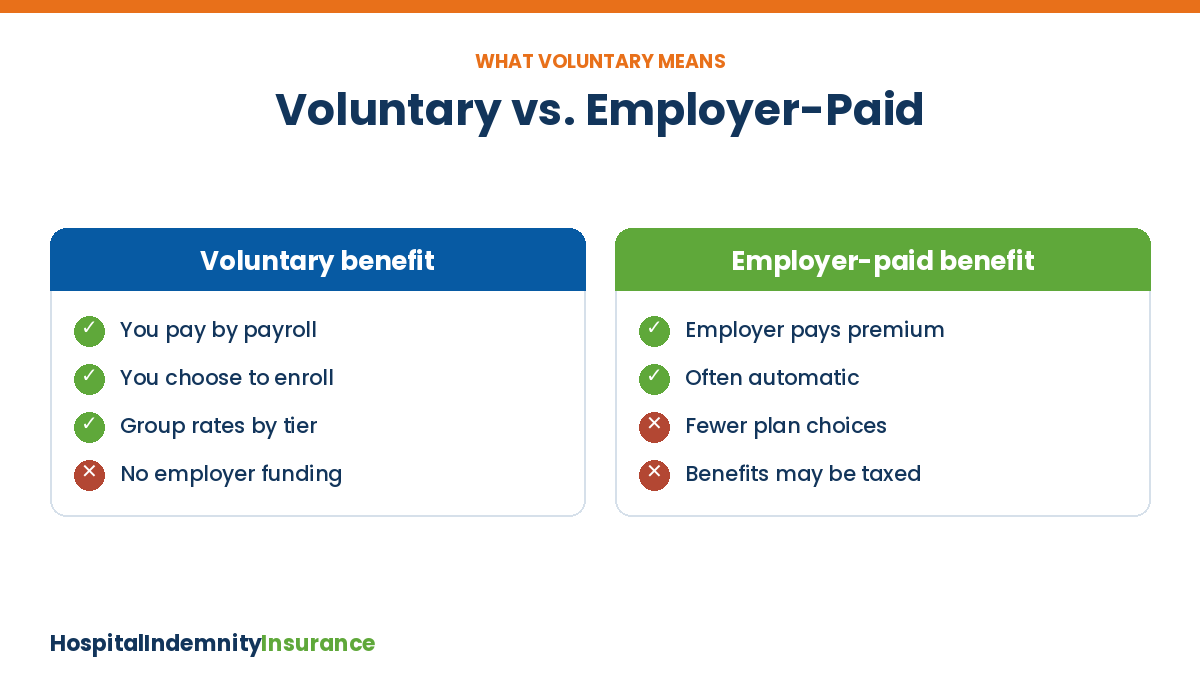
Voluntary hospital indemnity compared with employer-paid workplace benefits

Benefits at work fall into two groups. Employer-paid benefits, such as basic life insurance at many companies, cost you nothing. Voluntary benefits are offered at group rates, but the premium is deducted from your paycheck and you can say yes or no. Voluntary supplemental hospital indemnity insurance sits in the second group, layered on top of whatever medical plan you carry.

Your employer decides: which insurer, the plan levels on the menu, who is eligible (often a minimum number of weekly hours) and when the enrollment window opens.

You decide: whether to enroll at all, the low or high plan, and whether to add a spouse, a domestic partner or children.

The insurer decides: claims. Payments go to you, not the hospital, in fixed amounts set by the plan, no matter what the stay cost.

What it is not: A voluntary hospital plan is a limited-benefit, fixed-cash policy. It is not health insurance, it does not replace your medical plan and it does not count as ACA minimum essential coverage. The Hartford’s group materials also note these products do not coordinate with other health coverage, so they pay alongside it.

Hospital Indemnity Quotes

Call a Licensed Agent Now

Compare hospital indemnity plans from several insurance companies in one call. Any age.

☎ 1-888-891-0229

No obligation to enroll

Making Your Open Enrollment Election

1

Check your first-eligibility deadline. New hires usually get a short window. The Johns Hopkins plan, underwritten by Lincoln Financial, is guaranteed issue only if you elect it within 30 days of hire.

2

Choose a plan level. Most menus show a low and a high option. In MetLife’s 2024 plan for one employer group, the high plan paid $1,000 per admission and $200 a day versus $500 and $100 on the low plan.

3

Pick a coverage tier. Rates are usually flat by tier rather than by your age: employee, employee plus spouse, employee plus children, or family.

4

Confirm the active-at-work rule. MetLife’s summary says coverage is guaranteed if you are actively at work and covered dependents are not subject to the medical restrictions on the enrollment form.

5

Know the cost of waiting. Cigna’s 2026 summary for Dartmouth says late applicants, where allowed, may have to provide medical evidence of insurability. An Aon-administered Unum plan says enrolling later requires an approval process.

Monthly cost, low / high plan MetLife (employer plan, 2024) Cigna (Dartmouth, 2026)
Employee only $10.49 / $20.87 $11.23 / $22.27
Employee + spouse $16.03 / $32.17 $22.87 / $45.56
Employee + child(ren) $19.95 / $40.06 $18.92 / $37.64
Family $25.25 / $50.71 $25.98 / $51.80

From each employer’s published benefit summary. Your employer’s rates, plan levels and benefit amounts will differ.

Payroll Deduction: Pre-Tax or After-Tax Premiums

Your premium leaves each paycheck automatically, but the deduction can be set up two ways, and the choice is usually your employer’s. That setting matters more for this product than for most benefits because the plan pays you cash.

After-tax deduction. Aflac’s tax advisory says that when an employee pays on an after-tax basis, the entire benefit is tax-free. Symetra’s guidance says the same thing in general terms.

Pre-tax deduction (cafeteria plan). Aflac says benefits are excludable only up to your unreimbursed medical expenses, and any excess is taxable. Sun Life says it reports such benefits on a 1099.

Locked-in elections. Pre-tax elections made through a cafeteria plan generally cannot be dropped mid-year without a qualifying life event, such as marriage, a birth or a change in employment.

What the IRS memo said: In Chief Counsel Advice 202323006 (June 2023), the IRS looked at a fixed-indemnity plan paid with pre-tax salary reductions and found that cash wellness payments made without any unreimbursed medical expense were wages, subject to income tax and payroll taxes. Chief Counsel Advice is not precedent, and the memo addressed wellness payments, not hospital stays, so ask a tax professional how it applies to your claim.

For the full rules on reporting a hospital payment, see whether hospital indemnity is taxable.

When the Job Ends: Porting Your Coverage

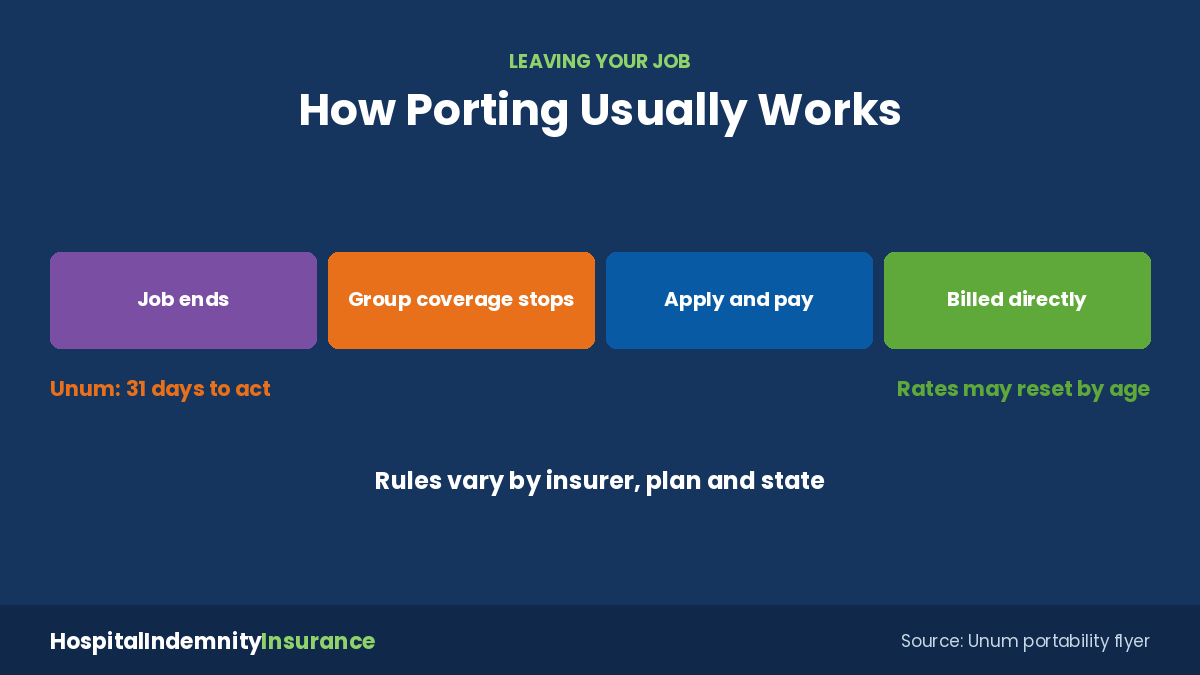
Timeline for porting voluntary hospital indemnity coverage after leaving a job

Group coverage normally stops when employment stops, but many voluntary hospital certificates include a portability provision that lets you keep paying the insurer directly. The rules are carrier-specific, and the clock is short.

Carrier document What it says about leaving
Unum portability flyer 31 days after employer coverage ends to apply and pay; group composite rates convert to issue-age rates; benefits cannot be increased when porting
Unum plan summary (Carson Tahoe) Coverage can be kept after leaving or retiring without answering new health questions
MetLife plan summary (2024) Portable while premiums are paid, but ends if the employer later offers similar coverage with another insurer; benefit reductions begin at age 65
Cigna summary (Dartmouth, 2026) Covered people must be under age 100 to continue coverage

Portability depends on your state and your employer’s plan. Read the certificate, not just the summary.

Price check before you port: Because ported rates may be recalculated by age, compare the direct bill with an individual hospital indemnity policy before the 31-day window closes.

See Hospital Indemnity Options Sold in Your ZIP Code

Pre-Existing Condition Limits Behind Guaranteed Acceptance

Guaranteed issue means the insurer must accept you. It does not always mean every claim pays from day one. Many voluntary plans add a pre-existing condition limitation for sickness, which can include pregnancy, while others skip it entirely. We lined up the employee-side rules from five published employer plan documents, since no single source shows them together.

Employer plan (insurer) Joining without health questions Pre-existing condition rule Leaving the job
Carson Tahoe (Unum) Not stated in summary No benefit for a covered loss in the first 12 months from a condition treated in the 6 months before coverage Portable, no new health questions
Caltech (Unum) Not stated in summary None; covered from day one Portable, billed directly
Employer group (MetLife, 2024) Guaranteed if actively at work There may be a limitation for hospital sickness benefits Portable while premiums are paid
Dartmouth (Cigna, 2026) Late applicants may need medical evidence Not stated in summary Continues up to age 100
Johns Hopkins (Lincoln Financial) Guaranteed within 30 days of hire Not stated on HR page Not stated on HR page

Our comparison of employer-published summaries and HR pages, checked November 2026. Where a summary is silent, the certificate controls.

If you are planning a pregnancy, the look-back and exclusion months matter most; see hospital indemnity and pre-existing conditions for how these clauses are worded.

Questions to Settle Before You Click Enroll

Does my deduction run pre-tax? Ask HR or check the enrollment screen. It changes how a claim check is taxed and whether you can cancel mid-year.

What does an admission require? The Johns Hopkins plan pays only after an admission of 20 hours or more; other plans set different thresholds or add observation benefits.

Who in my family needs it? Adding a spouse or children can more than double the monthly cost, so match the tier to who is likely to be hospitalized.

Would I keep it? If you expect to change jobs or retire soon, read the portability clause now rather than in your last week.

Whether the premium is good value for your household is its own question, covered in is voluntary hospital indemnity insurance worth it. For a plain overview of how workplace plans pay, read hospital indemnity insurance through an employer.

Bottom Line

Voluntary hospital indemnity puts the choice and the cost on you, in exchange for group rates and, inside the first-eligibility window, acceptance without health questions. Before enrolling, confirm your deadline, how the premium is deducted, any pre-existing condition limit and the porting terms. If no workplace plan fits, individual coverage is the alternative.

Get Free Hospital Indemnity Quotes for Your Household

Voluntary Hospital Indemnity — Frequently Asked Questions

➤ What does voluntary mean on a hospital indemnity enrollment form?

It means the benefit is optional and you pay the premium, usually through payroll deduction. Your employer chooses the insurer and plan design but does not fund the coverage.

➤ Is voluntary supplemental hospital indemnity insurance different from group hospital indemnity?

The terms overlap. Group describes how the policy is issued, to an employer, while voluntary describes who pays, the employee. Most workplace hospital plans are both.

➤ What happens if I skip hospital indemnity when I am first hired?

You can usually enroll at a later open enrollment, but guaranteed acceptance may be lost. Some plans ask late applicants for medical evidence of insurability or put them through an approval process.

➤ Can I drop voluntary hospital coverage in the middle of the year?

If the premium is deducted pre-tax through a cafeteria plan, you generally need a qualifying life event to stop it mid-year. After-tax deductions are often easier to cancel; check with HR.

➤ Do I get a tax form when a voluntary hospital plan pays me?

It depends on how premiums were deducted. Sun Life says it reports benefits on a 1099 when premiums were paid pre-tax, while after-tax premiums generally make the benefit tax-free.

➤ Will my ported hospital coverage cost the same as at work?

Not always. Unum’s portability flyer says group composite rates convert to issue-age rates when you port, and the insurer may change the premium.

➤ Can my spouse stay on my voluntary hospital plan?

Yes, while you are enrolled at the spouse tier and the plan’s age limits are met. If you port the coverage, dependents can usually port with you.

➤ Does a voluntary hospital plan pay my hospital bill directly?

No. Benefits are paid to you in fixed amounts, and you decide whether the money goes to the hospital, a deductible, rent or groceries.

Hospital Indemnity Quotes

Call a Licensed Agent Now

Compare hospital indemnity plans from several insurance companies in one call. Any age.

☎ 1-888-891-0229

No obligation to enroll

Find & Compare Plans Online

Speak with a licensed insurance agent

1-888-891-0229

ZRN Health & Financial Services, LLC, a Texas limited liability company