





Speak with a licensed insurance agent

1-888-891-0229

UnitedHealthcare Hospital Indemnity: How It Works, Who Sells It and What It Pays

Reviewed by Russell Noga, Licensed Insurance Agent — Last updated October 28, 2026

UnitedHealthcare hospital indemnity is a fixed-cash plan that pays you a set dollar amount when you are hospitalized for a covered reason, no matter what the hospital bills. It is sold through employers by UnitedHealthcare Insurance Company and to individuals through Golden Rule Insurance Company, a UnitedHealthcare company, including a plan for people ages 60 to 90.

UnitedHealthcare is best known for health insurance and Medicare plans, but it also sells hospital indemnity coverage. This kind of plan does not pay doctors or hospitals for your care. Instead, it sends cash to you, or to a provider you choose, so you can cover a deductible, daily copays, rent or groceries while you recover.

This guide is the big-picture overview: who stands behind the coverage, how the benefits work, what a stay might pay and how claims are handled. If you already know you want to compare specific options, see our UnitedHealthcare hospital indemnity plan finder.
Compare Hospital Indemnity Plans in Your Area

What UnitedHealthcare Hospital Indemnity Is (and Is Not)

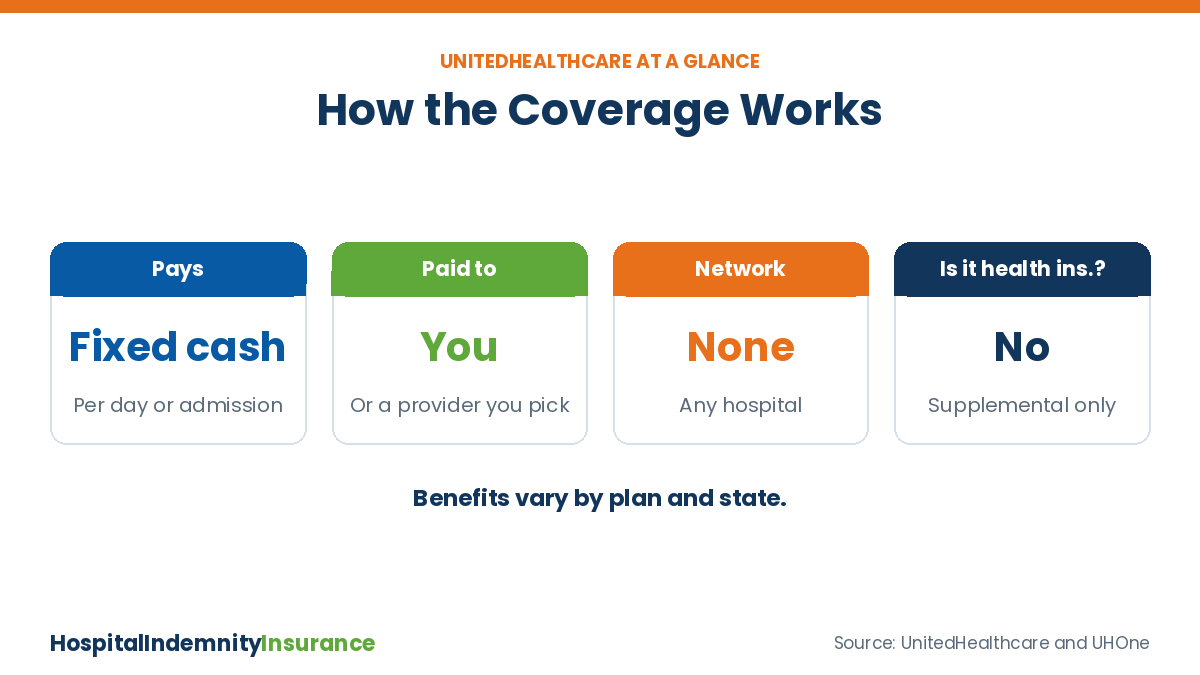
UnitedHealthcare hospital indemnity at a glance: fixed cash, paid to you, not health insurance

Hospital indemnity insurance is a limited-benefit plan. When a covered hospital stay happens, the plan pays a fixed amount, such as a set number of dollars per day or per admission. The payment is the same whether your hospital bill is $5,000 or $50,000.

Pays fixed cash. Benefits are set in advance and are not based on your actual costs.

Paid to you. Money goes to you unless you assign it to a hospital or provider.

Use it for anything. Deductibles, copays, travel, child care or household bills.

Works with other coverage. It is meant to sit on top of a health plan, employer coverage or Medicare.

Important: UnitedHealthcare hospital indemnity is NOT health insurance. It does not replace your health plan or Medicare and does not meet ACA minimum essential coverage.

Because it pays a flat amount, it is easiest to value when you know your own out-of-pocket exposure. A family with a $4,000 deductible, a worker who would lose pay during a stay and a retiree facing daily hospital copays all have a clear gap for the cash to fill.

Hospital Indemnity Quotes

Call a Licensed Agent Now

Compare hospital indemnity plans from several insurance companies in one call. Any age.

☎ 1-888-891-0229

No obligation to enroll

Which UnitedHealthcare Companies Insure the Coverage

The UnitedHealthcare name appears on several products, but the insurer on the policy depends on how you buy it.

Way to buy Insurer named on the policy Who it is for
Through your job UnitedHealthcare Insurance Company Employees at groups of 100 or more eligible workers, plus family
On your own before 65 Golden Rule Insurance Company Self-employed adults, families and early retirees
On your own at 60 to 90 (AdvantageGuard) Golden Rule Insurance Company Older adults, including Medicare Advantage members

Sources: UnitedHealthcare employer brochure, UHOne and Golden Rule AdvantageGuard brochure. Availability varies by state.

Golden Rule is a UnitedHealthcare company. Its AdvantageGuard brochure lists an AM Best rating of A+ (Superior) as of December 2023. Ratings can change, so check the current rating before you buy.

How the Benefits Work Day to Day

Each version of the coverage has its own benefit schedule, but they share the same basic parts.

Admission or daily benefit. A set amount when you are admitted, per day you stay, or both.

Observation stays. Some plans pay for short observation stays. AdvantageGuard pays 100% of the daily amount for 12 to 24 hours, up to 4 days a year.

ICU and other care. The workplace plan lists ICU admission, surgery, rehab therapy and mental health benefits.

Optional riders. Individual plans can add ER, ambulance, outpatient surgery, skilled nursing and more.

UHOne says most individual benefits have no waiting period and there are no network rules for the hospital benefit, so you get the same payment at any hospital. For dollar amounts by plan, see how much UnitedHealthcare hospital indemnity pays.

Sample Payouts: What a Stay Could Pay

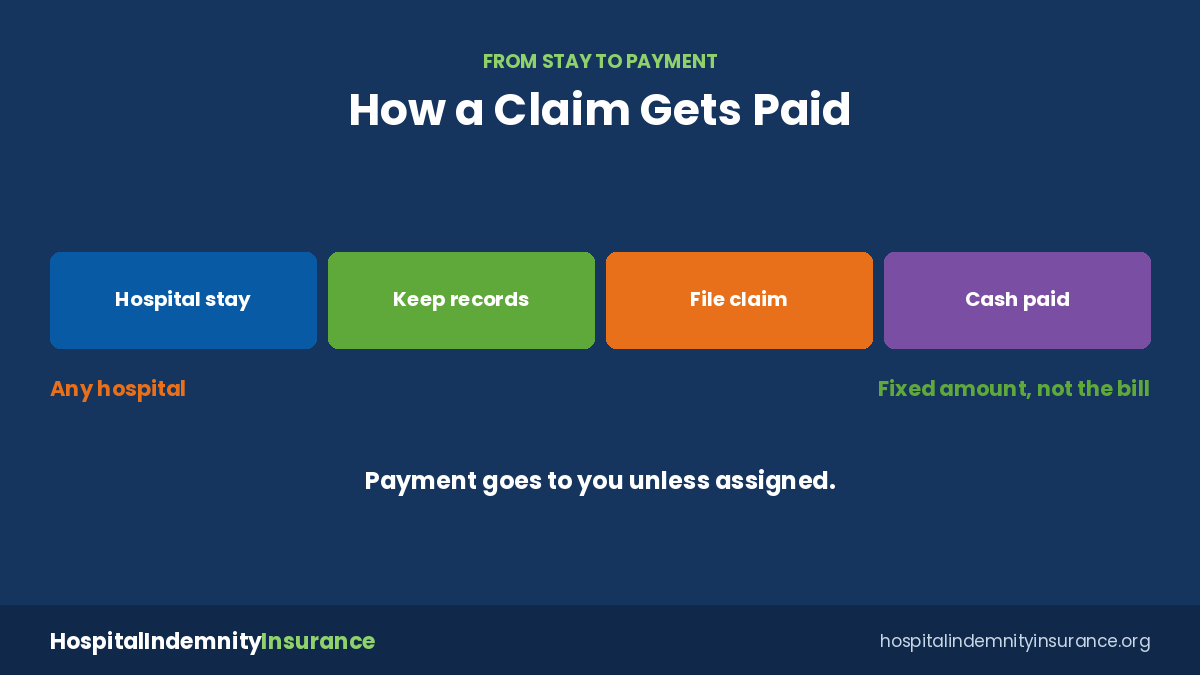
UnitedHealthcare hospital indemnity claim steps from hospital stay to cash payment

These are simple examples using benefit ranges from UnitedHealthcare and Golden Rule materials. Your own plan pays whatever its schedule says.

Example Benefit chosen What the plan pays
Worker has a C-section (workplace plan example) Admission plus recovery days $1,500 admission + $600 confinement = $2,100
Retiree, 4-day stay (AdvantageGuard) $300 a day, 5-day maximum $1,200
Retiree kept 18 hours in observation (AdvantageGuard) $300 a day $300
Retiree, 1-day maximum plan $1,500 for day one $1,500

C-section figures come from UnitedHealthcare’s employer brochure example. Other rows are illustrations built from AdvantageGuard benefit ranges ($50 to $1,000 a day for 3 to 10 days, or up to $3,000 on a 1-day plan).

Broker tip: Size the benefit to your real gap. If your health plan or Medicare Advantage plan charges about $350 a day for the first five days, a $300 to $350 daily benefit with a 5-day maximum lines up well.

If your employer offers two levels of coverage, our UnitedHealthcare hospital indemnity low vs high guide shows how to choose between them.

See UnitedHealthcare and Other Hospital Plans

Who UnitedHealthcare Hospital Indemnity Fits Best

Families with a high deductible. Cash from one stay can cover much of the deductible.

Couples planning a baby. Workplace coverage may pay for a childbirth stay. Individual plans for older adults generally exclude normal pregnancy.

Self-employed workers. Cash helps replace income you lose while in the hospital.

Medicare Advantage members. AdvantageGuard is built to help with daily hospital copays at ages 60 to 90.

For Medicare Advantage members, the key is matching the daily benefit and days per stay to your plan’s hospital copays. Our guide to hospital indemnity insurance with Medicare Advantage walks through the math.

Watch out for Why it matters
Pre-existing conditions AdvantageGuard will not pay for them for up to 6 months after your start date
Age limits Individual plans for younger buyers are renewable only until age 65
State rules AdvantageGuard is sold in about 42 jurisdictions, and riders vary by state
Children AdvantageGuard covers you and a spouse or partner, not kids

How UnitedHealthcare Hospital Indemnity Claims Are Paid

1

Get care first. Go to the hospital you need. There is no network requirement for the hospital benefit on individual plans.

2

Collect proof. Keep the discharge papers or itemized bill showing your admission and discharge dates.

3

File the claim. Submit the claim form with your records online, by mail or through your employer’s benefits portal.

4

Get paid. The insurer pays the fixed amount to you, or to a provider if you assigned benefits.

Claims move faster when the dates and diagnosis on your records are clear. Learn more in the UnitedHealthcare hospital indemnity payout process.

Good to know: Workplace coverage is portable. If you leave your job, you can usually keep it at group rates by applying within the window in your certificate.

Bottom Line

UnitedHealthcare hospital indemnity pays fixed cash for covered hospital stays, through employers and through Golden Rule individual plans, including AdvantageGuard for ages 60 to 90. It can soften a deductible or daily copays, but it is not health insurance. Compare its benefit schedule and price with at least one other carrier before you enroll.

Get Free Hospital Indemnity Insurance Quotes

UnitedHealthcare Hospital Indemnity — Frequently Asked Questions

➤ What is UnitedHealthcare hospital indemnity?

It is a fixed indemnity plan that pays a set cash amount for covered hospital stays and certain other services. The money is paid to you unless you assign it to a provider.

➤ Who insures UnitedHealthcare hospital indemnity plans?

Workplace coverage is insured by UnitedHealthcare Insurance Company. Individual plans, including AdvantageGuard, are underwritten by Golden Rule Insurance Company, a UnitedHealthcare company.

➤ Is UnitedHealthcare hospital indemnity health insurance?

No. It is a limited-benefit plan that pays fixed amounts. It does not replace health insurance or Medicare and does not count as ACA minimum essential coverage.

➤ Can I buy UnitedHealthcare hospital indemnity if I have Medicare?

Yes. AdvantageGuard is sold to people ages 60 to 90 and is designed to help with costs such as Medicare Advantage hospital copays. It is not sold in every state.

➤ Does UnitedHealthcare hospital indemnity have a waiting period?

UHOne says most individual benefits have no waiting period. Pre-existing conditions may not be covered for a time, up to 6 months on AdvantageGuard, and some riders have 30-day waits.

➤ Do I have to use UnitedHealthcare hospitals?

No network is required for the hospital benefit on individual plans. You receive the same fixed payment wherever you are treated.

➤ Does it cover childbirth?

UnitedHealthcare’s workplace brochure shows a C-section admission example. AdvantageGuard excludes pregnancy and childbirth except complications. Check your own certificate.

➤ How do I file a UnitedHealthcare hospital indemnity claim?

Submit the claim form with your hospital records showing admission and discharge dates. The insurer then pays the fixed benefit to you or to a provider you named.

Hospital Indemnity Quotes

Call a Licensed Agent Now

Compare hospital indemnity plans from several insurance companies in one call. Any age.

☎ 1-888-891-0229

No obligation to enroll

Find & Compare Plans Online

Speak with a licensed insurance agent

1-888-891-0229

ZRN Health & Financial Services, LLC, a Texas limited liability company