





Speak with a licensed insurance agent

1-888-891-0229

Vermont Hospital Indemnity Insurance: Regulation 80-1, Parity Rules and Life After the Medicare Advantage Exit

Reviewed by Russell Noga, Licensed Insurance Agent — Last updated November 10, 2026

Vermont hospital indemnity insurance is a fixed-benefit policy that pays you a set cash amount for a covered hospital stay, and Vermont Regulation 80-1 says a hospital confinement indemnity plan must pay at least $30 a day for at least 31 days per confinement. LifeSecure publishes Vermont rates for its individual plan, and worksite versions reach Vermont employees; you buy one from an insurer, an agent or an employer, never from Vermont Health Connect, and it is not health insurance or ACA minimum essential coverage.

2027 by the Numbers

$3,422

Vermont hospital expenses per adjusted inpatient day, 2024 (KFF; U.S. $3,297)

31 days

minimum benefit period per confinement under Vermont Regulation 80-1, at $30 a day or more

8

critical access hospitals in Vermont (Vermont Department of Health; HRSA, July 2026)

About 12%

of Vermont Medicare enrollees left in Medicare Advantage, Feb. 2026, after major plan exits (Healthcare Brew)

Vermont does health coverage its own way. A state board sets hospital budgets, Vermont Health Connect premiums do not change with age, and in 2026 most of the state’s Medicare Advantage plans disappeared. Each of those facts changes how a hospital cash plan fits a Vermont household.

Below: the state rule that sets a floor for these policies, the protections Vermont regulators look for, what Vermont-coded plan documents show and who gets the most from a daily benefit. For pairing one with a marketplace policy, see hospital indemnity with an ACA plan.
Compare Hospital Indemnity Plans in Vermont

Regulation 80-1: How Vermont Defines Hospital Confinement Indemnity Insurance

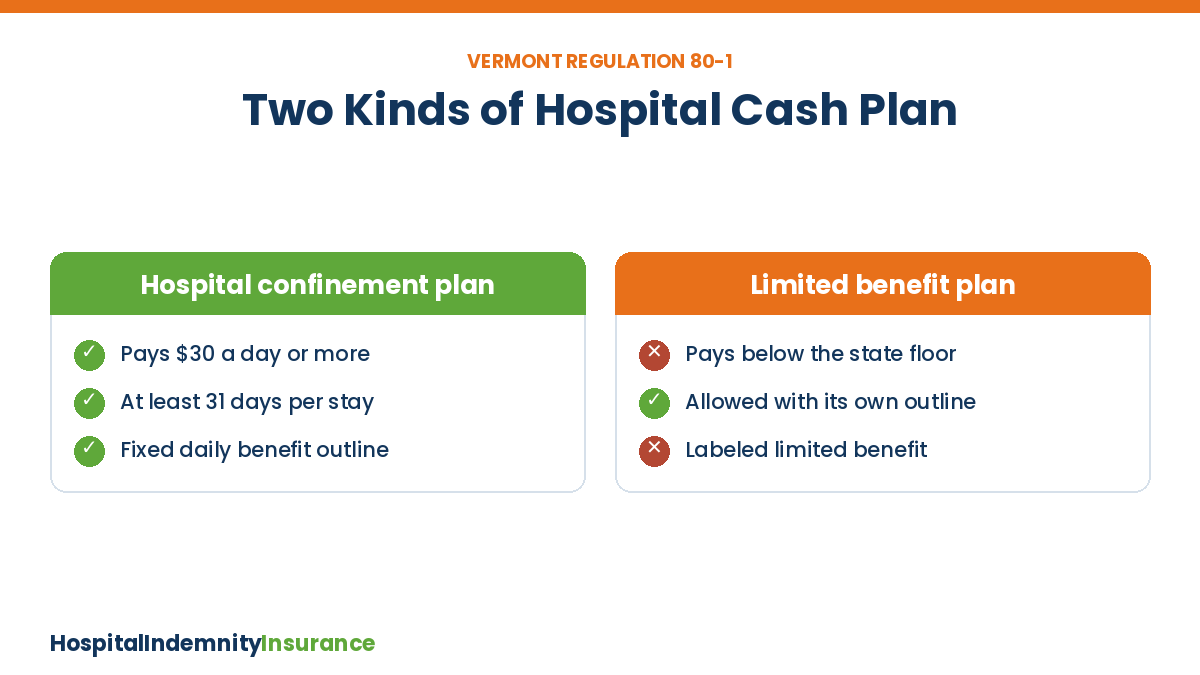
Vermont hospital indemnity insurance under Regulation 80-1: full hospital confinement plan compared with limited benefit coverage

Vermont’s Accident and Sickness Minimum Standards, known as Regulation 80-1 and in force since July 1, 1980, still sets how a hospital cash policy must be built. The Department of Financial Regulation (DFR) enforces it.

$30 a day, minimum. A policy sold as hospital confinement indemnity must pay daily benefits of at least $30 on an indemnity basis.

31 days per confinement. Those daily benefits must last for at least 31 days in any one period of confinement.

A real hospital. The policy may require licensed operation, physician-led inpatient care and 24-hour nursing under registered nurses, and may leave out nursing homes and custodial or rehab facilities.

A plain-language outline. Buyers get an outline of coverage stating the plan pays only a fixed daily amount for hospital confinement.

A plan paying less can still be sold, but only with an outline titled Limited Benefit Health Coverage. If your outline carries that title, you are looking at the smaller product.

Hospital Indemnity Quotes

Call a Licensed Agent Now

Compare hospital indemnity plans from several insurance companies in one call. Any age.

☎ 1-888-891-0229

No obligation to enroll

Vermont Filing Rules That Protect Policyholders

DFR keeps a list of recurring problems it flags in supplemental health filings, and hospital indemnity is named among those products.

Vermont requirement What it means for you Source
Capitalized cover-page warning The policy must say it does not meet ACA minimum coverage and should only be bought if you already have major medical DFR supplemental filing checklist
Mental health parity Benefits for a mental health condition cannot be lower than for other conditions, and stays tied to alcohol or substance use cannot be excluded 8 V.S.A. § 4089b
No narrow hospital definition A hospital benefit cannot exclude facilities that treat mental illness or substance use DFR checklist
No discretionary clauses The insurer cannot reserve the sole right to interpret the policy wording 8 V.S.A. § 4062f
Benefit caps reviewed DFR can reject limits so high the plan looks like a substitute for major medical DFR checklist

Source: Vermont DFR, Recurring Issues: Supplemental Health Insurance (April 2019). DFR has also told the NAIC it applies its supplemental standards to group coverage. Rules can change; ask the insurer for the current Vermont form.

Many brochures written for other states limit psychiatric stays, so the Vermont form matters. For how these benefits usually work, read hospital indemnity and mental health benefits.

Plans With Vermont Paperwork, Side by Side

Some national insurers leave Vermont out of their supplemental lineups, so the useful test is whether a plan has Vermont-coded forms.

Plan Vermont link Benefit design in the document Limits to note
LifeSecure Hospital Indemnity (individual) Vermont monthly rate sheet, form LS-HI4-0306 M VT, policy series LS-HI4-0004 VT Daily options from $200 to $900; 3, 6, 10 or 21 days; riders for ER and ambulance, lump-sum admission, outpatient surgery and rehab or skilled nursing Issue ages 18 to 85; price set by age band and family tier
Aflac Choice HSA-Compatible Hospital Confinement Indemnity Brochure whose form numbers end in VT Admission benefit of $500 to $2,000 once a year; $100 a day up to 365 days; ICU $50 a day up to 30 days 12-month pre-existing limit; 30-day sickness wait for people added later; birth in the first 10 months excluded
Voluntary worksite plan at Jay Peak Resort Employee overview posted by the Vermont employer (carrier not named) $1,000 admission and $100 a day up to 31 days; ICU $2,000 admission and $200 a day No pre-existing condition limitation listed; states it is not health insurance

Compiled from LifeSecure, Aflac and Jay Peak Resort documents reviewed November 2026. Not quotes. Ask for the current Vermont outline of coverage before buying.

Age matters here: Vermont Health Connect premiums do not vary by age, but LifeSecure’s Vermont hospital indemnity rates step up across nine age bands, from 18-29 to 80-85. Buying earlier locks in a younger band only if the policy says rates are set at issue age.

Employer versions follow group rules; see group hospital indemnity insurance for how they differ from an individual policy.

Original Medicare Is the Default Again for Most Vermonters

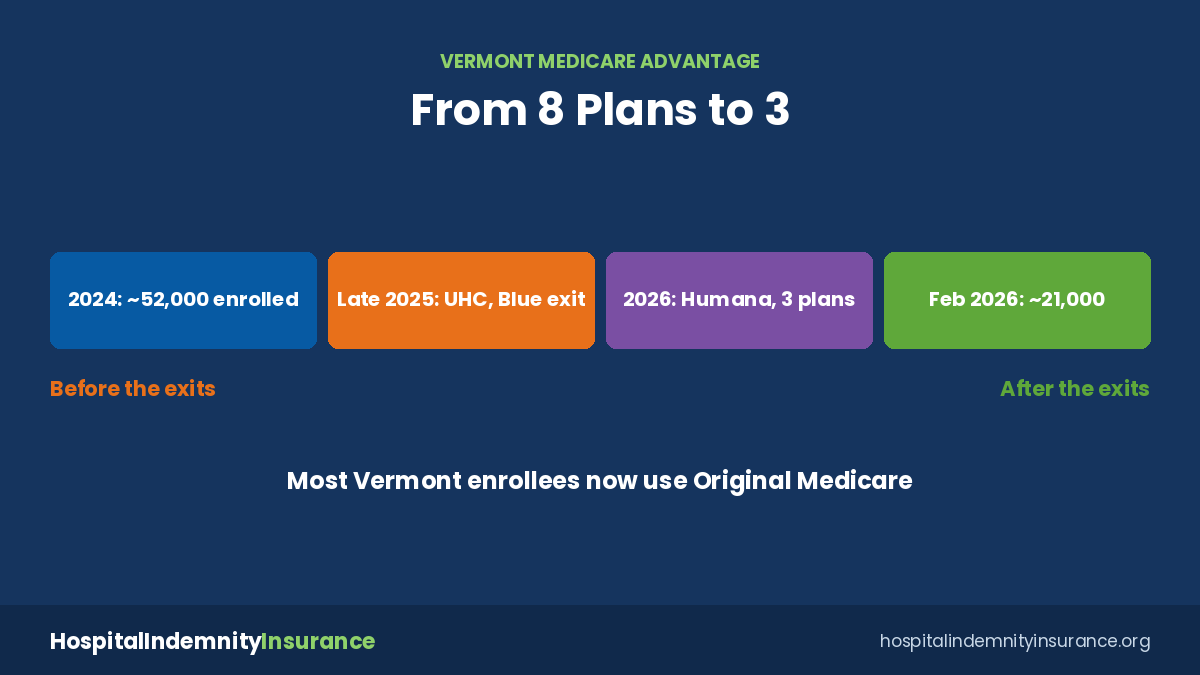
Vermont hospital indemnity insurance context: Medicare Advantage enrollment fell after UnitedHealthcare and Vermont Blue Advantage left

At the end of 2025, UnitedHealthcare and Vermont Blue Advantage stopped selling Medicare Advantage plans in the state. Healthcare Finance News reported Vermont’s plan count fell from eight in 2025 to three for 2026, all from Humana, and only 35.68% of the state’s 167,220 Medicare enrollees had a plan available where they live.

About 52,000 Vermonters were in Medicare Advantage in 2024, versus roughly 21,000 by February 2026, and KFF reports 60% of what remains is employer or union group coverage. Check the 2027 lineup during the October 15 to December 7 Medicare enrollment window.

Original Medicare without Medigap. You owe the Part A deductible for each benefit period, plus 20% of most Part B costs. A daily cash benefit can be aimed at that gap.

Original Medicare with Medigap. Most hospital costs are already covered, so a cash plan mainly helps with travel, lodging or help at home.

Lower-income enrollees. Vermont raised the Medicare Savings Program income limit on January 1, 2026, making more than 14,300 more people eligible for premium help, per the Office of the Health Care Advocate.

Our guide to how hospital indemnity works with Medicare walks through the pairing.

See Hospital Cash Plans for Your Vermont ZIP Code

Working Vermonters, Families and the Self-Employed

Only Blue Cross Blue Shield of Vermont and MVP sell plans on Vermont Health Connect; their approved 2027 increases were 2.2% and 3.9% before subsidies, and 30,344 people chose private plans for 2026. Enrollment for 2027 ends December 15.

Bronze and high-deductible buyers. A state health care advocate estimated about twice as many Vermonters picked bronze plans last year. A fixed benefit can be sized toward that deductible.

Parents of young children. Dr. Dynasaur covers children under 19 in households up to 317% of the poverty level with no premium or copays, so a family plan may matter more for the adults. See hospital indemnity for families.

Farmers, guides and sole owners. A daily benefit can replace some income lost during a stay. Read hospital indemnity for self-employed individuals.

Regulated prices, unregulated share: The Green Mountain Care Board reviews each hospital’s budget, and in September 2026 it ordered UVM Medical Center to cut commercial prices 4.4% for fiscal 2027. That shapes what insurers pay, not your deductible.

Reading a Vermont Outline of Coverage Line by Line

1

Check the title. A hospital confinement indemnity outline means the plan meets the $30 and 31-day floor; Limited Benefit Health Coverage means it does not.

2

Find the cover-page warning. Vermont filings carry a capitalized notice that the policy is not ACA coverage. If it is missing, ask whether the form is approved here.

3

Look up mental health stays. Under Vermont parity rules they should be paid like other covered admissions.

4

Note the age band and renewal terms. See whether the premium is set by attained age or issue age and whether the policy is guaranteed renewable.

5

Ask about out-of-state hospitals. Many Vermonters are treated in New Hampshire or New York. Confirm the definition of hospital is not limited by state.

6

Know where to complain. DFR’s Consumer Services handles insurance complaints for Vermont residents.

Bottom Line

Vermont hospital indemnity insurance pays fixed cash for covered stays, and Regulation 80-1 sets a floor of $30 a day for at least 31 days unless the plan is sold as limited benefit coverage. With most Advantage plans gone and bronze deductibles common, it can fill a gap, but only on top of real health coverage.

Get Free Vermont Hospital Indemnity Quotes

Vermont Hospital Indemnity Insurance — Frequently Asked Questions

➤ How much must hospital confinement indemnity insurance pay in Vermont?

Regulation 80-1 requires at least $30 a day for at least 31 days in each period of confinement. Plans paying less must be sold with a Limited Benefit Health Coverage outline.

➤ Do Vermont hospital cash plans pay for a psychiatric or substance use admission?

Vermont’s parity law applies to supplemental policies, and DFR rejects hospital definitions that exclude mental health or substance use facilities.

➤ Why does my hospital cash premium rise with age when my Vermont Health Connect premium does not?

Vermont’s marketplace plans cannot vary premiums by age, but hospital indemnity is a separate supplemental product. LifeSecure’s Vermont rates, for example, are set by age band.

➤ My Vermont Medicare Advantage plan ended. Is hospital indemnity a replacement?

No. It pays a fixed amount per stay or day and does not cover doctors, drugs or most bills. Look at Medigap and Medicare Savings Program help first.

➤ Can I buy hospital indemnity on Vermont Health Connect?

No. Vermont Health Connect sells qualified health and dental plans only, and subsidies cannot be used for a hospital indemnity policy.

➤ Is a hospital cash plan worth it if my children have Dr. Dynasaur?

Dr. Dynasaur has no premium or copays for covered children, so the hospital bill for a child is largely handled. The adults’ coverage is usually where a cash benefit has more use.

➤ Will a Vermont policy pay for a stay at a hospital in another state?

Many policies pay for a covered stay in any licensed hospital, but wording varies, so confirm the definition of hospital if you live near a state line.

➤ Who regulates hospital indemnity plans sold in Vermont?

The Vermont Department of Financial Regulation approves the forms, and its Consumer Services team handles complaints and denied claims.

Hospital Indemnity Quotes

Call a Licensed Agent Now

Compare hospital indemnity plans from several insurance companies in one call. Any age.

☎ 1-888-891-0229

No obligation to enroll

Find & Compare Plans Online

Speak with a licensed insurance agent

1-888-891-0229

ZRN Health & Financial Services, LLC, a Texas limited liability company