





Speak with a licensed insurance agent

1-888-891-0229

MetLife Hospital Indemnity Low vs High: Benefits, Costs and Which to Pick

Reviewed by Russell Noga, Licensed Insurance Agent — Last updated October 27, 2026

The MetLife High plan pays about twice as much cash per covered hospital stay as the Low plan, and its premium is roughly double. In published employer plans, a typical Low plan pays $500 per admission and $100 per day, while the High plan pays $1,000 and $200. Your employer sets the exact amounts.

MetLife sells hospital indemnity insurance mainly through employers, and many of those employers offer two choices at open enrollment: a Low Plan and a High Plan. Both pay you a fixed cash benefit when you are admitted to the hospital. The difference is how much cash you get and how much comes out of your paycheck.

This guide compares MetLife hospital indemnity low vs high plans using real benefit summaries that employers have published, then walks you through how to choose. For more on the carrier itself, see our full guide to MetLife hospital indemnity insurance.
Compare Hospital Indemnity Plans in Your Area

How MetLife Low and High Plans Work

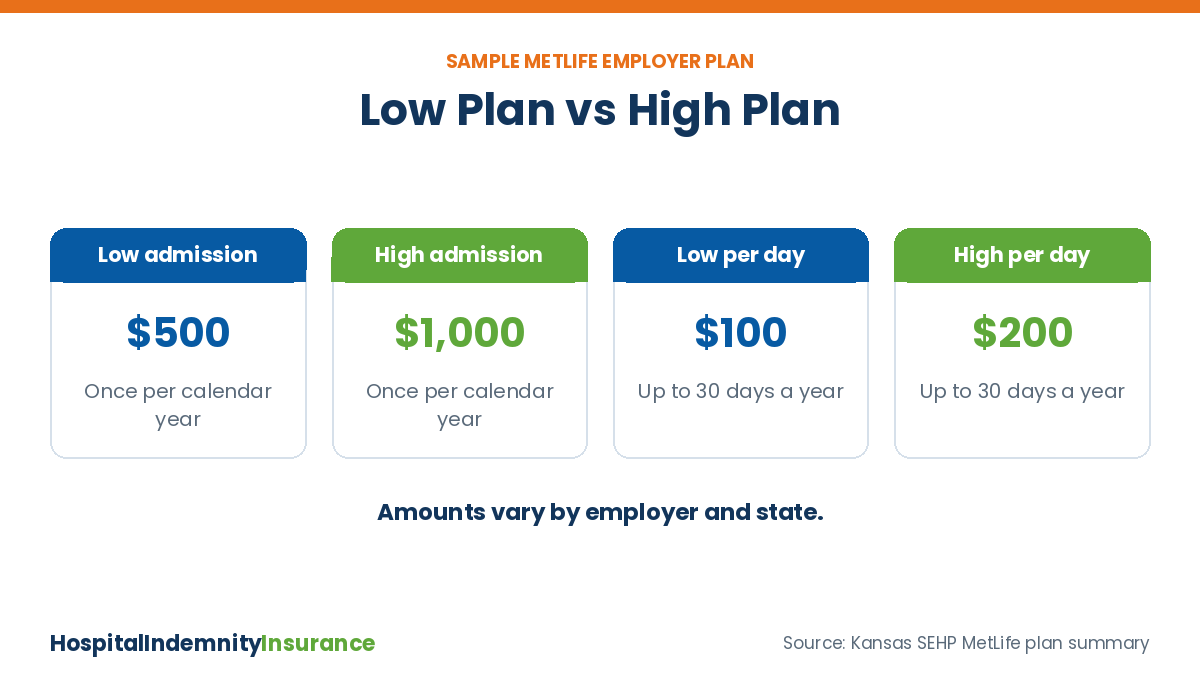
MetLife hospital indemnity low vs high chart showing admission and daily confinement amounts for each plan

MetLife hospital indemnity coverage is underwritten by Metropolitan Life Insurance Company. It pays a lump sum directly to you, not to the hospital, when a covered person is confined to a hospital because of an accident or sickness. MetLife counts an inpatient bed on a doctor’s advice as confinement. It also counts observation of at least 20 continuous hours on a doctor’s advice.

Same benefit menu. Low and High plans in the same employer group usually include the same benefits: admission, daily confinement, ICU, inpatient rehab and newborn care.

Bigger checks on High. The High plan pays larger amounts for each benefit, often about double the Low plan.

Higher premium on High. The High plan costs more each month, again often close to double.

Paid to you. You can use the cash for deductibles, copays, rent, childcare or travel.

Keep in mind that hospital indemnity is a limited-benefit plan that pays fixed amounts. It is not health insurance, does not replace your medical plan and does not count as minimum essential coverage under the Affordable Care Act.

Hospital Indemnity Quotes

Call a Licensed Agent Now

Compare hospital indemnity plans from several insurance companies in one call. Any age.

☎ 1-888-891-0229

No obligation to enroll

MetLife Low vs High Benefit Amounts

The table below shows a MetLife Low and High plan published for Kansas state employees. It is a good example of how the two levels line up, but your employer’s plan may use different amounts and limits.

Benefit Low Plan High Plan
Admission (once per calendar year) $500 $1,000
ICU supplemental admission $500 $1,000
Daily confinement (up to 30 days a year) $100 per day $200 per day
ICU supplemental confinement (up to 20 of those days) $100 per day $200 per day
Newborn nursery (2 days per confinement) $100 per day $200 per day
Inpatient rehabilitation (15 days a year) $100 per day $200 per day

Source: Kansas State Employee Health Plan MetLife hospital indemnity summary. Admission amounts are higher in some states, such as Connecticut and Idaho. When a plan includes an admission benefit, confinement starts on day 2.

Some employers design the levels differently. In a Nevada university plan, the High plan also starts paying confinement on the same day as admission, while the Low plan starts on day 2. That plan’s High option also pays the sickness admission benefit up to four times a year, compared with once a year on the Low plan. Small design details like these can matter as much as the headline amounts.

What a Hospital Stay Could Pay on Each Plan

Here is a simple example using the Kansas amounts above. Say you are admitted for a sickness and stay four days, with no ICU time. The admission benefit pays once, and daily confinement starts on day 2.

Example 4-day stay Low Plan High Plan
Admission benefit $500 $1,000
Confinement, days 2 to 4 $300 $600
Total cash paid to you $800 $1,600

Illustration only, based on one published employer plan. Actual payments depend on your certificate and the claim.

Broker tip: Compare the total to your health plan’s deductible. If your deductible is $3,000 or more, the Low plan may only cover a small slice, and the High plan can close more of the gap.

MetLife Low vs High Premiums

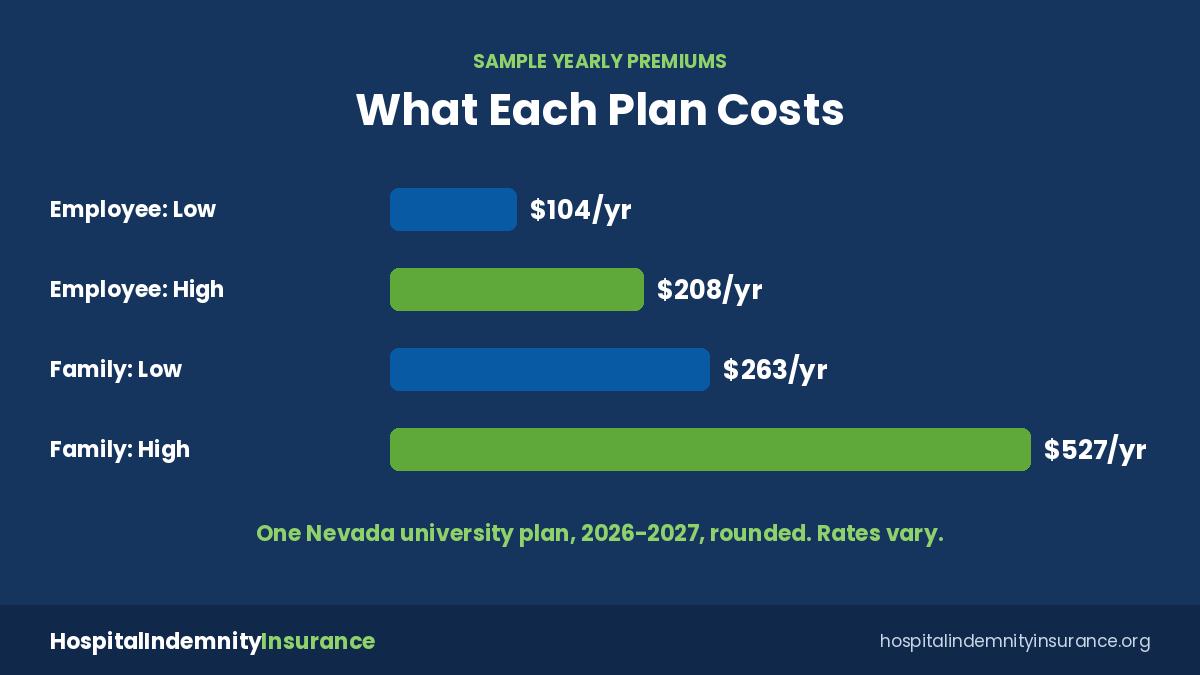
MetLife hospital indemnity low vs high yearly premium example by coverage tier

Premiums are set by your employer’s group contract and the people you cover. The example below is from a Nevada state university plan for the 2026-2027 plan year. It shows how the High plan costs about twice the Low plan at every coverage tier.

Who is covered Low Plan (monthly) High Plan (monthly)
Employee only $8.66 $17.32
Employee + spouse $14.60 $29.20
Employee + child(ren) $12.36 $24.72
Employee + spouse and child(ren) $21.95 $43.90

Source: Nevada System of Higher Education MetLife hospital comparison flyer. The flyer lists two rate sets; this is one of them. Your rates will differ.

In this example, choosing the High plan for employee-only coverage costs about $104 more per year. If you are admitted even once, the extra admission benefit alone could more than repay that difference. See the MetLife hospital indemnity high plan page for more on the upgrade.

See Hospital Indemnity Plans Near You

Rules That Apply to Both MetLife Plans

Pre-existing conditions. MetLife says a pre-existing condition limitation may apply to hospital sickness benefits. Check your plan’s look-back and exclusion period.

Benefits after 65. MetLife notes that benefits may be reduced starting at age 65 in some plans.

Portability. MetLife says you may be able to keep coverage if you leave your job or retire, through its continuation provision, subject to eligibility rules.

Medical coverage required in some states. Some states require you to have medical coverage to enroll in hospital indemnity.

Pregnancy and childbirth rules also vary by plan, so read the certificate before you count on a payment for a delivery. Our guide to MetLife hospital indemnity pregnancy coverage covers that topic in detail.

How to Pick Between MetLife Low and High

1

Check your health plan’s hospital costs. Find your deductible, hospital copay and out-of-pocket maximum.

2

Get your employer’s two summaries. Ask HR for the Low and High benefit schedules and the premium for your coverage tier.

3

Run a sample stay. Add the admission and a few days of confinement on each plan to see the real gap.

4

Weigh your household’s risk. Families, people planning a birth or surgery, and those with chronic conditions often get more value from the High plan.

5

Decide by open enrollment. You can usually change levels only during open enrollment or after a qualifying life event.

If you do not have MetLife at work, or you want to compare outside your employer, an independent agent can show individual plans from several carriers. Our general guide to hospital indemnity insurance low vs high plans explains the same decision across companies.

Bottom Line

MetLife hospital indemnity low vs high is mostly a question of scale: the High plan pays about double per stay for about double the premium. If a hospital stay would hit your deductible hard, the High plan usually earns its cost; if you are healthy and on a tight budget, the Low plan gives a smaller but useful cash cushion.

Get Free Hospital Indemnity Insurance Quotes

MetLife Hospital Indemnity Low vs High — Frequently Asked Questions

➤ What is the difference between MetLife hospital indemnity low and high?

The two plans usually cover the same events. The High plan pays larger cash amounts, often about double, and its premium is about double too.

➤ How much does the MetLife Low plan pay for a hospital stay?

In one published employer plan, the Low plan pays $500 per admission and $100 per day of confinement, while the High plan pays $1,000 and $200. Your employer’s plan may differ.

➤ Does MetLife hospital indemnity cover observation stays?

MetLife counts observation of at least 20 continuous hours on a doctor’s advice as hospital confinement. Shorter observation stays may not qualify.

➤ Who underwrites MetLife hospital indemnity?

Benefits are underwritten by Metropolitan Life Insurance Company. In 2026, AM Best affirmed its A+ (Superior) financial strength rating.

➤ Can I keep MetLife hospital indemnity if I leave my job?

MetLife says you may be able to keep it through its continuation provision, subject to eligibility requirements. Ask MetLife or HR before you leave.

➤ Are MetLife benefits reduced at 65?

MetLife notes that benefits may be reduced starting at age 65 in some plans. Check your certificate for the exact rule.

➤ Is MetLife hospital indemnity health insurance?

No. It is a limited-benefit plan that pays fixed cash amounts. It does not replace health insurance or count as minimum essential coverage under the Affordable Care Act.

➤ Can I buy MetLife hospital indemnity on my own?

MetLife mainly offers it through employers. If yours does not, you can compare individual hospital indemnity plans from other carriers.

Hospital Indemnity Quotes

Call a Licensed Agent Now

Compare hospital indemnity plans from several insurance companies in one call. Any age.

☎ 1-888-891-0229

No obligation to enroll

Find & Compare Plans Online

Speak with a licensed insurance agent

1-888-891-0229

ZRN Health & Financial Services, LLC, a Texas limited liability company