





Speak with a licensed insurance agent

1-888-891-0229

Can You Go to the Hospital Without Insurance? Your Rights, the Bill and Next Steps

Reviewed by Russell Noga, Licensed Insurance Agent — Last updated November 1, 2026

Yes. Under the federal EMTALA law, any hospital emergency department that takes Medicare must screen you and stabilize an emergency medical condition whether or not you have insurance or can pay. You will still get a bill afterward, and for scheduled, non-emergency care a hospital can ask for payment or a deposit before treating you.

2027 by the Numbers

26.7 million

people uninsured for all of 2025 (U.S. Census Bureau)

240 days

to apply for nonprofit hospital financial aid after the first bill (IRS 501(r))

2 months

Medicaid look-back for most new applicants starting 2027, down from 3 (H.R. 1)

60 days

to pick a Marketplace plan after losing coverage (HealthCare.gov)

If you are hurt, very sick or in labor, nobody at the emergency entrance gets to check your insurance card first. That protection is real, but it covers emergency care only, and it does nothing about the bill that arrives weeks later.

So if you are asking, can I go to the hospital without insurance, the full answer has three parts: what the hospital must do, what you can do about the bill, and how to get covered before the next visit. We also explain where a fixed-cash plan fits and why it is not the same thing as health insurance.
Compare Hospital Indemnity Plans in Your Area

Your Right to Emergency Care Under EMTALA

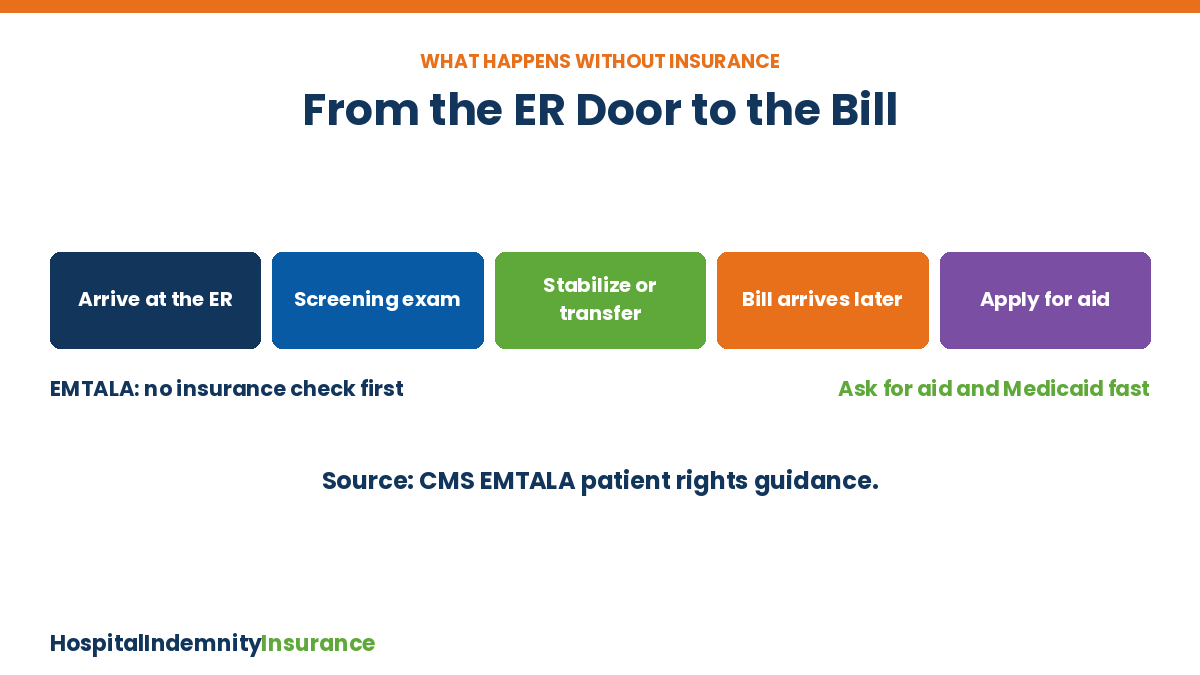
Can you go to the hospital without insurance: EMTALA steps from arrival to billing

The Emergency Medical Treatment and Labor Act (EMTALA) applies to hospital emergency departments that receive Medicare funds, which CMS says includes most U.S. hospitals. It protects everyone who walks in, insured or not, of any age.

A screening exam. A qualified professional checks whether you have an emergency medical condition.

Stabilizing treatment. If you do, the hospital treats you until the condition is unlikely to get materially worse.

A safe transfer. If it can’t stabilize you, it must arrange an appropriate transfer to a hospital that can.

Insurance questions can wait. Staff may ask about coverage at check-in only if that doesn’t delay your care.

Good to know: CMS notes that an emergency medical condition can include contractions, so a person in labor has the same rights.

Hospital Indemnity Quotes

Call a Licensed Agent Now

Compare hospital indemnity plans from several insurance companies in one call. Any age.

☎ 1-888-891-0229

No obligation to enroll

Emergency vs. Scheduled Care: Where the Rules Change

EMTALA is an emergency law. Once you are stable, or if your visit was never an emergency, the hospital’s normal payment policies take over. The same hospital that must treat you tonight can ask for a deposit before a planned procedure next week.

Type of visit Must the hospital see you? Can it ask for money first?
Emergency department, possible emergency Yes, under EMTALA Not before screening and stabilizing care
Admission that starts as an emergency Yes, until you are stable It can bill you later for the stay
Scheduled surgery, test or scan No federal duty Yes, often a deposit or estimated payment
Follow-up visits after discharge No EMTALA duty Yes, under the provider’s policy
Stand-alone urgent care clinic Often not a hospital ER, so EMTALA may not apply Often yes, at the visit

Compiled from CMS EMTALA patient-rights guidance. State laws and hospital policies can add protections.

Uninsured and self-pay patients booking care at least 3 business days ahead are owed a written good faith estimate under the No Surprises Act. Keep it: it is your proof if the bill runs high.

What Happens With the Bill After You Leave

Without coverage, you owe the hospital’s charges plus separate bills from doctors, labs and imaging groups, often at list prices higher than insurers pay. Our guide to overnight hospital stay costs covers the per-day figures.

1

Ask for an itemized statement. Look for duplicate charges or services you never got.

2

Ask whether the hospital is nonprofit. Most nonprofit hospitals must follow the federal financial assistance rules below.

3

Request the financial assistance application. Apply even if you think your income is too high. Each hospital sets its own limits.

4

Apply for Medicaid at the same time. If you qualify, Medicaid may pay for recent months.

5

Only then set up a payment plan. Try to shrink the balance first.

Watch the clock: A nonprofit hospital must wait at least 120 days after the first post-discharge bill before extraordinary collection actions, with written notice at least 30 days before.

Five Protections Compared: Who Qualifies and the Deadlines

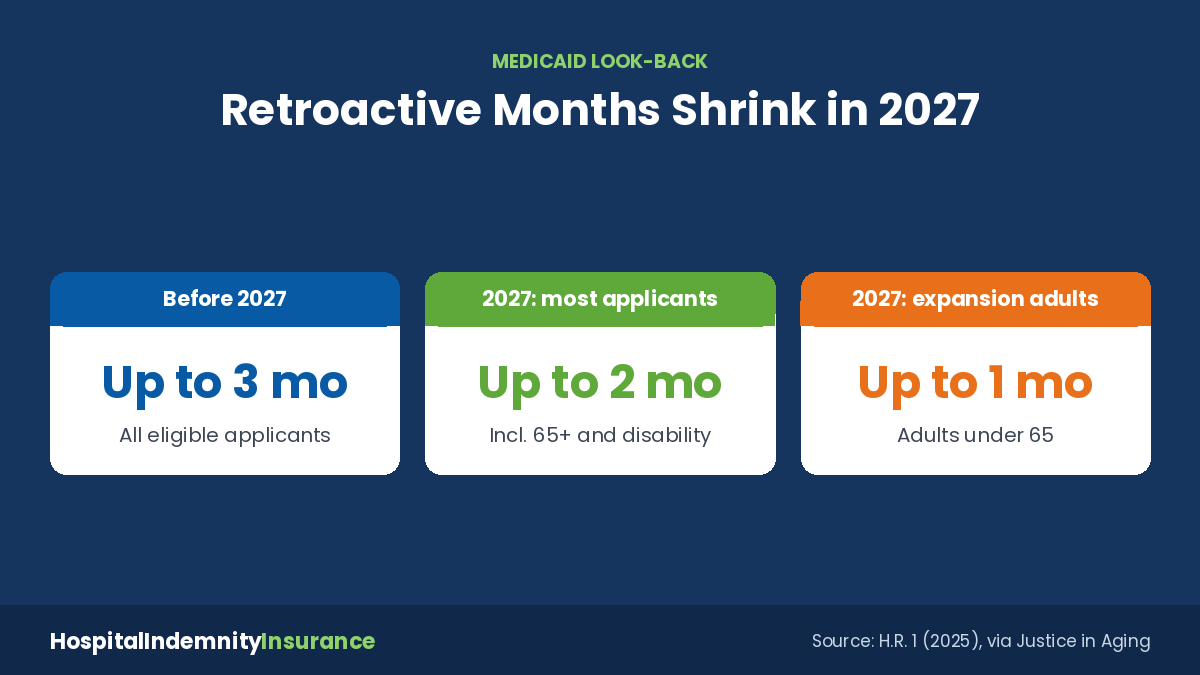
Medicaid retroactive coverage look-back before and after 2027 for people who go to the hospital without insurance

Each rule comes from a different federal law and covers a different moment, from the emergency itself to the bill months later. We compiled them into one table from the primary sources. Medicaid coverage dates from the month you apply, not the month you are approved, so applying fast matters more once the look-back shrinks.

Protection Who it helps What it does Time limit
EMTALA Anyone at a Medicare-funded hospital emergency department Screening and stabilizing care regardless of ability to pay During the emergency only
Nonprofit hospital financial assistance (IRS 501(r)) Patients who meet the hospital’s written rules, often income-based Free or discounted care; eligible patients can’t be charged more than insured patients are generally billed for emergency or medically necessary care At least 240 days from the first post-discharge bill
Medicaid retroactive coverage People who were eligible in the months before applying Pays covered bills from those months 3 months back now; from 2027, 2 months for most and 1 month for expansion adults
Marketplace special enrollment People who lose job-based or other qualifying coverage Buy a plan outside open enrollment 60 days from the loss of coverage
Good faith estimate dispute Uninsured or self-pay patients with scheduled care Challenge a bill well above the estimate $400+ over; dispute within 120 days

Sources: CMS EMTALA and No Surprises Act guidance, IRS Section 501(r) billing and charge rules, H.R. 1 (2025) as summarized by Justice in Aging, HealthCare.gov. For-profit and government hospitals follow their own aid policies and any state rules.

Extraordinary collection actions. The IRS list includes selling the debt, credit reporting, lawsuits, liens, wage garnishment and delaying needed care over an old bill.

See Plans That Pair With Your Health Coverage

How to Get Real Coverage Before the Next Hospital Visit

The best protection against a hospital bill is coverage that counts as real health insurance. Depending on your income, age and job, one of these routes is likely open now.

1

Check Medicaid and CHIP first. You can apply any time of year, and children may qualify even when parents don’t.

2

Use open enrollment for 2027 coverage. On HealthCare.gov it runs November 1, 2026 to January 15, 2027 in most states; enroll by December 15 for a January 1 start. A shorter window was blocked in court and is under appeal, so confirm dates.

3

Use a special enrollment period. Losing a job-based plan gives you 60 days to pick a Marketplace plan. Getting sick alone does not qualify.

4

Turning 65? Enroll in Medicare on time to avoid gaps and late penalties.

Plain fact: A new plan generally won’t pay for a stay that happened before it started. Medicaid’s retroactive months are the main exception.

Where Hospital Indemnity Fits, and Where It Doesn't

A hospital indemnity plan pays you a fixed cash amount when you are admitted, and some plans pay for an emergency visit or observation stay. It is a limited-benefit plan. It is NOT health insurance, does not meet ACA minimum essential coverage and is no substitute for being uninsured.

High-deductible and ACA plan members. Cash can help with the deductible. See hospital indemnity for high-deductible plans.

Medicare Advantage members. A fixed benefit can offset daily inpatient copays. Read about hospital indemnity with Medicare Advantage.

Self-employed workers. A stay can cost income too. See hospital indemnity for self-employed individuals.

Expecting parents. Childbirth is a hospital stay, so buy well before a due date and check any waiting period.

Already covered and shopping on your own? Start with individual hospital indemnity insurance. With no coverage at all, get Medicaid or a Marketplace plan first.

Bottom Line

You can go to the hospital without insurance: a Medicare-funded emergency department must screen and stabilize you whatever you can pay. The bill still comes, so apply for nonprofit financial assistance and Medicaid quickly, then get real coverage. Hospital indemnity is a cash supplement for people who already have health insurance, not a replacement.

Get Free Hospital Indemnity Insurance Quotes

Going to the Hospital Without Insurance — Frequently Asked Questions

➤ Can a hospital turn me away if I don’t have insurance?

A hospital emergency department that takes Medicare can’t deny you a screening exam or stabilizing care because you lack insurance or money. For scheduled care, the hospital sets its own payment rules.

➤ Can I go to the hospital without insurance for something that isn’t an emergency?

Yes, but you will usually be a self-pay patient. Ask for a written good faith estimate and whether the hospital offers a self-pay discount or financial assistance.

➤ Will the ER ask for my insurance or payment before treating me?

Staff may ask about coverage at check-in, but CMS says that can’t delay your exam or treatment.

➤ Do I still have to pay the bill afterward?

Yes. EMTALA guarantees care, not free care. You can apply for financial assistance and Medicaid, dispute errors and ask for a payment plan.

➤ How long do I have to apply for hospital financial assistance?

At a nonprofit hospital, IRS rules give you at least 240 days from the first post-discharge bill. Apply early, before any collection activity.

➤ Can Medicaid pay for a hospital stay that already happened?

It can, if you were eligible in those months. The look-back is up to 3 months today; starting in 2027 it is 2 months for most applicants and 1 month for expansion adults.

➤ Can I buy health insurance after going to the hospital?

You can enroll in Medicaid any time if eligible, or in a Marketplace plan during open enrollment or a special enrollment period. A new plan generally won’t pay for earlier care.

➤ Is hospital indemnity insurance enough if I’m uninsured?

No. It pays limited, fixed cash amounts and is not health insurance or ACA minimum essential coverage. It is meant to sit on top of a real health plan.

Hospital Indemnity Quotes

Call a Licensed Agent Now

Compare hospital indemnity plans from several insurance companies in one call. Any age.

☎ 1-888-891-0229

No obligation to enroll

Find & Compare Plans Online

Speak with a licensed insurance agent

1-888-891-0229

ZRN Health & Financial Services, LLC, a Texas limited liability company