





Speak with a licensed insurance agent

1-888-891-0229

Colonial Life Critical Illness Insurance Coverage: Covered Conditions, Payouts and Limits

Reviewed by Russell Noga, Licensed Insurance Agent — Last updated October 28, 2026

Colonial Life critical illness insurance coverage pays a lump sum of cash when you are diagnosed with a covered condition such as a heart attack, stroke, kidney failure or major organ failure. Most covered conditions pay 100% of the amount you choose, coronary artery bypass surgery pays 25%, and some plans also include cancer and a yearly health screening benefit.

Colonial Life & Accident Insurance Company, based in Columbia, South Carolina, sells critical illness coverage mainly through the workplace. You usually enroll during your employer’s benefits enrollment and pay by payroll deduction. The cash goes to you, not to doctors, so you decide how to use it.

This page focuses on what the coverage actually pays for: which conditions qualify, how much each pays, what happens if you get sick again and what is excluded. For the bigger picture, start with our Colonial Life critical illness insurance overview.
Compare Critical Illness and Hospital Plans

What Colonial Life Critical Illness Coverage Is (and Is Not)

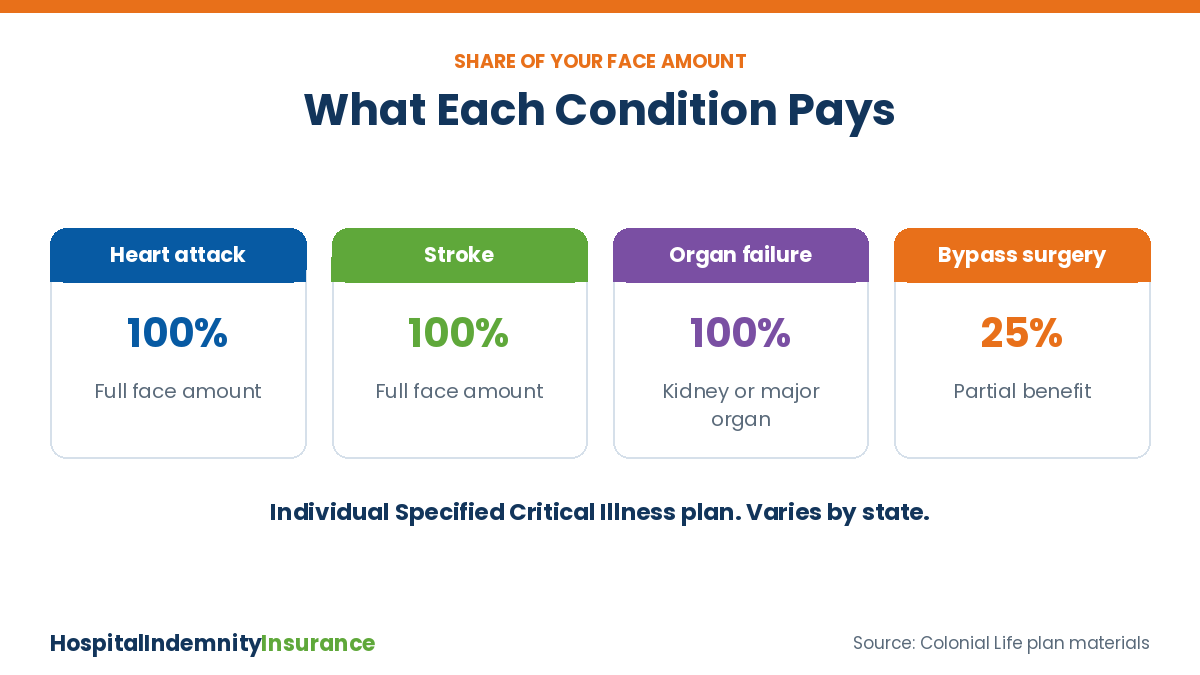
Colonial Life critical illness insurance coverage payouts by condition as a share of face amount

Critical illness insurance is a limited-benefit supplement. When a covered condition meets the policy’s definition, the plan pays a set percentage of your face amount in one lump sum. Your medical plan still pays your doctors and hospital. The critical illness payment is extra cash for everything else.

Pays a lump sum. One payment after a qualifying diagnosis, based on the face amount you chose at enrollment.

Use it any way you want. Deductibles, travel for treatment, mortgage payments, child care or lost pay while you recover.

Built to sit on top of health insurance. It fills money gaps but does not pay providers or cover routine care.

Colonial Life is part of Unum Group. In September 2025, AM Best affirmed an A (Excellent) financial strength rating for Unum’s U.S. insurance companies. Coverage is open to working adults of many ages, and plans often let you add a spouse and children, so it is not just for older workers. Benefits, definitions and options vary by state and by the plan your employer picks.

Important: Critical illness insurance and hospital indemnity are limited-benefit plans that pay fixed cash amounts. They are NOT health insurance, do not replace major medical coverage and do not meet ACA minimum essential coverage.

Hospital Indemnity Quotes

Call a Licensed Agent Now

Compare hospital indemnity plans from several insurance companies in one call. Any age.

☎ 1-888-891-0229

No obligation to enroll

Conditions Covered and What Each One Pays

Colonial Life’s individual Specified Critical Illness plan lists the conditions below. Each pays a share of your face amount. If you choose $20,000, a 100% condition pays $20,000 and a 25% condition pays $5,000.

Covered condition Share of face amount paid
Heart attack 100%
Stroke 100%
End-stage renal (kidney) failure 100%
Major organ failure 100%
Permanent paralysis from a covered accident 100%
Coma 100%
Blindness 100%
Occupational infectious HIV or hepatitis B, C or D 100%
Coronary artery bypass graft surgery (or coronary artery disease on HSA plans) 25%

Source: Colonial Life Specified Critical Illness plan materials (policy series CI 1.0). Definitions and conditions vary by state and plan.

Cancer is not on the individual list above. Many employer group plans from Colonial Life do include cancer along with heart attack, stroke, organ failure, kidney failure and coma. Check your own plan summary, and see our page on Colonial Life critical illness insurance for cancer if that is your main concern.

What Happens if You Are Diagnosed Again

A first payout does not always end your coverage. Colonial Life’s plan with a subsequent diagnosis benefit can pay again, with limits.

A different covered condition. Pays its full original percentage. A stroke after a paid heart attack can pay 100% again.

The same condition again. Pays 25% of the face amount. Bypass surgery and occupational HIV or hepatitis do not qualify.

Time between diagnoses. The two diagnoses must be at least 180 days apart.

Lifetime cap. Total benefits are capped at 3 times the named insured’s face amount, shared by everyone covered. The policy ends when the cap is paid.

Broker tip: Not every Colonial Life version has the same repeat-diagnosis rules. Plans without the subsequent diagnosis feature may cap total benefits at 100% of the face amount. Ask which version your employer offers.

Extra Benefits, Exclusions and Waiting Rules

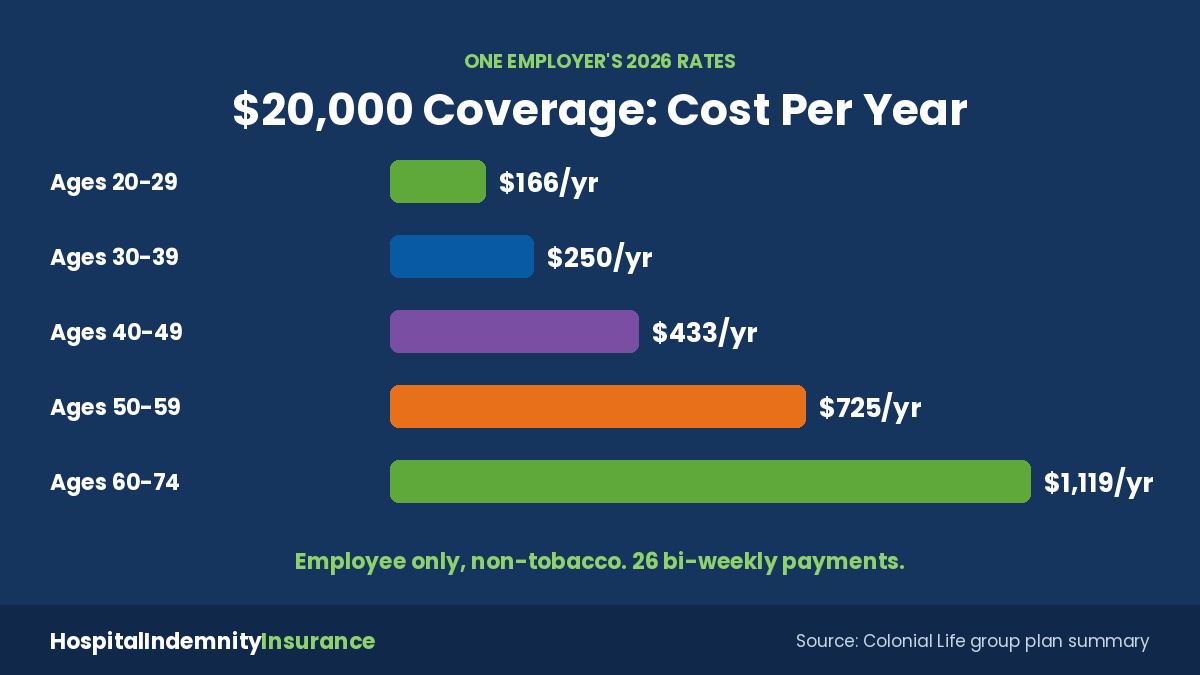
Colonial Life critical illness insurance coverage cost by age for a $20,000 benefit

Beyond the main lump sum, read the smaller benefits and the exclusions. They decide how much value you get from each premium dollar.

Feature What we found in Colonial Life materials
Health screening benefit One 2026 employer plan pays $100 a year for a covered screening such as a mammogram, colonoscopy, Pap test, PSA, cholesterol test or EKG
Pre-existing conditions Excluded; one group plan applies its limit for the first 12 months
Other exclusions Felonies, intoxicants or narcotics, psychiatric conditions, suicide or self-inflicted injury and war
Who can be covered Employee, spouse and children, depending on the coverage tier
If you leave your job One 2026 group plan says coverage is portable at the same cost and coverage

Sources: Colonial Life plan summaries from employers, 2026. Your plan’s terms may differ.

The health screening benefit can offset part of your premium if you get one routine test a year. Read more on Colonial Life critical illness insurance benefits.

See Supplemental Plans Available in Your Area

What Colonial Life Critical Illness Coverage Costs

Your price depends on your age band, the face amount, tobacco use and who you cover. Colonial Life does not publish one national rate chart, but employers often share theirs. Here is one real example for a single employee who does not use tobacco, paid every two weeks.

Age band $10,000 $20,000 $30,000
20-29 $4.73 $6.39 $8.05
30-39 $6.35 $9.62 $12.90
40-49 $9.85 $16.64 $23.42
50-59 $15.49 $27.90 $40.32
60-74 $23.05 $43.04 $63.02

Bi-weekly employee rates from one Massachusetts employer’s 2026 Colonial Life group plan. Your rates will differ.

For more on pricing, see Colonial Life critical illness insurance cost.

Critical Illness Coverage vs. Hospital Indemnity

Critical illness pays once for a serious diagnosis. Hospital indemnity pays for each covered hospital admission or day, whatever the reason. Many families pair the two: hospital indemnity for common stays such as childbirth, surgery or pneumonia, and critical illness for the rare but costly events.

Families with young children often lean toward hospital indemnity because kids, pregnancy and accidents lead to short hospital stays more often than to a critical diagnosis. People with a family history of heart disease or stroke may value critical illness more. Neither plan is a substitute for a solid emergency fund, but either one can keep a medical event from turning into a debt problem.

1

List your out-of-pocket risk. Find your health plan’s deductible and out-of-pocket maximum.

2

Decide what worries you most. A big diagnosis points to critical illness. Frequent or likely hospital stays point to hospital indemnity.

3

Read the condition list. Make sure the conditions you care about, such as cancer, are covered in your version.

4

Compare before enrollment closes. Workplace plans often have short windows, and late enrollment may require health questions.

See how the two work side by side in critical illness insurance vs. hospital indemnity.

Bottom Line

Colonial Life critical illness insurance coverage pays a cash lump sum for listed conditions, usually 100% of your face amount for events like heart attack and stroke and 25% for bypass surgery. Check whether your version covers cancer, pays for repeat diagnoses and includes a health screening benefit before you enroll.

Get Free Supplemental Insurance Quotes

Colonial Life Critical Illness Insurance Coverage — Frequently Asked Questions

➤ What does Colonial Life critical illness insurance cover?

The individual plan covers heart attack, stroke, end-stage kidney failure, major organ failure, accidental permanent paralysis, coma, blindness and occupational HIV or hepatitis at 100%, and bypass surgery at 25%.

➤ Does Colonial Life critical illness cover cancer?

Many Colonial Life group plans include cancer, but the individual Specified Critical Illness list does not. Check your plan summary or ask about a cancer option.

➤ How much does it pay?

It pays a percentage of the face amount you choose. Group plans we reviewed offered $10,000, $20,000 or $30,000.

➤ Can Colonial Life critical illness pay more than once?

Yes, on plans with a subsequent diagnosis benefit. A different condition pays its full percentage, the same condition pays 25%, and diagnoses must be 180 days apart.

➤ Does it cover pre-existing conditions?

Illnesses caused by a pre-existing condition are excluded. One group plan we reviewed applies this limit for the first 12 months of coverage.

➤ Is there a health screening benefit?

Some plans pay one, such as $100 a year for a covered screening like a mammogram, colonoscopy or cholesterol test.

➤ Can I keep coverage if I leave my job?

Many Colonial Life plans are portable. One 2026 group plan says you can keep the same cost and coverage after you leave.

➤ Is critical illness insurance the same as health insurance?

No. It is a limited-benefit plan that pays cash amounts. It does not replace health insurance or meet ACA minimum essential coverage.

Hospital Indemnity Quotes

Call a Licensed Agent Now

Compare hospital indemnity plans from several insurance companies in one call. Any age.

☎ 1-888-891-0229

No obligation to enroll

Find & Compare Plans Online

Speak with a licensed insurance agent

1-888-891-0229

ZRN Health & Financial Services, LLC, a Texas limited liability company