





Speak with a licensed insurance agent

1-888-891-0229

Colonial Life Critical Illness Insurance: The Individual and Group Plans, Side by Side

Reviewed by Russell Noga, Licensed Insurance Agent — Last updated November 21, 2026

Colonial Life critical illness insurance is a workplace plan from Colonial Life & Accident Insurance Company, a Unum Group company, that pays you a lump sum when you are diagnosed with a covered illness such as a heart attack, stroke or kidney failure. You enroll through an employer that offers it, and the money goes to you to spend as you choose, but it is a limited-benefit supplement, not health insurance.

2027 by the Numbers

A (Excellent)

AM Best financial strength rating for Colonial Life & Accident Insurance Company, affirmed September 2025

3x

lifetime maximum, as a multiple of the face amount, on the Critical Illness 1.0 policy with subsequent diagnosis

180 days

minimum gap between diagnosis dates for a second payment (Colonial Life brochures)

24

screening tests listed for the health screening benefit (Colonial Life brochures)

Colonial Life is based in Columbia, South Carolina, and sells voluntary benefits that employees pay for through payroll. Its critical illness coverage comes in more than one version, and two coworkers at different companies can hold plans with the same name that pay very differently.

This page is the hub for the brand. It explains the main Colonial Life critical illness plans, how each one pays, and where they fit next to your health plan. The full condition-by-condition list lives on our Colonial Life critical illness insurance coverage page.
Compare Critical Illness and Hospital Indemnity Plans

How Does Colonial Life Critical Illness Insurance Work?

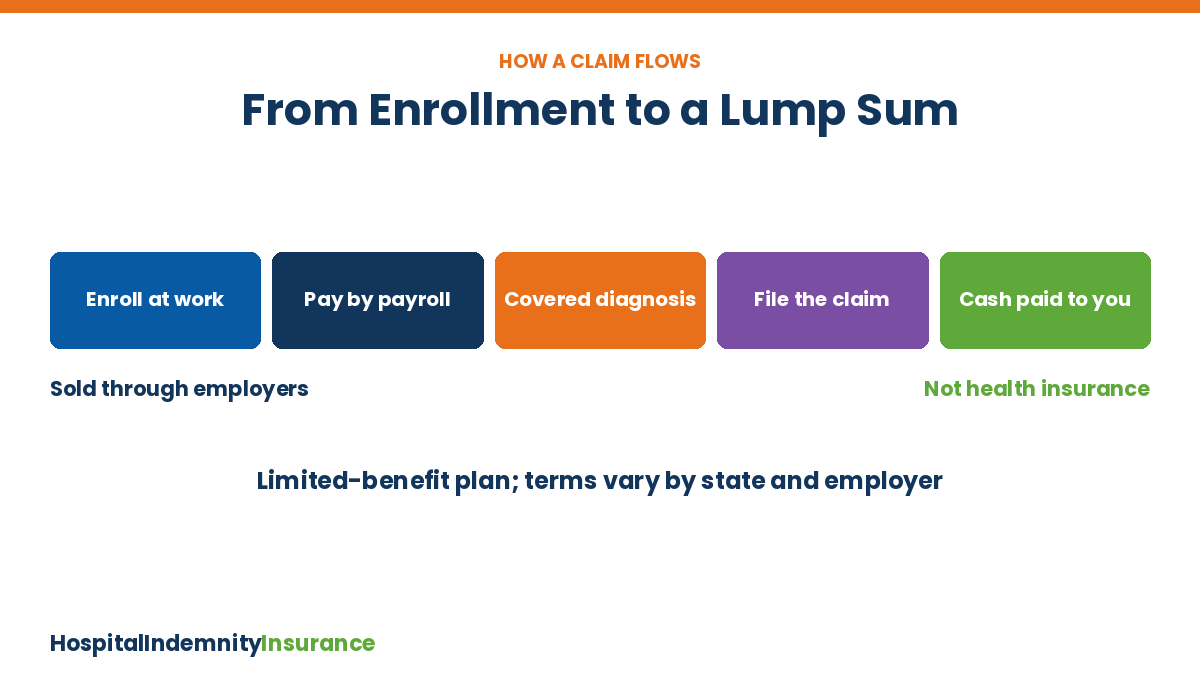
How Colonial Life critical illness insurance works from workplace enrollment to a lump-sum payment

The plan pays a set share of a coverage amount you pick at enrollment. A covered diagnosis triggers the payment, not a hospital bill. Colonial Life names deductibles, copays, travel during treatment and home health care as common uses, but the check comes to you to spend as you choose.

1

Your employer offers it. Colonial Life sells through businesses, not through a consumer website. Enrollment usually happens during your benefits window, often with a Colonial Life benefits counselor.

2

You choose an amount and who is covered. Premiums come out of your paycheck. Spouses and children can usually be added, at amounts tied to yours.

3

A doctor diagnoses a covered illness. The diagnosis must meet the policy’s definition and fall after any pre-existing condition period.

4

You file and get paid. Benefits are paid regardless of other insurance you have, so the plan pays on top of your health coverage.

Keep in mind: Every Colonial Life document reviewed for this page states that the coverage provides limited benefits. It does not pay doctor or hospital bills directly, does not replace major medical coverage and is not ACA minimum essential coverage.

Hospital Indemnity Quotes

Call a Licensed Agent Now

Compare hospital indemnity plans from several insurance companies in one call. Any age.

☎ 1-888-891-0229

No obligation to enroll

The Colonial Life Critical Illness Plan Lineup: Policy vs. Group Certificate

Colonial Life’s site offers employers both individual and group critical illness coverage. The individual product is a policy you own, sold at work under form numbers starting with CI-1.0. The group product is a certificate under your employer’s master policy, form GCI6000. We lined up the terms from Colonial Life brochures posted by employers so you can tell them apart.

Feature Critical Illness 1.0 (individual policy) Group Critical Illness (GCI6000)
Who owns it You own the policy Employer holds the master policy; you get a certificate
Adult conditions at 100% Heart attack, stroke, end-stage renal failure, major organ failure, coma, blindness, paralysis from a covered accident, occupational HIV or hepatitis B, C or D Adds benign brain tumor, sudden cardiac arrest and loss of hearing or speech to a similar list
Paid at 25% Coronary artery bypass graft surgery (coronary artery disease on HSA versions) Coronary artery disease
Children Family coverage available; terms vary Spouse at 50%; children at 50% at no added cost, plus five childhood conditions
Cancer Not on the base condition list Sold as a separate group cancer plan design on the same form
Second diagnosis Only on versions with subsequent diagnosis Built in: up to 100% for a different illness, 25% for the same one
Lifetime cap 100% of face amount without subsequent diagnosis; 3x with it Set in the certificate schedule

Compiled by HospitalIndemnityInsurance.org from Colonial Life brochures and plan summaries (forms CI-1.0, CI-1.0-PL6 and GCI6000) posted by employers, checked November 2026. Features, amounts and condition lists vary by state, employer and plan.

Read the form number: The form number printed at the bottom of your brochure, such as CI-1.0-TX or GCI6000-C, tells you which set of rules applies. Ask your benefits counselor for it before comparing your plan to anything online.

What a Colonial Life Critical Illness Policy Pays For

Both versions use the same basic math: each condition pays a percentage of your coverage amount. Most major heart, brain and organ events pay the full amount, while a less severe heart diagnosis pays a quarter.

Full-amount events. Heart attack, stroke, kidney failure, organ failure needing a transplant and coma pay 100% in both plan families.

Quarter-amount heart benefit. Bypass surgery or coronary artery disease pays 25%, so a heart condition can pay out without a heart attack.

Childhood conditions. The group plan pays 100% of a child’s amount for cerebral palsy, cleft lip or palate, cystic fibrosis, Down syndrome or spina bifida.

Cancer is separate. The critical illness plans reviewed did not list cancer; employers add it through a cancer plan design. See Colonial Life critical illness insurance for cancer.

Exclusions include illnesses tied to felonies, intoxicants, self-inflicted injury and war. Exact definitions, such as what counts as a stroke, are in the policy.

Second Diagnoses: The Rule That Changes a Plan's Value Most

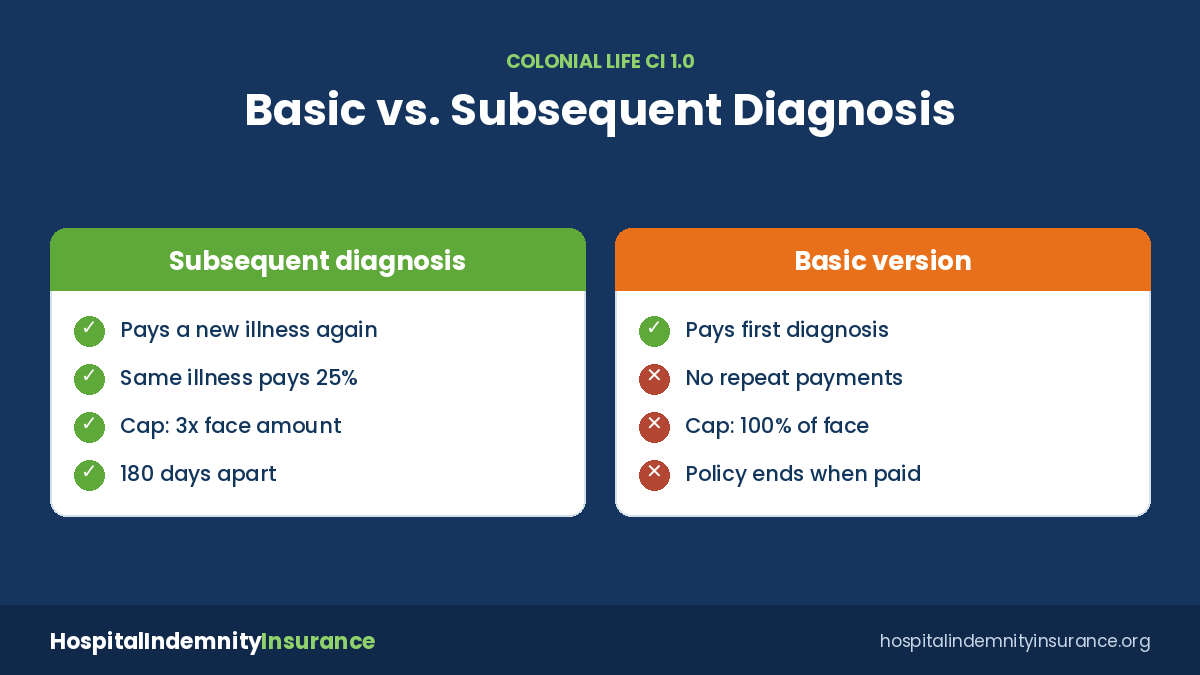
Colonial Life critical illness insurance basic CI 1.0 policy compared with the version that pays subsequent diagnoses

The biggest gap between Colonial Life plans is what happens after the first check. A basic Critical Illness 1.0 policy without the subsequent diagnosis feature caps total payments at 100% of the face amount per covered person, and the policy ends once that is paid. The version with subsequent diagnosis keeps paying, up to three times the face amount across the whole family.

Event after a first payment CI 1.0 with subsequent diagnosis Group GCI6000
Different covered illness Pays that illness’s original percentage Up to 100% of the coverage amount
Same illness again 25% of the face amount Up to 25% of the coverage amount
Waiting time between diagnoses At least 180 days More than 180 days
Not eligible to repeat Bypass surgery, occupational HIV or hepatitis Coronary artery disease, loss of hearing, sight or speech, occupational HIV or hepatitis

From Colonial Life brochures for forms CI-1.0 with subsequent diagnosis and GCI6000 Plan 1. Your certificate may differ.

Hypothetical example: on a $20,000 plan with repeat benefits, a stroke pays $20,000. A heart attack a year later is a different illness and could pay another $20,000, while a second stroke would pay $5,000. Without the feature, the first $20,000 would be the last payment.

See Supplemental Plans Sold in Your ZIP Code

Health Screening, Portability and Pre-Existing Condition Rules

Health screening benefit. Some plans pay a set amount when a covered person gets one of 24 listed tests, such as a mammogram, colonoscopy, cholesterol panel or stress test. One group version allows one test per person per calendar year after a 30-day wait.

Guaranteed coverage, within limits. Group brochures say coverage is available regardless of medical history up to specified limits, often tied to employer participation.

Pre-existing limits. The group plan pays nothing for a condition treated or advised on in the 12 months before coverage starts if it is diagnosed in the first 12 months.

Portability. Colonial Life has said group coverage can continue after you change jobs or retire, and one brochure warns the premium may increase once ported.

State differences: One Colonial Life group brochure lists different pre-existing periods by state: 6 and 12 months in Florida, Indiana and Massachusetts, 6 and 6 months in Maine, Michigan and Utah, and 90 days and 12 months in Pennsylvania. Check the certificate for your state.

Premiums depend on age, amount, tobacco use and the employer’s plan; see our Colonial Life critical illness insurance cost page.

Pairing a Colonial Life Critical Illness Plan With Hospital Indemnity

Critical illness and hospital indemnity solve different problems. Critical illness pays once per covered diagnosis, whether or not you are admitted. Hospital indemnity pays fixed cash for each admission or day in the hospital, for almost any covered reason, including childbirth, surgery or an accident.

Heart attack with a 4-day stay. Critical illness pays the lump sum for the diagnosis; hospital indemnity adds its admission and daily amounts.

Knee surgery or a baby’s delivery. Not a critical illness, so only a hospital plan would pay.

Coronary artery disease managed with medication. May pay the 25% critical illness benefit with no hospital stay at all.

Colonial Life is one of eight core Unum Group insurers that AM Best rated A (Excellent) with a stable outlook in September 2025. Compare it with its sister brand on our Unum critical illness insurance page, or read critical illness insurance vs. hospital indemnity for a deeper look at using both.

No workplace plan? Colonial Life does not sell to individuals outside of a job. Self-employed workers, early retirees and people on Medicare can look at critical illness and hospital indemnity plans that other insurers sell directly.

Bottom Line

Colonial Life critical illness insurance is a lump-sum workplace benefit from an A-rated Unum Group company, sold as an individual CI 1.0 policy or a group GCI6000 certificate. The version your employer picked decides whether a second diagnosis pays, whether children’s conditions are included and how long pre-existing limits last. Read the form number and schedule before you enroll.

Get Free Critical Illness Insurance Quotes

Colonial Life Critical Illness Insurance — Frequently Asked Questions

➤ How does Colonial Life critical illness insurance work?

You enroll through an employer and pay by payroll deduction. If you or a covered family member is diagnosed with a covered illness, Colonial Life pays a set percentage of your coverage amount in cash, directly to you.

➤ Which company underwrites a Colonial Life critical illness plan?

Colonial Life & Accident Insurance Company of Columbia, South Carolina, a subsidiary of Unum Group. AM Best affirmed its A (Excellent) financial strength rating in September 2025.

➤ Can I get a Colonial Life critical illness policy without an employer?

Generally no. Colonial Life markets its coverage through businesses and organizations. Without a workplace plan, you would need a critical illness policy from another insurer.

➤ What is the difference between Colonial Life’s CI 1.0 and GCI6000 plans?

CI 1.0 is an individual policy you own, and repeat payments come only with the subsequent diagnosis version. GCI6000 is a group certificate that builds in second-diagnosis benefits and adds childhood conditions.

➤ How long between diagnoses before a Colonial Life plan pays again?

Colonial Life brochures require diagnosis dates at least 180 days apart. Some conditions, such as occupational HIV or hepatitis, can never pay a second time.

➤ Is there a Colonial Life critical illness plan that works with an HSA?

Yes. Colonial Life offers HSA-compatible designs; in those versions the coronary artery disease benefit replaces the bypass surgery benefit. Ask your employer whether yours is the HSA version.

➤ What tests count for the Colonial Life health screening benefit?

Brochures list 24 tests, including mammograms, Pap tests, PSA blood tests, colonoscopies, cholesterol and glucose tests, EKGs and stress tests. The benefit amount is shown on your own schedule.

➤ Are my children covered by a Colonial Life critical illness plan?

Under the group plan, eligible children are covered at 50% of your amount at no extra cost. Individual policies offer family coverage, but the child terms vary by plan.

Hospital Indemnity Quotes

Call a Licensed Agent Now

Compare hospital indemnity plans from several insurance companies in one call. Any age.

☎ 1-888-891-0229

No obligation to enroll

Find & Compare Plans Online

Speak with a licensed insurance agent

1-888-891-0229

ZRN Health & Financial Services, LLC, a Texas limited liability company