





Speak with a licensed insurance agent

1-888-891-0229

Dave Ramsey on Hospital Indemnity Insurance: His Rule, the Math and the Exceptions

Reviewed by Russell Noga, Licensed Insurance Agent — Last updated November 3, 2026

Dave Ramsey’s advice on hospital indemnity insurance is to skip it: Ramsey Solutions lists supplemental medical insurance among the policies you can do without, as long as you have good health insurance and a fully funded emergency fund. The rule holds up once your savings can cover your deductible, but until then a low-cost hospital indemnity plan can fill a real gap.

2027 by the Numbers

$1,000

Ramsey’s Baby Step 1 starter emergency fund

$1,750

2027 minimum deductible for an HSA-eligible plan, single (IRS)

$3,297

average hospital expense per inpatient day, 2024 (KFF)

63%

of adults would cover a $400 surprise bill with cash (Federal Reserve, 2025 data)

If you follow the Baby Steps, you have likely heard that most add-on insurance is a waste of money. So when an enrollment form offers a plan that pays cash for each hospital day, it is fair to ask whether Dave Ramsey would buy it. His company’s published guidance says no.

Below: what Ramsey Solutions actually says, the money logic behind it, premiums paid versus a fixed hospital benefit, and the situations where the rule can leave you exposed, such as a high-deductible health plan with a small savings cushion. This site is not affiliated with or endorsed by Dave Ramsey or Ramsey Solutions.
Compare Hospital Indemnity Plans in Your Area

What Ramsey Solutions Actually Says About Supplemental Medical Plans

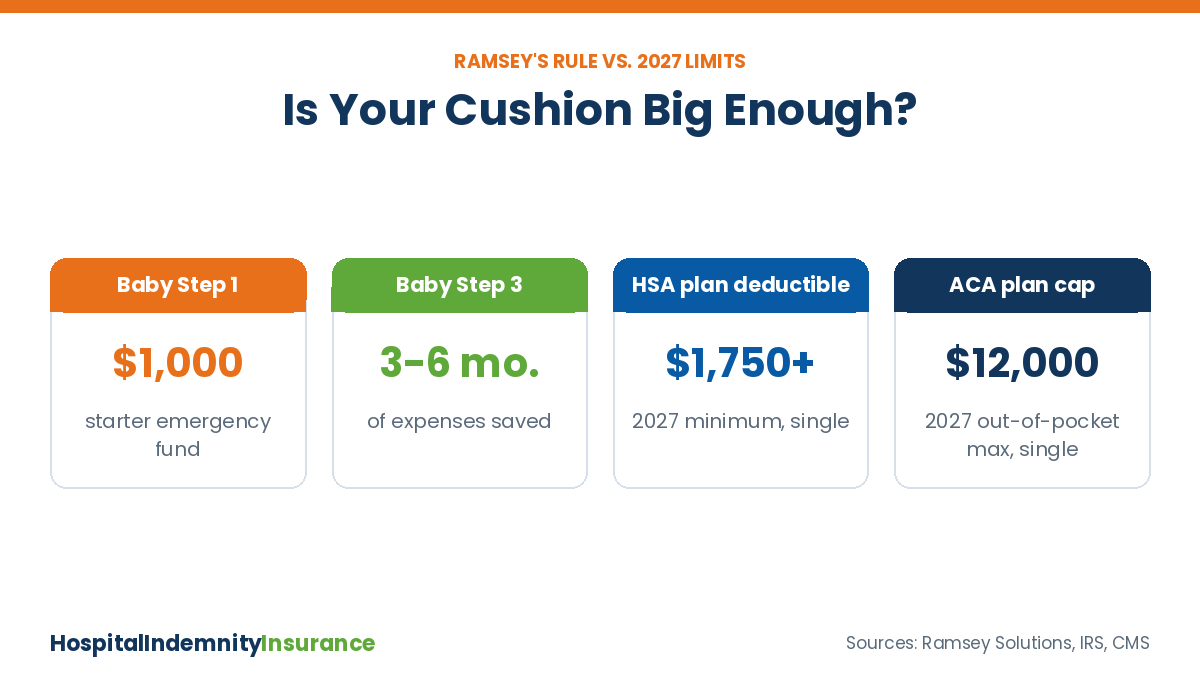
Dave Ramsey hospital indemnity insurance rule compared with 2027 deductible and out-of-pocket limits

Ramsey Solutions keeps a list of insurance products it calls gimmicks you can do without. Supplemental insurance for medical issues is on that list, next to cancer insurance, accidental death coverage, mortgage protection, credit life and whole life. The article does not name hospital indemnity by itself, but a plan that pays a set amount when you are admitted is a supplemental medical policy, so it falls in the same group.

The core argument. If you can absorb a cost yourself, you do not need to insure it. Ramsey’s position is that good medical insurance plus a fully funded emergency fund covers short-term medical bills.

The bigger risk. For long-term medical problems, the same article points readers to long-term disability insurance, which replaces part of your paycheck, instead of policies that pay small fixed amounts.

Cancer coverage, same logic. A separate Ramsey article on cancer insurance says regular health plans already cover cancer like any other disease, so a single-disease policy duplicates what you have.

Hospital Indemnity Quotes

Call a Licensed Agent Now

Compare hospital indemnity plans from several insurance companies in one call. Any age.

☎ 1-888-891-0229

No obligation to enroll

The Logic Behind the Rule: Pay Small Fixed Costs From Savings

Every premium includes the insurer’s costs and profit, so over many years a typical buyer pays in more than the policy pays out. The idea behind the advice is to insure losses that would wreck you and to pay predictable hits of a few thousand dollars with cash you control.

1

Baby Step 1: $1,000. A starter emergency fund for small surprises while you pay off debt.

2

Baby Step 3: 3 to 6 months of expenses. A fully funded emergency fund, the cushion the rest of the plan leans on.

3

Major medical with a high deductible. Ramsey Solutions notes that a high-deductible plan usually has lower premiums and lets you open a health savings account (HSA).

4

Long-term disability. Protects income if illness keeps you out of work for months, which a per-day hospital benefit was never built to do.

Worth knowing: Hospital indemnity is a limited-benefit plan that pays fixed cash amounts. It is not health insurance, does not replace your health plan and does not count as ACA minimum essential coverage.

Where the Ramsey Rule Fits Well

For many households, skipping hospital indemnity is the right call. The plan turns one large, sudden bill into small monthly payments. If that bill would not hurt you, you are paying for protection you do not need.

Your savings already beat your out-of-pocket max. If your emergency fund could pay your plan’s full annual out-of-pocket limit and still leave months of living costs, a cash hospital benefit adds little.

You have paid sick leave and disability coverage. If your paycheck keeps coming while you recover, the main reason to want extra cash during a hospital stay mostly goes away.

You are still paying off debt. Ramsey’s plan puts every spare dollar toward the debt snowball. A new monthly premium works against that, so the bar for buying should be high.

Run the Numbers: Premiums Paid vs. a Fixed Hospital Benefit

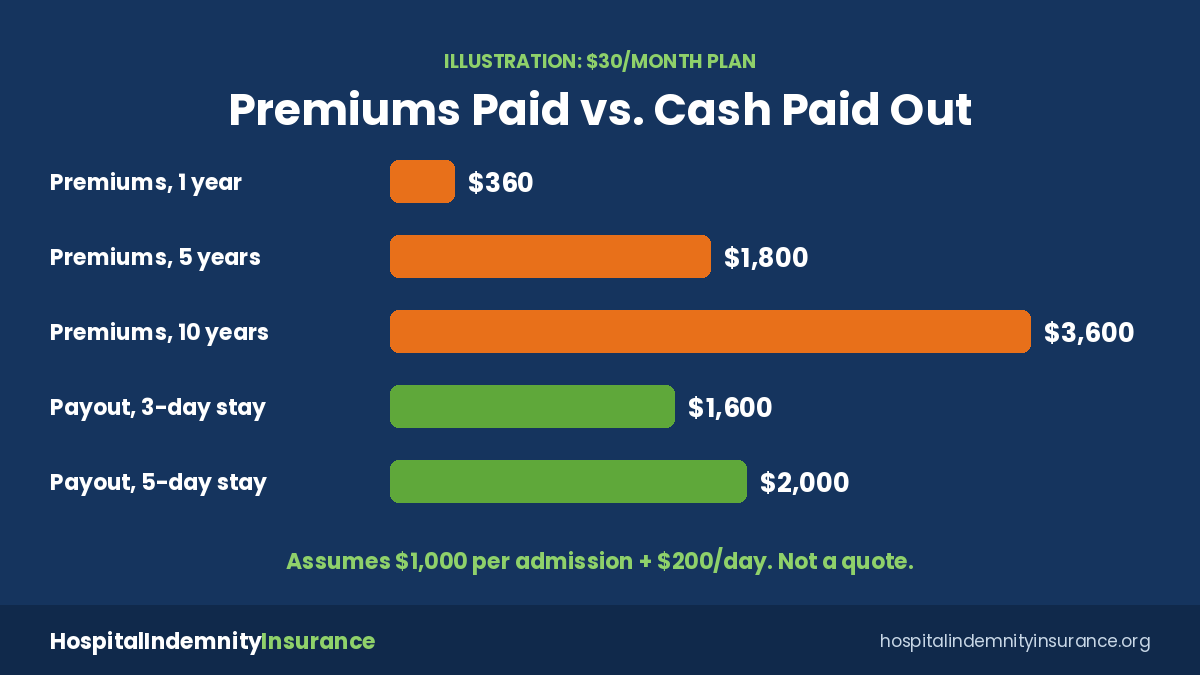
Premiums paid versus hospital indemnity payout in a Dave Ramsey hospital indemnity insurance comparison

The table below is an illustration, not a quote. It assumes a plan costing $30 a month that pays $1,000 when you are admitted plus $200 for each day in the hospital. Real premiums depend on your age, state and benefit level, so check monthly hospital indemnity costs before plugging in your own figures.

Over 5 years Premiums paid Cash benefit received Net result
No hospital stays $1,800 $0 You are out $1,800
One 3-day stay $1,800 $1,600 You are out $200
One 5-day stay $1,800 $2,000 You come out $200 ahead
Two 3-day stays $1,800 $3,200 You come out $1,400 ahead
Skip the plan and save $30 a month $0 $1,800 in your own account Money is yours whether or not you are admitted

Our illustration. Assumes $30/month premium, $1,000 per admission and $200 per hospital day, with no waiting period or benefit limits. Interest on savings not included.

This is Ramsey’s argument in numbers: with no admissions, every premium dollar is gone, while saved money stays yours. The plan wins only if you are admitted, and it helps most when the stay comes early, before your savings have grown.

Check Hospital Indemnity Prices for Your Age

When the Rule Can Leave You Exposed

The Ramsey approach assumes the cushion already exists. The Federal Reserve’s survey for 2025 found 63% of adults would cover a $400 surprise expense with cash or its equivalent, so more than a third would not. In these cases a fixed hospital benefit can be a bridge rather than a gimmick.

High deductible, thin savings. In 2027 an HSA-eligible plan must have a deductible of at least $1,750 for single coverage, and its out-of-pocket max can reach $8,700. A $1,000 starter fund falls short. IRS rules list insurance paying a fixed amount per day of hospitalization as permitted coverage, so it does not cost you HSA eligibility.

Planning a pregnancy. A birth is a planned hospital admission. Many plans pay for it only if you buy before you are pregnant and finish any waiting period, so timing matters. See whether to buy before a pregnancy.

Medicare Advantage daily copays. Many Medicare Advantage plans charge a copay for each of the first several days of an inpatient stay. A daily cash benefit can offset those; see hospital indemnity with Medicare Advantage.

Self-employed with no paid leave. When you stop working, income stops too. Cash paid straight to you can cover rent and groceries during recovery; self-employed buyers often weigh it next to disability coverage.

Fine print: Waiting periods, pre-existing condition limits, observation-stay rules and yearly caps vary by plan and state. A plan that excludes your most likely stay is no bridge.

How to Decide for Yourself, Ramsey-Style

1

Find your real worst case. Look up your health plan’s hospital deductible and out-of-pocket maximum. For a 2027 ACA plan, the out-of-pocket max can be as high as $12,000 for one person.

2

Compare it to cash on hand. If your emergency fund already covers that number, you are in Ramsey’s comfort zone and can likely skip the plan.

3

If it does not, size the gap. Price a plan whose admission and daily benefits cover the shortfall, not a bigger one. Our general guide to whether hospital indemnity is worth it covers benefit designs.

4

Set an exit date. Treat the plan as temporary. Once Baby Step 3 is done and savings exceed your out-of-pocket max, cancel it and keep the premium.

Bottom Line

Ramsey Solutions puts supplemental medical policies, the group hospital indemnity belongs to, on its skip list, because a fully funded emergency fund and good health insurance do the same job without a premium. That holds once your savings can cover your deductible. Until then, a modest plan with a clear cancel date is a reasonable bridge.

Get Free Hospital Indemnity Quotes and Run Your Own Math

Dave Ramsey and Hospital Indemnity Insurance — Frequently Asked Questions

➤ Does Dave Ramsey recommend hospital indemnity insurance?

No. Ramsey Solutions lists supplemental insurance for medical issues among the coverage you can do without, saying good health insurance plus a fully funded emergency fund handles short-term bills. It does not single out hospital indemnity by name.

➤ What insurance does Ramsey say you should have?

Ramsey Solutions lists health, auto, life (it recommends term), homeowners or renters, long-term disability, long-term care, identity theft protection and an umbrella policy. Hospital indemnity is not on that list.

➤ How big should my emergency fund be before I drop hospital indemnity?

Ramsey’s Baby Step 3 calls for 3 to 6 months of expenses. A practical test: can your savings pay your plan’s full out-of-pocket maximum and still cover living costs?

➤ Does Ramsey’s advice change if I have a high-deductible plan?

His company favors high-deductible plans with an HSA, which work best when savings cover the deductible. A $1,000 starter fund falls short of the $1,750 minimum HSA-eligible deductible for 2027.

➤ Can I keep contributing to my HSA if I buy hospital indemnity?

Generally yes. IRS rules treat insurance that pays a fixed amount per day of hospitalization as permitted coverage, so it does not by itself end HSA eligibility. Check that your specific policy is a fixed-indemnity design.

➤ Is hospital indemnity the same as the cancer insurance Ramsey warns about?

No, but the reasoning is similar. Cancer insurance pays for one disease; hospital indemnity pays a set amount for a covered hospital admission or day. Both are limited-benefit plans layered on top of health insurance.

➤ Did Dave Ramsey ever sell or endorse a hospital indemnity plan?

We found no Ramsey Solutions article recommending a hospital indemnity plan. This site is independent and is not affiliated with or endorsed by Ramsey.

➤ Should seniors on Medicare follow the same rule?

The same logic applies: if savings comfortably cover your plan’s hospital copays and out-of-pocket limit, extra coverage adds little. Medicare Advantage members with daily inpatient copays and thin savings are most likely to see value.

Hospital Indemnity Quotes

Call a Licensed Agent Now

Compare hospital indemnity plans from several insurance companies in one call. Any age.

☎ 1-888-891-0229

No obligation to enroll

Find & Compare Plans Online

Speak with a licensed insurance agent

1-888-891-0229

ZRN Health & Financial Services, LLC, a Texas limited liability company