





Speak with a licensed insurance agent

1-888-891-0229

How to Negotiate a Hospital Bill: Documents, Discounts, Dispute Rights and a Call Script

Reviewed by Russell Noga, Licensed Insurance Agent — Last updated November 4, 2026

To negotiate a hospital bill, get the itemized bill, match each line to your EOB and records, then ask billing for corrections, a financial assistance review and a self-pay or prompt-pay discount before paying. Back the request with a benchmark, such as the hospital’s posted cash price or the Medicare rate for the same code, and get any deal in writing.

2027 by the Numbers

93%

of people who negotiated a medical bill saw it cut or dropped (LendingTree, 2021)

$400

over a Good Faith Estimate opens a federal self-pay dispute (CMS)

240 days

minimum nonprofit hospital assistance window (IRS 501(r))

300%

of poverty level: free-care cutoff at large Washington systems

A hospital’s first statement is an opening number, not a final price. Billing offices fix mistakes, write off balances for patients who qualify for assistance and accept less from people who pay quickly or show what others pay.

The order below tends to work: documents, errors, price benchmarks, relief programs, then the phone call. It ends with how a hospital indemnity plan’s fixed cash benefit can cover part of what remains.
Compare Hospital Indemnity Plans That Pay You Cash

Before You Pick Up the Phone: Four Papers to Collect

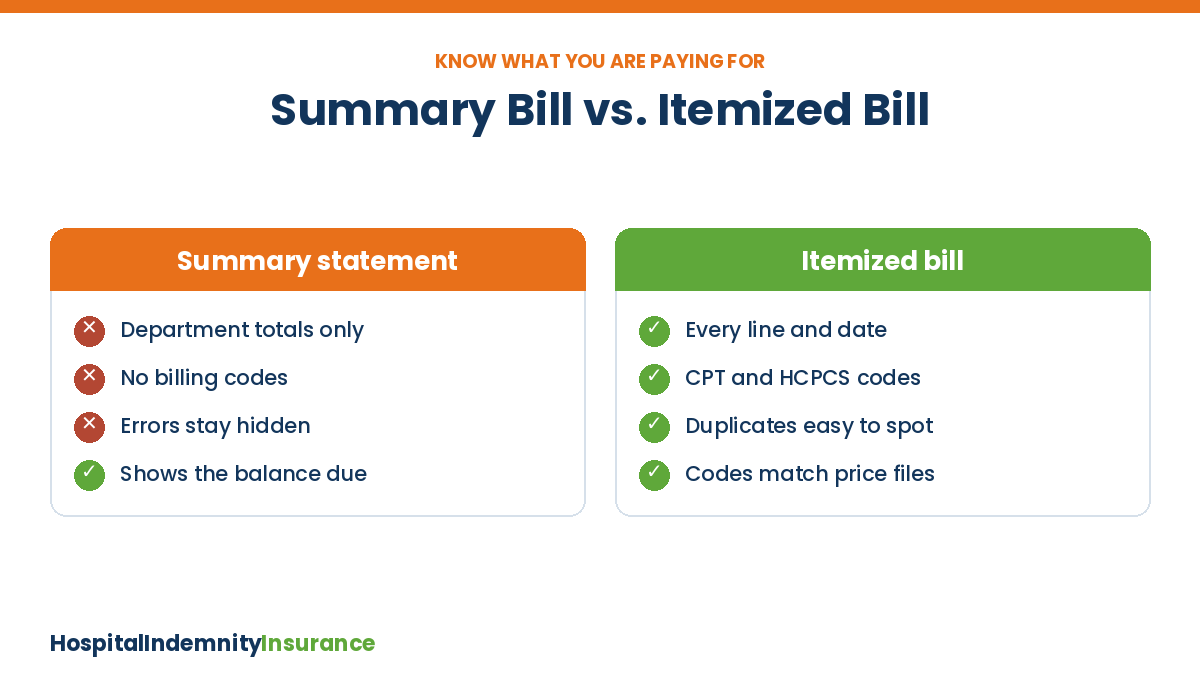
How to negotiate hospital bill charges: summary statement compared with an itemized hospital bill

Most hospitals first mail a summary with department totals and no detail. Nobody can negotiate a line they cannot see, so start by collecting paperwork that shows every charge.

The itemized bill. Each line with date, CPT or HCPCS code, units and charge. Ask for it by name; it is usually free.

Your Explanation of Benefits. If insurance paid, the EOB shows the allowed amount and your share. The bill should match its patient responsibility line.

Medical records for the stay. Medication records and the discharge summary confirm what was actually done.

The assistance policy summary. Nonprofit hospitals must publish a plain-language summary of their financial assistance policy.

Records right: Under HIPAA, billing records are part of the record set patients may request, and providers generally must respond within 30 days. Make the request in writing and note the date.

Hospital Indemnity Quotes

Call a Licensed Agent Now

Compare hospital indemnity plans from several insurance companies in one call. Any age.

☎ 1-888-891-0229

No obligation to enroll

Reading an Itemized Hospital Bill for Errors

Go through the itemized hospital bill with your records beside it. These are the problems worth flagging and the document that proves each one.

What to look for How it shows up Check it against
Duplicate charges The same code and date listed twice Medication and procedure records
Extra room days Charged for the day of discharge Admission and discharge times
Upcoded visit level A higher-level code than the visit warranted Discharge summary and time spent
Unbundled supplies Gloves, gowns or kits billed one by one Ask whether the room or procedure rate already includes them
Insurance not applied Full charge shown with no plan adjustment Your EOB and plan portal

Ask billing to explain any code you cannot match, in plain words.

If your plan wrongly denied a claim, the fix runs through the insurer’s appeal process, not the hospital. Once errors are corrected, the next lever is price.

Using Posted Prices and Medicare Rates as Leverage

Since 2021, federal price transparency rules have required hospitals to post a machine-readable file of standard charges plus a shopper-friendly list or price estimator. Those numbers make a strong benchmark because they come from the hospital itself.

1

Find the price file. Search the hospital site for standard charges. The file lists the gross charge, discounted cash price, each insurer’s rate and the lowest and highest negotiated rates.

2

Compare your lines. For each large charge, note the cash price and minimum negotiated rate for the same code.

3

Add an outside benchmark. The CMS Physician Fee Schedule Look-Up Tool shows Medicare rates by code; FAIR Health Consumer shows typical local prices.

4

Make a written offer. Ask to be billed at the hospital’s own cash price or a stated multiple of Medicare, with your figures attached.

Fair-price tip: A request tied to the hospital’s own posted cash price is hard to dismiss. Cite the code and posted figure.

Relief Programs Side by Side: Who Qualifies and the Deadline

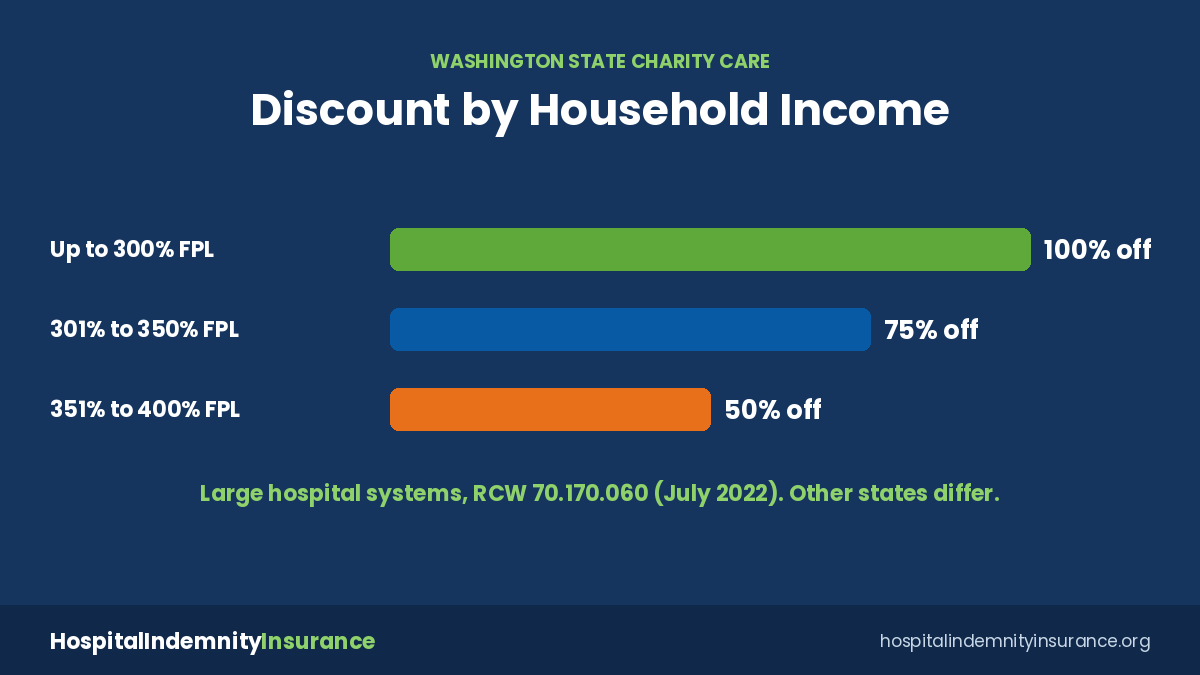
Washington charity care discounts by income at large hospital systems, a lever when you negotiate a hospital bill

Several programs can lower or erase a balance, each with its own trigger and clock.

Option Who qualifies Deadline Who to ask Possible result
Financial assistance (IRS 501(r)) Nonprofit hospital patients under its income limits, insured or not At least 240 days from first post-discharge bill Financial counselor Free or discounted care, capped at amounts generally billed to insurers
State charity care law Varies; Washington: free care to 300% of poverty at large systems State rules Billing office Free care or 50% to 75% off in Washington
No Surprises Act dispute Self-pay patients billed $400+ over a Good Faith Estimate 120 days from the bill; $25 fee CMS Independent reviewer sets what you owe
Self-pay or prompt-pay discount Uninsured or lump-sum payers Before the account ages Billing office Hospital policy; ask the percentage
Interest-free payment plan Most patients Any time Billing office Monthly payments, no hospital interest
Insurer appeal or NSA complaint Insured patients with a denial or surprise out-of-network bill Plan appeal rules Insurer or No Surprises Help Desk Reprocessed at in-network cost sharing

Sources: IRS Section 501(r); Washington RCW 70.170.060 (July 1, 2022); CMS No Surprises Act guidance. Hospital discounts and plans vary.

Nonprofit hospitals also cannot start extraordinary collection actions until 120 days after the first post-discharge bill. Uninsured patients can read more about going to the hospital without insurance.

See Cash-Benefit Plans Available in Your ZIP Code

A Call Script for the Billing Office

Call patient financial services, and log the representative’s name, the date and a reference number. Keep the requests in this order.

1

Ask for a hold. I am reviewing this bill. Please place the account on hold while I do.

2

Raise the errors. Lines 14 and 15 are the same drug on the same date, and I was billed for my discharge day. Please correct and reissue the bill.

3

Ask about assistance. Please send the financial assistance application and income limits.

4

Name your benchmark. Your posted cash price for this code is lower than my charge. Can the balance be reset to it?

5

Offer a resolution. At this amount I can pay in full this month, or set up an interest-free monthly plan.

Paper trail: Phone agreements are easy to lose. Get any reduction or payment plan in writing before paying. Hospital patient advocates and independent billing advocates can also make these calls.

Where Hospital Indemnity Cash Fits After the Bill Comes Down

Negotiation trims what a hospital charges, but it rarely erases an insured patient’s deductible or coinsurance. Hospital indemnity plans pay a fixed cash amount, such as a set sum per admission or per day, directly to the policyholder.

The payout follows the event. Most plans pay a stated amount per covered admission or day, so a lower negotiated bill generally does not shrink the benefit. Check the policy.

The cash is yours to direct. Use it on the negotiated balance, the deductible, a lump-sum offer or plan payments.

Claims use the same papers. Insurers often ask for the discharge summary and itemized bill you already gathered.

Hospital indemnity is a limited-benefit plan. It is not health insurance, does not replace it and does not count as ACA minimum essential coverage. Adults of any age, families and Medicare Advantage members buy it, often alongside a high-deductible health plan. For the stay costs benefits are sized against, see overnight hospital stay cost.

Bottom Line

To negotiate a hospital bill down, get the itemized version, fix the errors, quote the hospital’s own cash price and apply for assistance before paying, then get the deal in writing. Hospital indemnity adds fixed cash toward what remains, as a supplement to health insurance, never a replacement.

Get Free Hospital Indemnity Insurance Quotes

Negotiating a Hospital Bill — Frequently Asked Questions

➤ Can you really negotiate a hospital bill?

Yes. In a 2021 LendingTree survey, 93% of people who negotiated a medical bill said it was reduced or dropped.

➤ How do I request an itemized hospital bill?

Ask billing, in writing or through the patient portal, for an itemized statement with CPT or HCPCS codes on each line. Note the date and follow up if it does not arrive.

➤ Should I pay the bill before negotiating?

Generally no, because paying in full removes most of your leverage. Ask for a hold during review, then pay once a correction or discount is confirmed in writing.

➤ How do I reduce a hospital bill after insurance has paid?

Compare it with your EOB; for in-network care the hospital should not bill more than the patient responsibility shown. Nonprofit hospital assistance is also open to insured patients under the income limits.

➤ What is a fair price to offer a hospital?

The hospital’s own cash price or minimum negotiated rate from its price file is a defensible start. The Medicare rate for the same code is another common benchmark.

➤ What if my bill is far above my Good Faith Estimate?

If you were self-pay and a provider billed at least $400 over its estimate, you can open a federal dispute within 120 days of the bill. The filing fee is $25.

➤ Do I need a medical billing advocate?

Not always. Many hospitals have free patient advocates; independent advocates charge hourly or a share of savings.

➤ Can hospital indemnity pay a bill I already negotiated?

It pays you a fixed amount for a covered event, and you choose where the cash goes. The plan must be in force before the stay, and waiting periods or pre-existing condition limits can apply.

Hospital Indemnity Quotes

Call a Licensed Agent Now

Compare hospital indemnity plans from several insurance companies in one call. Any age.

☎ 1-888-891-0229

No obligation to enroll

Find & Compare Plans Online

Speak with a licensed insurance agent

1-888-891-0229

ZRN Health & Financial Services, LLC, a Texas limited liability company