





Speak with a licensed insurance agent

1-888-891-0229

Hospital Indemnity Insurance Providers: Who Sells Coverage and How to Choose

Reviewed by Russell Noga, Licensed Insurance Agent — Last updated October 27, 2026

Hospital indemnity insurance providers fall into three groups: carriers that sell individual policies, insurers that sell through employers, and health insurers such as Blue Cross Blue Shield companies that offer plans alongside their medical coverage. Which providers you can buy from depends mostly on your state, your age and whether you have a workplace plan.

Plenty of insurers sell hospital indemnity coverage, but you cannot buy from all of them. Some only sell through employers, some only in certain states and some only to people of certain ages.

This guide sorts the major hospital indemnity insurance providers by how they sell, explains how individual and workplace coverage differ and shows what to compare beyond the premium. For a carrier-by-carrier table of ages and benefits, see our comparison of top hospital indemnity insurance companies.
Get Free Hospital Indemnity Insurance Quotes

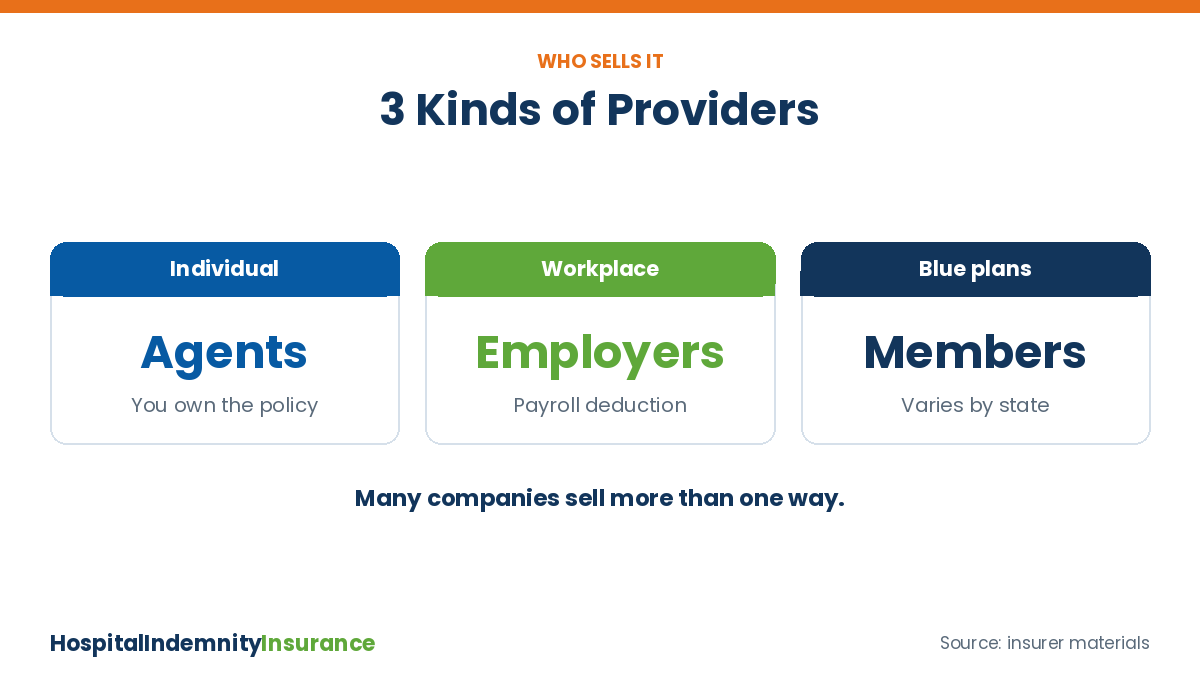
The Three Kinds of Hospital Indemnity Providers

Hospital indemnity insurance providers by type: individual carriers, workplace insurers and Blue plans

Every provider sells the same basic product: a policy that pays a set dollar amount when a covered hospital event happens. Where they differ is in how you can buy it.

Individual carriers. Companies such as Aetna, UnitedHealthcare, Wellabe, ManhattanLife, Cigna and Mutual of Omaha sell policies you buy and own, usually through licensed agents.

Workplace insurers. Companies such as Aflac, MetLife, Chubb, Guardian, Unum and The Standard mainly sell hospital indemnity to employers as a voluntary benefit.

Health insurers and Blue plans. Some Blue Cross Blue Shield companies sell hospital indemnity to their members, either their own plan or one underwritten by a partner such as LifeSecure.

Providers also change over time. Cigna’s supplemental products, including its hospital indemnity plans, have been run by Health Care Service Corporation, a Blue Cross Blue Shield company, since March 2025. The plans still carry the Cigna name and are still underwritten by Loyal American Life.

Good to know: A brand name on the brochure is not always the insurer. Check who underwrites the policy, because that company pays your claims.

Hospital Indemnity Quotes

Call a Licensed Agent Now

Compare hospital indemnity plans from several insurance companies in one call. Any age.

☎ 1-888-891-0229

No obligation to enroll

Major Hospital Indemnity Insurance Providers

Provider How you can buy What stands out
Aetna Individual Hospital Indemnity Flex from Continental Life, ages 18 to 89, up to six riders
UnitedHealthcare Individual, age 60+ AdvantageGuard from Golden Rule, designed around Medicare Advantage copays
Wellabe Individual Underwritten by Medico; $100 to $600 daily benefit; observation in the base plan
ManhattanLife Individual Hospital Indemnity Select, ages 18 to 89, guaranteed renewable for life
Cigna Individual Three plan levels from Loyal American Life, now run by HCSC
Mutual of Omaha Individual and workplace Sold in most states; plans and riders vary by state
Aflac, MetLife, Chubb Mostly workplace Payroll-deducted plans; some individual options by state
Blue Cross Blue Shield companies Members and groups Options differ by state; some use LifeSecure

Availability, ages and benefits vary by state and can change. Not every provider sells in every state.

Allstate sold its workplace benefits business to The Standard in April 2025, so many former Allstate workplace plans are now with The Standard. If you see an older Allstate policy, check who services it today.

How to Compare Providers Beyond the Premium

1

Benefit schedule. Compare admission, daily, ICU, surgery and ambulance benefits, and how they add up for a typical stay.

2

Covered events. Check whether observation stays, ER visits and outpatient care trigger a payment.

3

Benefit limits. Look at maximum days per stay, yearly caps and how a readmission is handled.

4

Waiting periods and pre-existing rules. Find out when benefits start, especially for pregnancy, and how prior conditions are treated.

5

Renewability. A guaranteed renewable policy cannot be canceled because your health changes, as long as you pay.

6

Underwriter strength. Check who issues the policy and its financial rating.

Broker tip: A cheaper premium can hide a short day limit or no observation benefit. Compare what each plan would pay for the same three-day stay.

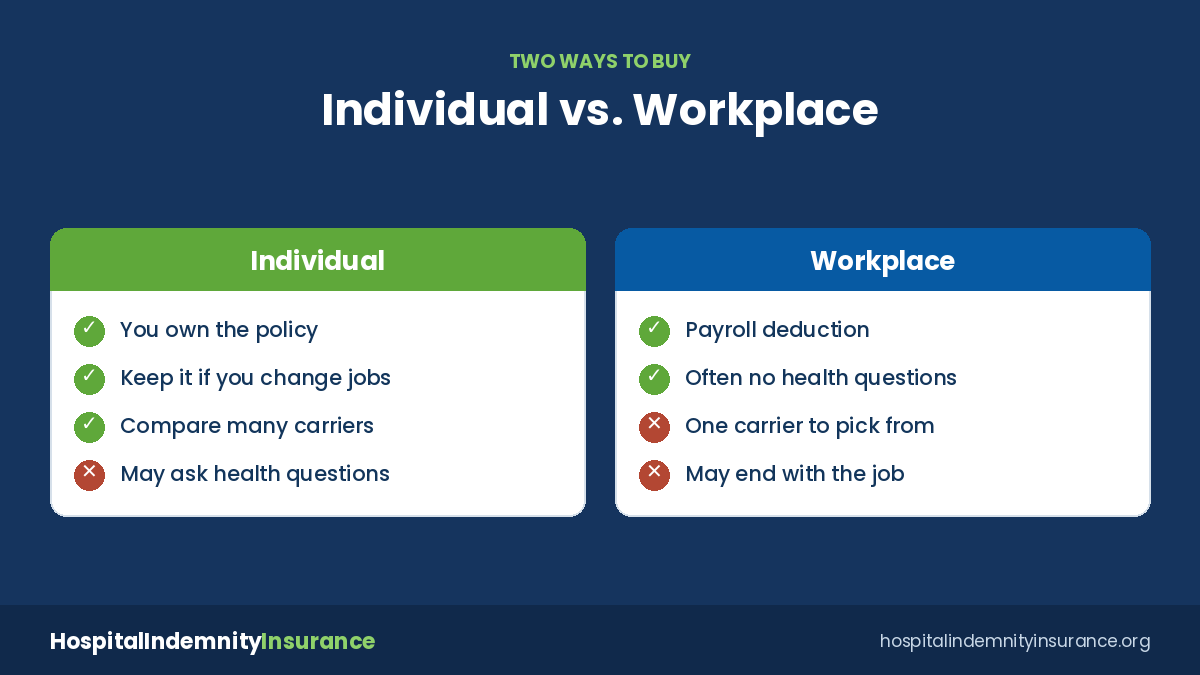
Individual vs. Workplace Providers

Hospital indemnity insurance providers individual vs workplace policies compared

Most people meet hospital indemnity in one of two places: an open enrollment menu at work, or a licensed agent who quotes several individual carriers at once. Neither is better across the board. A workplace plan is often easier to get, while an individual plan gives you more choice and stays with you. Many households use both, since these plans pay regardless of other coverage, though some insurers cap total benefits.

The same company can sell both ways, but the two kinds of coverage work differently.

Question Individual policy Workplace policy
Who owns it You Your employer holds the group policy
Health questions Often a few, unless you qualify for guaranteed issue Often none for eligible employees
If you leave your job Coverage stays with you May end or may be portable, depending on the plan
Choice of provider Compare many carriers Limited to the one your employer picked
How you pay Direct bill or bank draft Payroll deduction

Already offered a plan at work? See how hospital indemnity through an employer works before you decide.

Compare Hospital Indemnity Providers in Your Area

Policy Terms to Review Before Enrolling

Policy term What to check Why it matters
Maximum covered days The most days the policy pays per stay Benefits may stop during a long stay
Admission definition Whether observation counts as a stay A short visit may pay nothing
Pre-existing conditions Look-back and exclusion periods Related stays may not pay at first
Pregnancy waiting period How long before childbirth is covered A pregnancy that started earlier may be excluded
Exclusions Conditions and situations not covered An excluded stay earns no benefit

Want to know what other buyers say? Read our roundup of hospital indemnity insurance reviews.

Which Provider Fits You

Working adults and families. Start with your workplace plan, then compare individual carriers that accept applicants from age 18.

Expecting parents. Choose a provider that covers childbirth and buy before pregnancy. See hospital indemnity for pregnancy.

Self-employed. With no employer plan, an individual provider is your main option, and the cash can replace lost income during a stay.

People on Medicare. Look for providers with guaranteed issue windows around age 65 and plans built around Medicare Advantage copays.

Important: Hospital indemnity is a limited-benefit plan that pays fixed cash amounts. It is NOT health insurance, does not replace major medical coverage or Medicare and does not meet ACA minimum essential coverage.

Bottom Line

Many providers sell hospital indemnity insurance, but which ones you can buy from depends on your state, your age and your job. Compare the full benefit schedule, limits and exclusions from several providers, not just the premium, before you choose.

Related: hospital indemnity insurance in Colorado Colorado hospital cost data, the state’s notice rules and carriers with Colorado-filed plans.

Related: hospital indemnity insurance in Mississippi Mississippi hospital costs, the state’s ad rules for hospital cash plans and carriers found in MS documents.

Related: Physicians Mutual hospital indemnity insurance What the Omaha insurer sells today and how its plans treat a hospital stay.

Related: hospital indemnity insurance Idaho Idaho’s $40-a-day and 31-day plan minimums, Idaho hospital cost data and plans filed with Idaho form numbers.

Related: Maine hospital indemnity insurance Maine’s Chapter 755 minimums, required buyer notices and the carriers selling hospital cash plans in Maine.

Related: Oklahoma hospital indemnity insurance Oklahoma’s $30-a-day rule, insurers in Oklahoma documents and state hospital cost data.

Related: Vermont hospital indemnity insurance Vermont’s Regulation 80-1 floor, parity rules and plans with Vermont-coded forms.

Related: Connecticut hospital indemnity insurance Connecticut’s benefit floor, readmission rule and the plans that carry CT form numbers.

Related: South Dakota hospital indemnity insurance South Dakota’s 10-day free look, SD hospital cost data and the state employee MetLife hospital plan.

Related: West Virginia hospital indemnity insurance WV hospital cost data, the 114CSR12 minimum standards and plans sold in West Virginia.

Related: Securian hospital indemnity insurance How to get Securian’s workplace hospital plan and what five real group plans pay.

Related: hospital indemnity insurance Alabama Alabama plans from PEEHIP, SEIB and employers, hospital cost data and state claim rules.

Related: hospital indemnity insurance Kentucky Kentucky carriers, hospital cost data, Medicaid protections and the state’s 30-day claim rule.

Related: hospital indemnity insurance Louisiana Louisiana hospital costs, carriers on state and parish documents, and the state’s application notice rules.

Related: hospital indemnity insurance Minnesota Minnesota’s loss-ratio and renewal rules and the insurers that list the state.

Related: hospital indemnity insurance in Arkansas Arkansas’s $80-a-day policy floor, two carriers’ Arkansas plans compared, and 2027 Medicaid and marketplace changes.

Related: hospital indemnity insurance in Iowa Iowa’s $40-a-day rule, insurers with Iowa forms and state hospital cost data.

Related: hospital indemnity insurance in Kansas Kansas’s $50-a-day rule, the BCBS Kansas no-questions plan and insurers that list the state.

Related: hospital indemnity insurance in Nevada PEBP+ plan amounts side by side, carriers selling in Nevada and the state’s 10-day return law.

Related: hospital indemnity insurance Hawaii Which insurers list Hawaii and how a cash plan fits beside Prepaid job coverage.

Related: hospital indemnity insurance in Nebraska Mutual of Omaha’s home-state plan, the LifeSecure plan with BCBS Nebraska and Nebraska’s ad rules.

Related: hospital indemnity insurance New Mexico rules and sellers New Mexico’s $1,500 first-stay minimum, required sign-offs, and which carriers sell plans in the state.

Related: hospital indemnity insurance Utah Utah’s pregnancy exclusion rule, the $50-a-day floor and posted Utah rates by age.

Related: hospital indemnity insurance Delaware Delaware’s $30-a-day Regulation 1304 floor, insurers with Delaware forms and 2027 Medicare data by county.

Related: hospital indemnity insurance Montana Montana-filed LifeSecure rates, the CSI fixed indemnity notice and how rural transfers affect a cash benefit.

Related: hospital indemnity insurance New Hampshire The state’s $50-a-day minimum, insurers filing in NH and 2027 Medicare gaps by county.

Related: hospital indemnity insurance Rhode Island Rhode Island hospital costs, the state mandate, carriers selling here and 2027 Medicare data.

Related: hospital indemnity insurance Alaska Which insurers sell hospital cash plans in Alaska and how they fit around medevac and travel costs.

Related: hospital indemnity insurance North Dakota Carriers with North Dakota forms, KFF hospital cost trends and county Medicare Advantage gaps.

Get Your Free Hospital Indemnity Quote

Hospital Indemnity Insurance Providers — Frequently Asked Questions

➤ Who are the main hospital indemnity insurance providers?

Well-known individual providers include Aetna, UnitedHealthcare, Wellabe, ManhattanLife, Cigna and Mutual of Omaha. Aflac, MetLife and Chubb are major workplace providers, and some Blue Cross Blue Shield companies offer plans too.

➤ Which hospital indemnity provider is best?

No single provider is best for everyone. The right one depends on your state, age, health and the benefits you need, so compare quotes side by side.

➤ Can I buy hospital indemnity insurance without an employer?

Yes. Individual carriers sell policies directly through licensed agents. Many accept applicants from age 18, and some are built for people on Medicare.

➤ Do all providers sell in every state?

No. For example, Aetna’s Hospital Indemnity Flex is not offered in Maine or New York, and Cigna’s plans are not offered in Massachusetts, New Jersey, New Mexico or New York.

➤ Does hospital indemnity insurance replace health insurance?

No. It is a limited-benefit plan that pays fixed cash amounts. It does not replace health insurance or Medicare and does not meet ACA minimum essential coverage.

➤ Does a bigger hospital bill mean a bigger payment?

Usually not. The policy pays the amount listed for each covered event, no matter how large the hospital bill is or what your health plan paid.

➤ Can I keep a workplace hospital indemnity plan if I leave my job?

It depends on the plan. Some are portable and others end when your job ends. An individual policy stays with you as long as you pay premiums.

➤ How do I compare hospital indemnity insurance providers?

Enter your ZIP code on this page to see plans in your area. A licensed agent can line up benefits and premiums from several providers side by side.

Hospital Indemnity Quotes

Call a Licensed Agent Now

Compare hospital indemnity plans from several insurance companies in one call. Any age.

☎ 1-888-891-0229

No obligation to enroll

Find & Compare Plans Online

Speak with a licensed insurance agent

1-888-891-0229

ZRN Health & Financial Services, LLC, a Texas limited liability company